Einstein’s Relativity Crumbles: Time Travel Found in New Universe
Mathematician Kurt Gödel discovered a universe within Einstein's relativity where time travel is inevitable, challenging our understanding of cause and effect. This groundbreaking solution revealed potential paradoxes in the fabric of spacetime.

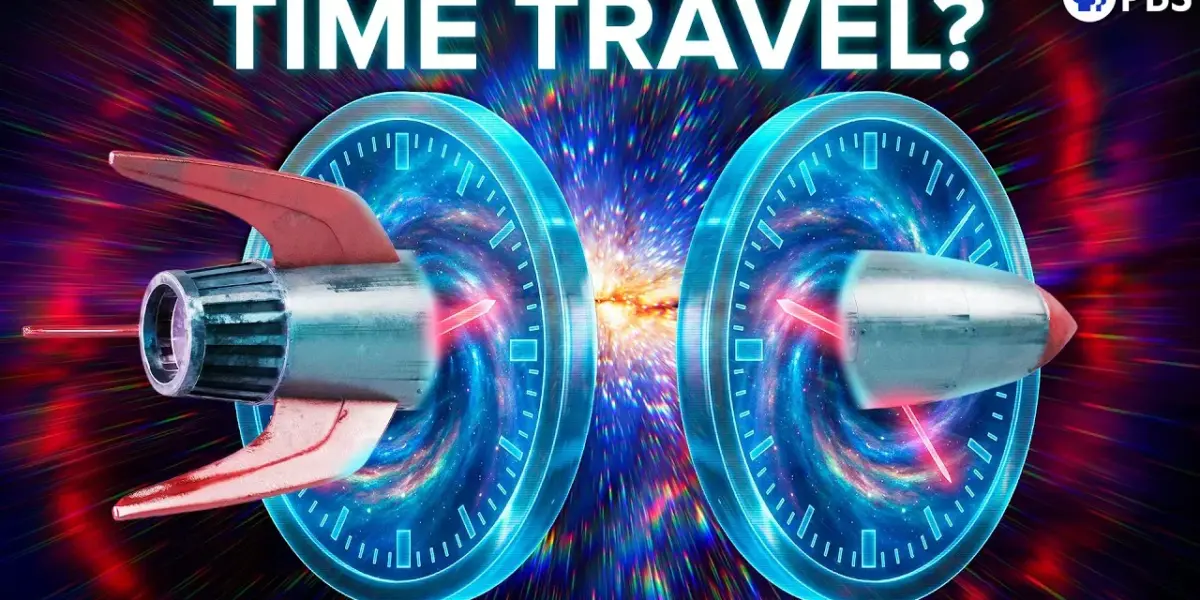
Einstein’s Theory Challenged by Time-Bending Universe
In a stunning revelation that shook the foundations of physics, mathematician Kurt Gödel discovered a universe where time travel is not only possible but inevitable. This mind-bending creation, derived from Albert Einstein’s own theory of relativity, suggests that the universe as we understand it might not guarantee a clear, forward march of time. Einstein and Gödel, known to be close friends, inadvertently presented the scientific community with a profound puzzle that continues to be explored today.
Gödel’s Universe: A Cosmic Paradox
Kurt Gödel, a brilliant logician famous for his incompleteness theorems, found a solution to Einstein’s field equations—the mathematical heart of general relativity. This solution described a universe with a unique property: it contained ‘closed timelike curves’ (CTCs). These are essentially loops in spacetime that allow an object or person to travel back to their own past. Unlike previous theoretical possibilities for time travel, which often required exotic and seemingly impossible elements like negative energy, Gödel’s universe did not need these speculative ingredients.
Imagine spacetime as a four-dimensional fabric, woven from space and time. Normally, everything moves forward through time, like a river flowing in one direction. Your ability to influence the future is like being able to throw a pebble into the river ahead of you, but you can never reach back upstream to change what has already happened. This is depicted by your ‘light cone’—a region of spacetime representing all possible futures you can affect and all past events that could have influenced you. Traveling faster than light would, theoretically, allow you to break free of this light cone and access the past.
Frame Dragging and the Twisting of Spacetime
Einstein’s theory of general relativity explains gravity not as a force, but as the curvature of spacetime caused by mass and energy. Massive objects warp this fabric, and this warping affects how things move. A key phenomenon related to this warping is ‘frame dragging,’ where rotating masses twist the spacetime around them. Scientists have even measured this effect: NASA’s Gravity Probe B mission sent a gyroscope into orbit around Earth, and found that Earth’s rotation caused the gyroscope to slowly swivel, as if spacetime itself was being dragged along.
Gödel realized that if this frame-dragging effect were amplified and present throughout the entire universe, it could lead to CTCs. His model involved a universe with a specific kind of geometry, known as hyperbolic geometry, which has a saddle-like shape. This negatively curved space, combined with a global rotational motion, creates a cosmic vortex. In this Gödel universe, as you travel outwards from any point, your path through spacetime twists so much that it eventually loops back on itself, allowing for travel into the past.
Beyond Exotic Physics: A Fundamental Challenge
What made Gödel’s discovery so significant was its implication for the fundamental assumptions of general relativity. Before Gödel, physicists believed that general relativity, when combined with a condition called the ‘weak energy condition’ (which essentially prohibits impossible things like negative energy density), would guarantee a universe with a clear cause-and-effect structure. This means that events would always happen in a predictable order, with causes preceding their effects. Gödel showed this wasn’t necessarily true.
His solution demonstrated that even with the weak energy condition, general relativity could permit spacetimes where the past and future become tangled. This challenged the idea of a simple, linear progression of time. It meant that the very fabric of spacetime, as described by Einstein, might not inherently prevent paradoxes.
The Search for Order: Protecting Causality
Gödel’s work spurred further research into ensuring that our universe has a predictable, causal structure. Physicists proposed additional requirements, such as ‘global hyperbolicity.’ This condition ensures that any ‘slice’ of the universe at a particular moment in time can uniquely determine the next slice, maintaining a strict causal order. Later, Stephen Hawking proposed the ‘Chronology Protection Conjecture,’ suggesting that any spacetime structure that would allow for time travel might be inherently unstable, collapsing under its own paradoxical feedback before time travel could actually occur.
A Lasting Legacy
While Gödel’s universe might not be a perfect description of our own cosmos, his discovery was a crucial birthday gift to Einstein. It highlighted potential limitations and complexities within general relativity, pushing physicists to refine their understanding and search for deeper theories. Gödel didn’t break Einstein’s theory, but he revealed some of its most intriguing and challenging aspects, inspiring generations of scientists to continue exploring the mysteries of spacetime, gravity, and the very nature of time itself.
Source: The Time Travel Paradox Hidden Inside Einstein’s Relativity (YouTube)

Related Articles
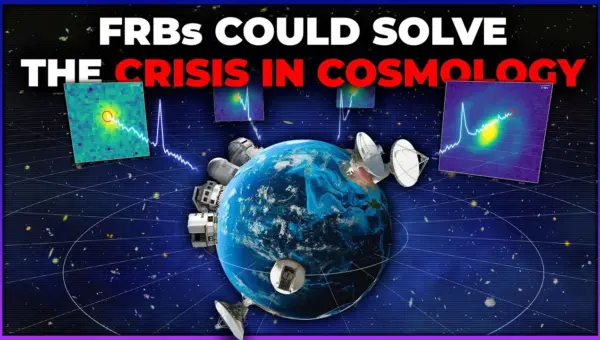
Cosmic GPS: FRBs Could Map Universe Expansion
A proposed 'cosmic GPS' system using mysterious Fast Radio Bursts (FRBs) could help resolve the Hubble Tension, a major disagreement in measuring the universe's expansion rate. The system would use a network of spacecraft to measure distances geometrically, bypassing traditional methods.
Dark Matter Weaves Cosmic Web Across Universe
Dark matter forms an invisible cosmic web, connecting galaxies with vast filaments. Computer simulations predicted this structure decades ago, and recent observations confirm its existence. The cosmic web provides crucial evidence for dark matter and helps us understand the universe's evolution.


Dark Matter Defies Gravity, Forming Fuzzy Clouds Instead of Stars
Dark matter, which outweighs all visible matter, surprisingly does not collapse under gravity to form stars or black holes. Instead, it forms vast, diffuse clouds around galaxies, baffling scientists with its unique behavior. Understanding this cosmic enigma is key to comprehending the universe's structure and evolution.