Germany Tests War Readiness: Can It Evacuate 1,000 Wounded NATO Soldiers Daily?
Germany recently held its largest medical exercise in decades, Quadriga 2026, to test its capacity to evacuate up to 1,000 wounded NATO soldiers daily from the alliance's eastern flank. The drill simulated real-world conditions, from battlefield injuries in Lithuania to hospital transfers across Germany, exposing both strengths and critical weaknesses in the nation's war readiness.

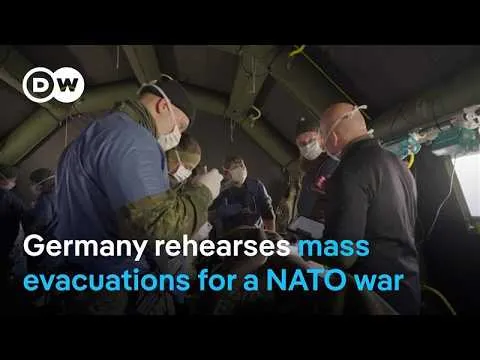
Germany Holds Largest Medical Exercise in Decades Amid NATO War Fears
Germany recently conducted its largest medical exercise in decades, known as Quadriga 2026, to test its ability to handle a massive influx of wounded soldiers in the event of a NATO war on the alliance’s eastern flank. The exercise simulated the evacuation of up to 1,000 injured soldiers per day from Lithuania, near Belarus, to a network of hospitals across Germany. This massive undertaking highlights Germany’s critical role in NATO’s medical support and its preparedness for a potential large-scale conflict in Europe.
Lithuania: The First Line of Defense and Medical Care
The exercise began at the Bundes mobile surgical hospital in Lithuania, close to the border with Belarus. This location is vital as Germany leads NATO’s enhanced presence in the region, a multinational force established to deter Russian aggression. Since Russia’s full-scale invasion of Ukraine in 2022, Europe’s security landscape has significantly changed. In response, Germany has deployed permanent troops abroad for the first time since World War II. The German brigade in Lithuania is expanding rapidly, with forces expected to grow from 800 this year to 4,800 by 2027.
“Germany, but especially the Bundeswehr, is taking the challenge presented by Russia and the prospect of large-scale conventional war in Europe really seriously,” stated a correspondent. Providing medical care to these troops is a core part of NATO’s operational readiness. This includes planning for the medical support of not only injured soldiers but also civilians who might need evacuation.
Berlin: A Crucial Hub for Medical Evacuation
The second phase of the exercise shifted to Germany, with a medical hub set up near Berlin’s airport. Here, simulated patients arriving from Lithuania were stabilized before being transferred to hospitals nationwide. This logistical center plays a key role in managing the flow of casualties and ensuring they receive necessary care.
“By practicing something like this, we send a strong signal to the outside world, but also to the alliance. Show them they can rely on us. Let them see we are practicing exactly what would be important for our allies in an emergency,” said a participant. The German army emphasized that Quadriga 2026 is more than just an exercise; it’s designed to function like a mission-ready operation. “We’ve never practiced this in this form in the past, at least not with the signs we have now. The important thing is that we’re actually able to cope with a large number of wounded people in a real crisis,” a representative noted.
Concerns Over Hospital Preparedness
Despite the military’s commitment, emergency responders and experts express concerns about Germany’s overall readiness. A report by the German Hospital Institute last year found that hospitals are poorly equipped for a NATO emergency. The study, surveying 165 hospital operators, revealed significant gaps in medical preparedness for war. These included limited training for mass casualty situations and insufficient preparation for new types of battlefield injuries.
Modern Warfare’s Evolving Medical Challenges
Modern warfare presents new and complex medical challenges, particularly with the increased use of drones. The war in Ukraine has provided crucial lessons on changing injury patterns. Suicide drones, for instance, can cause devastating injuries, including severe burns, blast injuries, and open abdominal wounds, which are far more complex than those seen in previous conflicts. These injuries require more extensive surgical interventions and often lead to worse outcomes.
Medical professionals face the daunting prospect of surges in critically injured patients not just for a single day, but potentially every day for the duration of a large-scale conflict. This scenario would push their physical and psychological limits. Germany recognizes that the long-term resilience of its armed forces depends heavily on the quality and speed of medical care provided to soldiers, impacting their recovery and ability to return to duty.
Rising Threats to Medical Personnel
The war in Ukraine has also highlighted a disturbing trend: medics and medical facilities are increasingly becoming targets. This phenomenon, sometimes called “healthcide,” involves deliberate attacks on those providing care. “We see this in Ukraine indeed that Russian drone operators specifically target Ukrainian combat medics and medical professionals close to the front line but also further to the rear. They occasionally target medical vehicles that are trying to evacuate Ukrainian military personnel from the front line, which is a war crime,” a reporter observed. Such attacks add another layer of risk to the entire evacuation process.
Adapting to a New Era of Conflict
Evacuating large numbers of wounded soldiers under potential drone fire complicates every step of the rescue chain. Even organizations like the Red Cross, traditionally protected, now face the risk of being targeted. “We also have to expect to be a target ourselves and work under the most adverse conditions,” noted a representative. Ensuring that these complex systems remain functional under extreme pressure is a central challenge being addressed by exercises like Quadriga 2026.
For years, Germany and much of Europe built their infrastructure around peacetime. Now, they are compelled to prepare for a different reality. “My impression is that we are already resilient, but there will also be weaknesses. Recognizing them and eliminating them is the task of this exercise,” a participant commented.
The Urgency of Preparedness
NATO believes Russia could launch an attack as early as 2029, underscoring the urgency of these preparations. Quadriga 2026 is a critical test of Germany’s ability to adapt quickly to the demands of modern warfare. The fundamental question is whether the systems in place will hold if the worst-case scenario occurs.
Politically, leaders face difficult conversations. In a crisis, elective medical procedures might need to be postponed, impacting civilian healthcare. “Someone’s grandma could not get the hip replaced, for example. And that is not a very appealing conversation in an electoral political context to have,” noted a commentator, highlighting the societal trade-offs involved in preparing for war.
Source: Germany tests readiness to evacuate wounded NATO soldiers | DW News (YouTube)

Related Articles


Trump’s NATO Threats Spark Global Unease, Ex-Envoy Warns
Former Ambassador Kurt Volker warns that President Trump's questioning of NATO and the ongoing conflict with Iran are creating global instability. The war's unclear outcome benefits Russia and potentially China, while straining U.S. relations with European allies. Volker suggests Trump's NATO threats are a tactic to pressure allies, but legal and political hurdles make withdrawal difficult.


Syrians Face Harsh Reality Upon Return Home
Syrians returning to their homeland after years in exile are finding a country with severely damaged infrastructure and a high cost of living. Despite calls from European leaders for refugees to go home, returnees report a lack of basic services and persistent safety concerns, questioning the feasibility of mass repatriation.


Kirby: NATO Without US ‘Hard to Comprehend’
Retired U.S. Navy Rear Admiral John Kirby finds the concept of a NATO alliance without U.S. leadership difficult to imagine. He noted relief among allies following a presidential address that omitted criticism of NATO, despite past threats. Kirby also highlighted Secretary of State Marco Rubio's evolving public stance on the alliance.