Hubble Tension Solved? New Cosmic Clocks Measure Universe’s Expansion
New 'cosmic clocks' like time-delay cosmography are helping astronomers tackle the Hubble tension, a discrepancy in measuring the universe's expansion rate. Meanwhile, the return to the Moon aims to teach humanity how to live in space, while the threat of weaponized satellites looms.

Universe’s Expansion Puzzles Astronomers, New ‘Cosmic Clocks’ Offer Hope
Scientists are grappling with a cosmic puzzle: the universe’s expansion rate, known as the Hubble constant, doesn’t quite match up depending on how it’s measured. This discrepancy, called the “Hubble tension,” suggests our understanding of the cosmos might be incomplete. Now, innovative techniques like “time-delay cosmography” are emerging as powerful new tools to resolve this mystery.
Unraveling the Hubble Tension
For decades, astronomers have used two main methods to calculate the Hubble constant. One involves building a “distance ladder” by measuring objects like Cepheid variable stars and Type Ia supernovae in relatively nearby space. This method suggests the universe is about 13 billion years old.
The other method looks at the cosmic microwave background (CMB), the faint afterglow of the Big Bang. Analyzing the CMB points to a universe that is about 13.8 billion years old. This 800-million-year difference is significant and perplexing.
“Why is this number different, yet it should be the same?” asks a science communicator. The Hubble tension implies that either our measurements are off, or our cosmological models need revision.
Time-Delay Cosmography: A New Way to Measure Time
One promising new approach is time-delay cosmography. This technique uses a phenomenon called gravitational lensing, where massive objects like galaxy clusters bend the light from objects behind them, similar to how a lens focuses light.
Imagine a supernova exploding in a distant galaxy. If this galaxy is behind a massive cluster, its light can travel along multiple paths around the cluster to reach Earth. Because these paths have different lengths, the light from the supernova will arrive at different times. This time difference, which can be months or even years, allows astronomers to measure the expansion rate.
“Where this becomes very powerful is that you can have a supernova go off in the background object,” explains the science communicator. “And then you see the light appear in the different galaxy lenses at different times.”
To use this method effectively, scientists must accurately determine the mass of the lensing object. Knowing this mass helps them trace the light’s journey and calculate the expansion rate independently of the traditional distance ladder or CMB measurements.
Gravitational Waves: Another Independent Measure
Another exciting avenue for measuring the Hubble constant comes from gravitational waves. These ripples in spacetime, generated by events like merging black holes, offer a completely different way to probe the universe’s expansion.
When two black holes collide, the resulting gravitational wave signal can, in principle, tell us the distance to the event. However, current gravitational wave detectors have large error margins, making these measurements imprecise for now.
“The problem is that the error bars are just way too big right now,” the communicator notes. “But eventually, if we get better gravitational wave telescopes, we’ll be able to measure that as another fourth independent way of measuring the expansion rate of the universe.”
The hope is that these diverse methods will converge on a single, accurate value for the Hubble constant, finally resolving the Hubble tension.
Why Go Back to the Moon? Learning to Live in Space
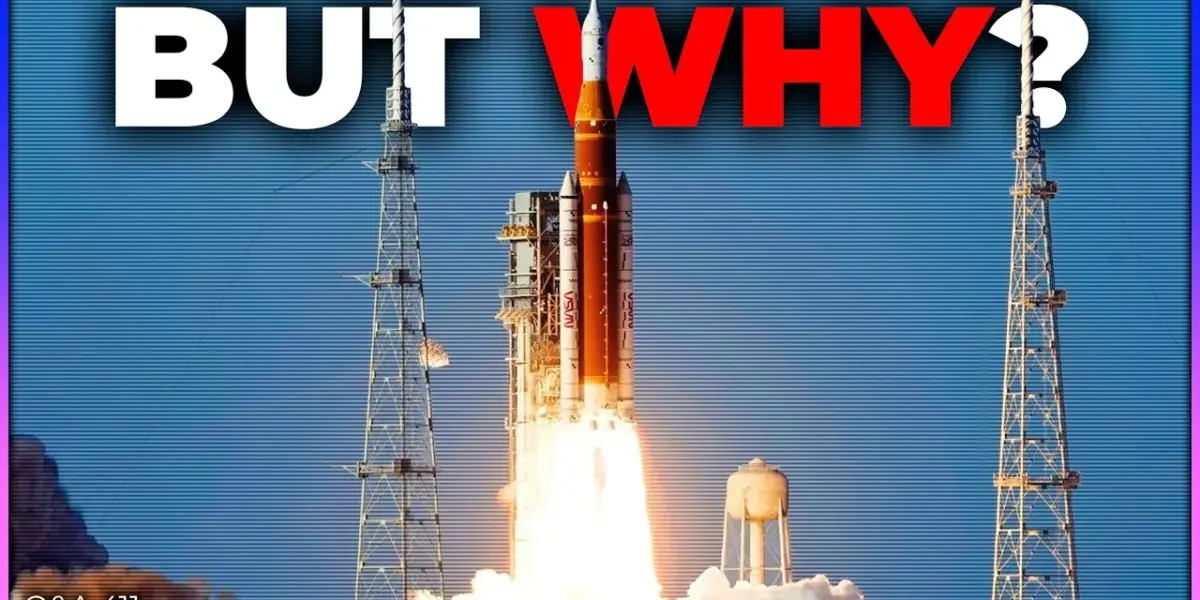
While the scientific community debates cosmic expansion, a renewed focus on lunar exploration is underway. The primary goal of returning humans to the Moon, and eventually Mars, is not just science; it’s about learning to live in space.
“If what you want to do is science, you send the robots,” the expert states. “The reason we will send humans to the Moon, the reason we will send humans to Mars, is because that’s how we will learn to live in space.”
Living on the Moon requires creating a self-sustaining environment. This means generating oxygen, recycling water, producing food, managing waste, and repairing equipment – all without the readily available resources of Earth.
“You have to bring your entire environment with you,” he explains. “There’s nothing you can breathe. There’s no atmosphere. It doesn’t rain. Plants aren’t growing.”
Experience from the International Space Station has taught us much about living in Earth’s orbit. However, the Moon presents greater challenges due to its distance and the lack of immediate rescue capabilities. Mars will be an even more extreme environment, requiring months or years for any potential return to Earth.
“Let’s figure them out close to home before we try to figure it out things farther away,” the communicator advises. The Moon serves as a crucial stepping stone, a practice ground for developing the technologies and strategies needed for long-duration space habitation.
The Peril of Space Debris and Warfare
The increasing reliance on satellites for communication, navigation, and observation raises concerns about their vulnerability, especially in times of conflict. Several nations have demonstrated the capability to destroy satellites with missiles, a potential act that creates dangerous space debris.
Destroying even a single satellite can generate thousands of pieces of debris. If a conflict escalates to targeting hundreds of satellites, the resulting debris could render near-Earth space unusable for decades, posing a severe threat to existing spacecraft and even the International Space Station.
“You would be causing thousands of pieces of debris for every satellite that you destroy,” the expert warns. “If you’re going to destroy hundreds of your enemy’s satellites, you’re going to create hundreds of thousands of pieces of debris.”
While debris in low Earth orbit (300-600 km altitude) will eventually burn up in the atmosphere within 5-10 years, targeting higher orbits (around 2,000 km) is far more concerning. Debris in these higher regions, where many weather and GPS satellites reside, can take hundreds or thousands of years to decay.
“If you turn those into debris, then there’s just no cleaning that up for hundreds if not thousands of years,” he states. The hope is that nations will avoid targeting satellites and, if necessary, limit any potential conflict to low-altitude orbits to minimize long-term damage to the space environment.
The Observable Universe: Our Personal Cosmic Horizon
The question of why the universe appears the same size in all directions leads to the concept of the observable universe. What we see is limited by the age of the universe and the speed of light.
Light from the Big Bang has been traveling for about 13.8 billion years. The observable universe is simply the sphere around us from which light has had time to reach us since the Big Bang. This means each observer in the universe sees their own unique observable universe.
“The observable universe is just the amount of the universe that you can see,” the communicator explains. “Where the light has traveled for 13.8 billion years to arrive at your eyeballs.”
The actual size and shape of the entire universe remain unknown; it could be infinite or finite with a complex topology. The analogy of being in fog helps illustrate this: you can only see as far as the fog allows, and your friend next to you has their own, slightly different, fog-bound view.
Dark Matter in Our Solar System?
While dark matter forms a vast halo around our Milky Way galaxy, its concentration within our solar system is believed to be very low. Most of the solar system’s mass comes from the Sun and planets, not dark matter.
If dark matter exists in our solar system, its total mass would likely be comparable to that of a small asteroid. “The amount of dark matter that is present in any small area is actually going to be very small,” the expert notes.
The focus remains on understanding dark matter’s nature and its role in galaxy formation and the universe’s large-scale structure, rather than its direct impact within our solar system.
Source: Reasons to Return to The Moon, WW3 and The Kessler Syndrome, Time Delay Cosmography | Q&A 411 (YouTube)

Related Articles
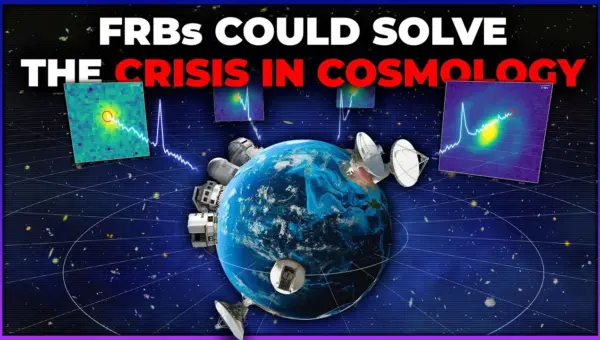
Cosmic GPS: FRBs Could Map Universe Expansion
A proposed 'cosmic GPS' system using mysterious Fast Radio Bursts (FRBs) could help resolve the Hubble Tension, a major disagreement in measuring the universe's expansion rate. The system would use a network of spacecraft to measure distances geometrically, bypassing traditional methods.
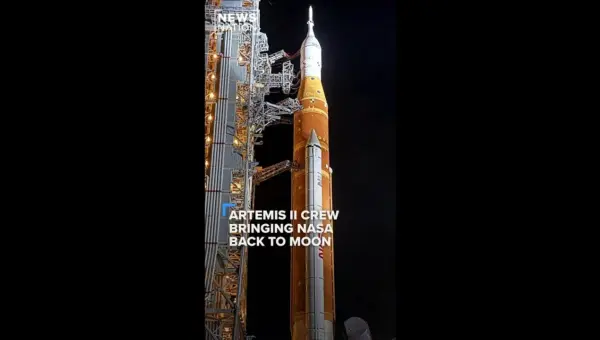
US Reclaims Lunar Frontier, Eyes Mars Mission
NASA's Artemis II mission is set to send astronauts around the Moon, marking humanity's return to deep space for the first time since 1972. This mission is a crucial step toward establishing a lunar base and eventually reaching Mars.
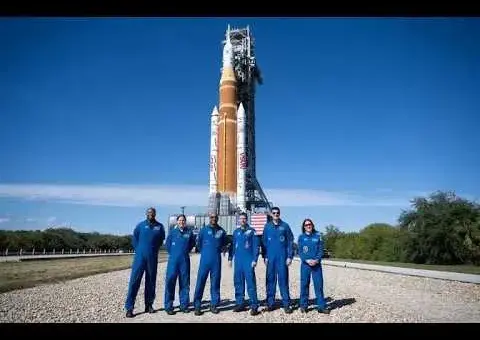
Artemis Blasts Off: NASA’s Moon Return Begins
NASA's Artemis mission has launched a crewed test flight around the Moon, marking a significant return to deep space exploration. This program aims to establish a long-term lunar presence and eventually pave the way for Mars missions. The journey builds on the legacy of Apollo while forging a new path for scientific discovery and technological advancement.