Artemis IV: Humans to Land on Moon First Time Since 1972
Humans are set to return to the Moon with the Artemis IV mission, marking the first lunar landing since 1972. Goonhilly Earth Station is a key player, supporting crucial test flights and future endeavors. The program emphasizes technological advancement and the growing role of private companies in space exploration.


Humans Set for Lunar Return with Artemis IV After 50-Year Gap
Humans are poised to walk on the Moon again for the first time since 1972, with the Artemis IV mission eyed as the likely candidate for this historic return. The Artemis program aims to re-establish a long-term human presence on the lunar surface, a goal that has been decades in the making. This ambitious endeavor marks a significant step in space exploration, building upon previous uncrewed test flights and paving the way for future missions, including potential trips to Mars.
Goonhilly Earth Station Plays Key Role in Artemis Missions
Jamie Williams, a senior deep space operator at Goonhilly Earth Station in Cornwall, shared his excitement about the Artemis program. Goonhilly has a history of supporting space missions, having participated in uncrewed lunar missions, including the Artemis I test flight and commercial moon landings. Williams emphasized the pride and enthusiasm felt by the operations team at Goonhilly, especially as they contribute to a historic crewed launch around the Moon. “For much of us in the operations team, this is the first time where we’ve been a part of a historic crewed launch around the Moon,” Williams stated.
Artemis II: A Crucial Test Flight
The current Artemis II mission, while not a landing, is a vital step in the program. It serves to test and prove the new Space Launch System (SLS) rocket, the NASA Orion crew capsule, and various international components, including the European service module. These technologies are essential for the success of future Artemis missions. Williams explained that for those new to lunar exploration, the mission is incredibly exciting, even if it mirrors the trajectory of early Apollo missions like Apollo 8. “It’s proving the new rocket, the Space Launch System. Proving the NASA Orion crew capsule, all of the international components,” Williams noted.
The Long Road Back to the Moon
The gap of over fifty years since the last human moon landing is a result of shifting priorities in space exploration. Following the Apollo missions, the focus shifted to establishing a sustained human presence in low Earth orbit. This led to the development of the Skylab space station and later the Space Shuttle program, which was instrumental in building the International Space Station (ISS). The ISS has been continuously crewed since 2000, representing 26 years of ongoing human exploration in Earth’s orbit. The idea of returning to the Moon and establishing a base is a long-term aspiration.
Future Prospects: Moon Bases and Mars
Establishing a permanent moon base is still some years away. The immediate next steps involve proving technologies for the Artemis III mission, which will include docking a lunar lander with the Orion capsule. Artemis IV is then anticipated to be the mission where humans will land on the Moon once more. “Once we’ve established being able to land and successfully repeat that, then it opens up to how we go for the next steps and having that sustained prolonged human presence on the Moon,” Williams explained. Beyond the Moon, the ultimate goal for many is sending humans to Mars, a mission that presents even greater challenges and will require significant technological advancements and infrastructure development.
The Rise of Commercial Spaceflight
A significant difference in this new era of space exploration is the prominent role of private companies. Unlike the agency-led Apollo program, commercial entities are now key partners. Companies like Goonhilly are involved in deep space communication for various space agencies and are working with commercial partners to develop lunar landers. Williams highlighted this shift: “We’re talking about private companies taking part in a way that we’ve never seen, and that’s a big part of this.” Goonhilly has supported multiple uncrewed lunar landings for companies like Intuitive Machines and ispace, which are crucial for testing and refining technologies needed for future crewed missions.
What’s Next in Lunar Exploration?
The Artemis program is progressing with a clear roadmap towards sustained lunar presence and eventual human missions to Mars. Future Artemis missions will focus on demonstrating landing capabilities, establishing infrastructure, and preparing for longer stays on the Moon. The involvement of commercial partners is expected to accelerate progress and reduce costs. The public can anticipate further updates on technological advancements and mission timelines as NASA and its international and commercial partners continue their journey back to the Moon and beyond.
Source: First Moon Landing Since 1972 Likely To Be Artemis IV | Jamie Williams (YouTube)

Related Articles


Artemis II Blasts Off, Igniting New Space Race Era
NASA's Artemis II mission has successfully launched, sending a four-person crew on a historic journey around the Moon. The mission marks a significant step towards lunar exploration and potential Mars missions. Meanwhile, global markets react to escalating tensions with Iran, and a new, more convenient weight loss pill gains FDA approval.

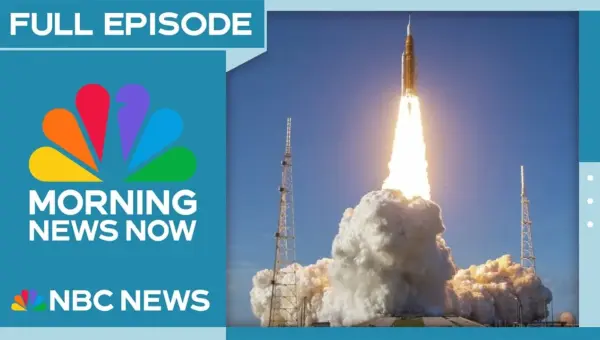
Artemis II Launches: Humanity’s Next Lunar Leap Begins
The Artemis II mission has successfully launched, marking humanity's return to lunar exploration after over 50 years. Meanwhile, President Trump addressed the nation on the Iran conflict, vowing to continue strikes while claiming objectives are nearing completion. Elsewhere, a new weight loss pill was approved, and severe storms threaten the Midwest.


Trump Declares Iran War Nears End; SCOTUS Weighs Citizenship
President Trump announced the nearing end of U.S. military operations in Iran, targeting its military infrastructure and nuclear ambitions. The Supreme Court heard arguments on Trump's executive order affecting birthright citizenship, with a ruling expected soon. NASA also launched Artemis II, sending astronauts on a historic four-day trip around the moon.