Ukraine Proposes Easter Truce Amid Diplomatic Storm
Ukraine has proposed an Easter ceasefire with Russia, while its foreign minister condemned Hungary's reported conversations with Moscow. Meanwhile, drone strikes have hit Russian oil ports, impacting exports, and Ukraine claims significant Russian troop losses.

Ukraine Proposes Easter Truce Amid Diplomatic Storm
Ukrainian President Volodymyr Zelenskyy has proposed an Easter ceasefire with Russia, signaling a diplomatic push for de-escalation during the upcoming holiday. The president announced this initiative to European ministers, expressing hope for a positive response from Moscow and anticipating discussions with U.S. officials on the matter. “We are waiting for a response from Russia,” Zelenskyy stated. “Tomorrow I will speak with the American team, including on this issue. We hope for results.”
The proposal, made on March 30th, suggests a truce of two to three days, during which Ukraine believes Russia would not be able to significantly strengthen its positions. This initiative, according to the Ukrainian leadership, should not impact the current situation on the front lines. However, the Kremlin’s reaction was swift and critical. Kremlin spokesperson Dmitry Peskov stated that Ukraine had not presented a clear ceasefire proposal. He further demanded that Ukrainian President Zelenskyy accept Russia’s ultimatums and move towards peace, rather than a ceasefire.
Diplomatic Fallout Over Hungarian Minister’s Actions
Adding to the tense diplomatic atmosphere, Ukrainian Foreign Minister Dmytro Kuleba condemned his Hungarian counterpart Péter Szijjártó’s reported conversations with Russian Foreign Minister Sergey Lavrov as “disgusting.” Kuleba described the leaked audio recordings of Szijjártó’s calls to Lavrov as “obsequious reporting to Russian patrons.” He emphasized that such actions are a disgrace and warrant an investigation, particularly given the diplomatic standards of caution required in professional conduct.
“What has now become public poses a threat,” Kuleba warned. “In fact, it threatens the discussion platforms that exist within the European Union, including closed ones.” The Ukrainian foreign minister highlighted that Ukraine is often called upon to provide briefings on the actual situation, underscoring the need for an appropriate response to this incident. The controversy stems from audio recordings leaked on March 31st, detailing conversations between Szijjártó and Lavrov concerning the lifting of sanctions on specific Russian individuals. Lavrov had reportedly asked Szijjártó for assistance in removing a relative of a Russian oligarch from a sanctions list, a request to which Szijjártó allegedly promised to help, and the individual was later removed.
The Washington Post previously reported that Szijjártó maintained regular contact with Lavrov during breaks in European Union meetings. This close communication, according to the report, effectively allowed Russia to have a presence at the negotiating table during many EU meetings over the years. Szijjártó later acknowledged his regular contact with Lavrov during closed EU Council meetings, though he maintained that no sensitive information was discussed.
EU Financial Aid and Frozen Assets Debate
The European Union may reconsider a reparations loan for Ukraine if Hungary continues to block the allocation of 90 billion euros. EU foreign policy chief Josep Borrell, speaking alongside Kuleba, stated that the 90 billion euro loan, approved by EU leaders late last year, was a “plan B.” He recalled that the original plan, “plan A,” involved using frozen Russian assets. If “plan B” proves unworkable, a return to “plan A” would be considered, Borrell emphasized the necessity of providing Ukraine with the funds needed to resist Russian aggression.
The idea of a 210 billion euro reparation loan backed by frozen Russian assets was actively discussed last year. However, EU member states could not reach an agreement, largely due to Belgium’s position, which sought strong guarantees. A significant portion of Russia’s frozen assets are held in Belgium. Reports from The Guardian suggest that Russian intelligence attempted to influence Belgian officials to oppose the reparations loan. Consequently, in late December, EU countries agreed on a 90 billion euro loan for Ukraine. While approved, the transfer of funds has been stalled by Hungary’s veto on a procedural decision required for the loan’s disbursement.
Military Incidents and Economic Impact
In a separate incident, Russia reported losing contact with an An-26 aircraft during a routine flight over occupied Crimea. The fate of the crew remains unknown, and search and rescue teams have been dispatched to the area. Russia claims no signs of a strike on the plane have been recorded, and this theory is not considered primary. The circumstances are under investigation.
Meanwhile, Ukrainian drone strikes on Russian ports in Ust-Luga and Primorsk have significantly impacted Russia’s oil exports. According to Bloomberg, these attacks caused a collapse in oil exports from the Baltic region, dropping to one-third of the previous week’s volume. Oil shipments via the Baltic Sea reached their lowest level since the full-scale invasion of Ukraine began. Between March 22nd and March 29th, Russia’s total oil exports fell by 43%, from over 4 million barrels per day to approximately 2.3 million barrels per day.
Despite the decrease in export volumes, Russia’s weekly export revenues reached $1.79 billion, the highest since May 2024. This increase is attributed to rising global oil prices driven by geopolitical tensions in the Middle East. Prices for oil from Baltic ports jumped to $73.24 per barrel, with ESPO oil reaching $84.90 and shipments to India nearing $97 per barrel. These drone strikes occurred as Moscow was experiencing windfall profits due to higher global oil prices.
Russian Casualties and Mobilization Concerns
Ukrainian President Zelenskyy stated that Russia lost 89,000 soldiers killed and seriously wounded on the front lines between January 1st and March 26th of this year. “We are talking about irreversible losses of personnel. This is a very serious figure,” Zelenskyy noted. He also addressed the pace of Russian mobilization, indicating that the Russian army planned to recruit 49,000 personnel in 2026. As of March, approximately 20-22% of this target has been met.
Zelenskyy highlighted the ratio between Russian losses and its mobilization capacity, stating, “1/5 of 409,000… is about 80,000. They’ve lost more. This is an important signal.” He also reported increased Russian activity in the Bakhmut direction, though significant advances have not been made, and the situation remains under control. Zelenskyy expressed doubt about Russia conducting a general mobilization in the near future, citing a lack of confirmation for such signals. “I would not rush to say that they will definitely carry out general mobilization,” he said, adding that while signals exist, there is no confirmation. He suggested that if Russia were to undertake general mobilization, it could indicate plans for aggression against other states, potentially including Lithuania, Latvia, and Estonia.
U.S. Security Guarantees and Disputed Claims
In related news, President Zelenskyy recently stated that the United States had set a condition for Ukraine to withdraw troops from certain areas to receive security guarantees. He indicated that the U.S. was ready to finalize these guarantees at a high level once Ukraine agreed. However, U.S. Secretary of State Antony Blinken called Zelenskyy’s statement a lie. Blinken clarified that Ukrainian authorities had been informed differently, stressing that security guarantees would only take effect after the war concludes.
Source: Lavrov shocked with a statement about Russia! Kremlin alarmed. Zelenskyy didn’t hold back his words (YouTube)

Related Articles

Trump’s NATO Insults Spark Global Outrage, Allies Push Back
Former U.S. President Donald Trump's leaked private remarks, filled with insults aimed at NATO allies, have sparked international outrage and calls for European self-reliance. The comments highlight growing concerns about U.S. reliability and the potential for a long-term split in transatlantic relations. The discussion also touched upon domestic UK issues, including NHS strikes and political shifts, alongside a unique debate on marmalade regulations.

Russia Claims Luhansk Control Amid Diplomatic Stalls
Russia rejected Ukraine's Easter ceasefire proposal, citing unclear terms and shifting blame to Kyiv. Meanwhile, Moscow's claims of full control over Luhansk are contradicted by Ukrainian forces and battlefield data. The conflict's economic impact is also growing, with Ukrainian drone strikes significantly reducing Russia's oil export capacity.
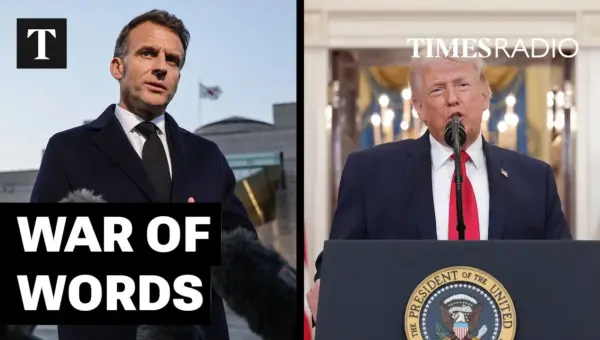
Macron Fires Back at Trump Over Wife Remarks
French President Emmanuel Macron publicly condemned Donald Trump's personal remarks about his wife, Brigitte Macron, calling them "neither elegant nor up to standard." The comments, made at a private event and later leaked, sparked debate on diplomatic engagement strategies. While Macron criticized Trump directly, other leaders like Italy's Giorgia Meloni have found success with private, personal diplomacy.