Artemis II Blasts Off: Crew Heads to Moon After 50-Year Wait
The Artemis II rocket launched successfully, carrying a four-person crew on a 10-day mission around the Moon. This historic flight marks humanity's return to lunar exploration after 50 years, overcoming earlier technical challenges. The crew's journey will test the Orion capsule and pave the way for future lunar missions.


Artemis II Blasts Off: Crew Heads to Moon After 50-Year Wait
In a moment watched by millions, the Artemis II rocket successfully launched Tuesday, sending a four-person crew on a historic 10-day journey around the Moon. The mission marks a significant step in humanity’s return to lunar exploration after a half-century hiatus. The crew, carrying the hopes of a new generation, communicated their readiness with powerful words before liftoff: “We are going for all humanity.” The launch concluded a tense countdown, overcoming earlier technical challenges that had caused delays.
A Momentous Launch
The thunderous roar of the rocket filled the air as it powered through Earth’s atmosphere, a spectacle of smoke and fire signifying the start of an ambitious mission. Launch director Charlie Blackwell-Thompson sent the crew off with a heartfelt message, emphasizing the daring spirit of the American people and global partners. “Good luck. Godspeed, Artemis 2. Let’s go,” she declared. This launch is the culmination of years of work and dedication from the Artemis team, aiming to reignite lunar exploration.
Overcoming Hurdles
The path to launch was not without its difficulties. Earlier in the year, dangerous hydrogen leaks during a countdown test led to a lengthy delay. Mission control teams worked tirelessly to address these issues, ensuring the safety and success of the mission. Space journalist Leonard David, with decades of experience covering space exploration, expressed his relief and awe. “I didn’t even think they would get off,” David admitted. “That team worked unbelievable to get those folks off.” He highlighted the critical role of the mission control team in monitoring every variable and making precise decisions.
The Crew and Their Mission
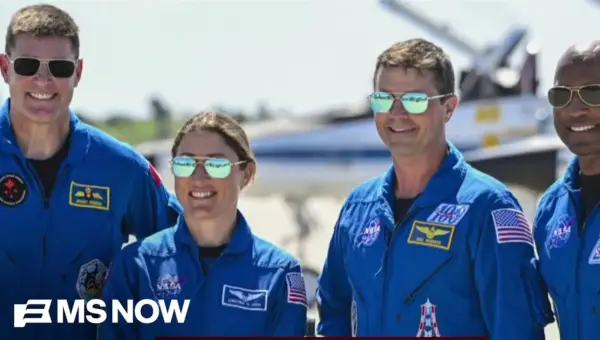
The Artemis II crew consists of three NASA astronauts and one Canadian astronaut. They are embarking on a journey that will take them approximately 600,000 miles, looping around the Moon before returning to Earth. Their mission is designed as a free-return trajectory, using the gravitational pull of Earth and the Moon to naturally guide the capsule home. While the mission is 10 days long, it serves as a crucial test for the Orion capsule and its systems, paving the way for future, longer lunar missions.
Inside the Orion Capsule
The Orion capsule is the heart of this mission, designed to withstand the rigors of deep space travel. The crew is meticulously checking all systems, including life support and propulsion. A key focus is the deployment and functionality of the solar arrays, which are vital for generating power. “Got to have power,” David stressed. The crew will also be monitoring for solar radiation, a critical factor for astronaut safety during their journey. The Orion capsule’s heat shield, which faced scrutiny after the Artemis I mission, will also undergo rigorous testing during the fiery re-entry into Earth’s atmosphere.
Looking Ahead: The Next Steps
The immediate next step for the Artemis II crew is the trans-lunar injection burn, a critical maneuver that will propel them from Earth’s orbit towards the Moon. Mission control will be closely monitoring all systems to ensure everything is functioning as expected. David cautioned against premature celebration, noting that many checks remain. “We got a little bit of way to go. Don’t get too confident,” he advised. The mission is not just about reaching the Moon; it’s about gathering crucial data and experience for future lunar landings and potential Mars missions.
A New Era of Exploration
The Artemis II mission represents more than just a technical achievement; it signifies a renewed commitment to space exploration. After 53 years, humans are once again venturing towards the Moon. This mission is seen as a vital milestone for restarting lunar exploration and potentially setting the stage for future human presence on the Moon and beyond. David also pointed to the global race for space, urging attention to China’s own lunar ambitions. “Keep an eye on China,” he warned, highlighting the competitive nature of space exploration in the 21st century. The successful launch of Artemis II is expected to propel America into a new era of opportunity and discovery.
Future Challenges and Prospects
As the Artemis II crew continues their journey, the world watches with anticipation. The upcoming maneuvers, including the lunar flyby and the critical re-entry phase, will be closely observed. The insights gained from this mission will be invaluable for the development of future spacecraft and exploration strategies. “This is going to be fun. I hope it’s energetic for the astronauts, and I think it’s going to propel America into a new opportunity in the 21st century,” David concluded. The success of Artemis II is a testament to human ingenuity and the enduring drive to explore the unknown, promising exciting developments in the years to come.
Source: Artemis II rocket launches, astronauts bound for moon on historic journey (YouTube)

Related Articles


Trump Fires AG Bondi, Iran Tensions Rise, Artemis II Heads to Moon
Attorney General Pam Bondi has been fired by President Trump, with Deputy AG Todd Blanche stepping in as acting AG. Amidst rising oil prices and escalating tensions, the U.S. warns Iran as the Artemis II mission successfully heads towards the Moon. Golfer Tiger Woods was arrested for DUI and is stepping away for treatment.
Astronauts Head to Moon Amidst Divided Nation
The Artemis II mission has launched, sending four astronauts towards the Moon in a journey that highlights both humanity's drive for exploration and the current divisions within society. While the launch captured global attention, it also sparked conversations about how fragmented media impacts shared national experiences.


Moon Missions Spark New Space Race: Fuel & Power
Renewed moon missions are fueling a new space race, driven by the potential for rocket fuel production and strategic control. However, concerns about space weaponization and the lack of clear property rights in this lawless frontier add a complex geopolitical layer to lunar ambitions.