Cosmic GPS: FRBs Could Map Universe Expansion
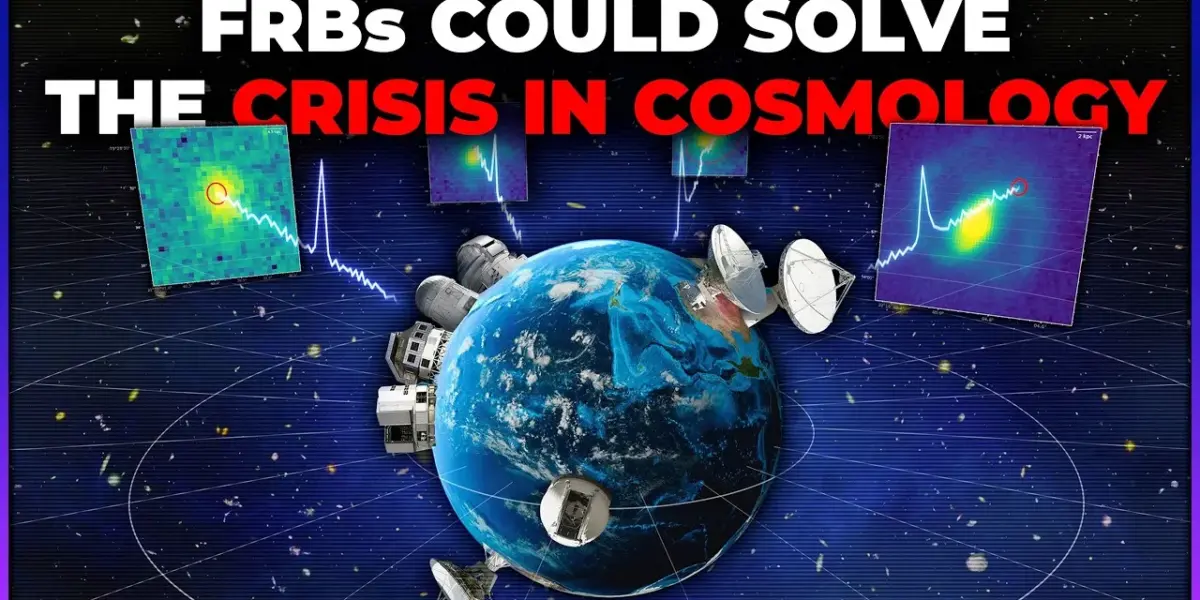
A proposed 'cosmic GPS' system using mysterious Fast Radio Bursts (FRBs) could help resolve the Hubble Tension, a major disagreement in measuring the universe's expansion rate. The system would use a network of spacecraft to measure distances geometrically, bypassing traditional methods.

Cosmic GPS: FRBs Could Map Universe Expansion
A groundbreaking project, inspired by the mysterious Fast Radio Bursts (FRBs), aims to create a “cosmic GPS” system. This ambitious plan could help solve one of the biggest puzzles in astronomy today: the Hubble Tension. This tension refers to the conflicting measurements of how fast the universe is expanding. The new system, proposed by Dr. Matt McQuinn of the University of Washington, could provide a more accurate and independent way to measure this expansion rate.
The Mystery of Fast Radio Bursts
Fast Radio Bursts are intense, millisecond-long flashes of radio waves that come from deep space. First discovered in 2007, their exact cause is still unknown. Scientists believe they might originate from highly magnetized neutron stars called magnetars. Despite the mystery, FRBs have a unique property that makes them incredibly useful for astronomers: they interact with electrons in space.
As FRB light travels through the universe, it encounters electrons. This interaction causes different wavelengths of the radio waves to travel at slightly different speeds. When the signal reaches Earth, astronomers can measure this delay. By analyzing this delay, they can determine the total number of electrons the burst has passed through. This number is directly related to the distance the signal has traveled.
Solving the Hubble Tension
The Hubble Tension arises because measurements of the universe’s expansion rate using different methods don’t quite agree. Current methods, like observing Cepheid variable stars and Type Ia supernovae, rely on a “cosmic distance ladder.” This step-by-step process has inherent uncertainties.
Dr. McQuinn’s proposed “Cosmic Positioning System” offers an independent way to measure distances. Instead of relying on the brightness of objects, it uses the properties of FRBs. By precisely measuring the distance to many FRBs, astronomers can plot their positions and velocities. This data can then be used to calculate the universe’s expansion rate with unprecedented accuracy.
A Network of Spacecraft
To achieve this, the project envisions a constellation of spacecraft positioned very far apart, potentially 50 astronomical units (AU) from each other. An AU is the distance between the Earth and the Sun. This vast separation is necessary to measure the tiny changes in the arrival time of FRB signals at different spacecraft.
The system would work similarly to Earth’s GPS. Your phone uses signals from multiple satellites to pinpoint your location. The Cosmic Positioning System would use FRBs as the signal source. By comparing when an FRB signal arrives at different spacecraft, astronomers can triangulate the source’s location and determine its distance. This geometric method bypasses the need for a distance ladder.
Measuring Distances Across the Cosmos
The system aims to measure distances to FRBs located up to 500 million light-years away. At these distances, objects are considered to be in the “Hubble flow,” meaning their motion is dominated by the expansion of the universe, not just local gravitational pulls. Measuring distances accurately within this flow is crucial for understanding cosmic expansion.
The project’s goal is to achieve a measurement accuracy of about 1%. This level of precision is needed to resolve the Hubble Tension and potentially uncover new physics. The project has received funding from NASA’s Innovative Advanced Concepts (NIAC) program, which supports early-stage research into visionary concepts for space exploration.
What Comes Next?
The development of the Cosmic Positioning System is a long-term endeavor. It requires advancements in spacecraft technology, precise timing, and sophisticated data analysis. Future radio telescopes, like the Square Kilometre Array (SKA), will discover many more FRBs, providing more data for this system.
If successful, this project could revolutionize our understanding of the universe. It might help confirm or refute existing cosmological models, like the Lambda-CDM model, and potentially reveal new components or forces shaping the cosmos. The quest to understand the universe’s expansion is a fundamental pursuit, and FRBs might just hold the key.
Source: A NIAC Project That Could Crush The Hubble Tension (YouTube)

Related Articles


Astronaut Chris Hadfield on Artemis Prep & Space’s Human Heart
Former astronaut Chris Hadfield emphasizes that space exploration's greatest challenge is mental, not physical. He discusses the intense preparation required for missions like Artemis and reflects on the deeply human emotions involved in spaceflight, comparing it to our innate drive to explore.


Humans Return to Moon Orbit After 52 Years
Humans are heading back to the moon for the first time in over 50 years with the Artemis II mission. The four-astronaut crew will orbit the moon, marking a historic return to deep space exploration. Meanwhile, political developments include President Trump's warnings of further strikes against Iran and a leadership change at the Justice Department.

Artemis II Fuels New Space Race Era
NASA's Artemis II mission, sending astronauts beyond the Moon for the first time in 50 years, signals a new era of space exploration. Astronaut Butch Wilmore's insights from past challenges and the mission's pristine progress highlight renewed ambition amidst global space competition. This journey is poised to reshape international relations and technological leadership.