Ukraine’s New Drone Strikes Deep: A Game Changer?
Ukraine's new Blisskovka "Lightning" drone, a modified Russian design, offers extended range and heavy payloads at a lower cost. This innovation allows for deep strikes on enemy supply lines and fortifications, marking a significant development in drone warfare.

Ukraine’s New Drone Strikes Deep: A Game Changer?
Ukraine is rapidly evolving its drone warfare, and a new weapon is making waves. It’s called the Blisskovka, or “Lightning” drone. This isn’t just another drone; it’s a modified version of a Russian design. The goal was simple: make something better, cheaper, and more effective. This drone is designed to hit targets much farther behind enemy lines than many older models. It can carry a heavier punch, too, with up to 8 kilograms of explosives.
Ross, a member of the team that builds the Lightning drone, explained its purpose. “The idea behind it was to fulfill the mission that was standing behind before our guys,” he said. “Russians are entrenched and entrenched deeply and they have a lot of field bunkers that needs to be bumped.” This drone can drop a tank mine directly onto a bunker, destroying it.
A Drone Built for Distance and Payload
The Lightning drone is a fixed-wing aircraft, like a small plane. This design allows it to fly much farther than typical quadcopter drones. With a light load, it can travel up to 80 kilometers, or about 50 miles. Even with its maximum 8-kilogram payload, it can reach 40 kilometers, roughly 25 miles. This extended range is crucial for attacking targets far from the front lines. It also means the drone is harder to jam or shoot down.
“We are fixed wind drone and because we don’t need to fight the wind and even if we are jammed under heavy jamming because this is the plane basically it’s still goes and it it is quite heavy to shoot down,” Ross noted.
Targeting Logistics and Fortifications
The Lightning drone isn’t just for destroying bunkers. It’s also a powerful tool for disrupting enemy supply lines. “Logistics is the gods of war basically,” Ross stated. “And if there is no logistics to the front line, there is no front line.” The drone can be used to destroy vehicles, equipment, and even target individual soldiers carrying supplies.
The ability to change payloads makes the drone versatile. It can carry anything from a small grenade to a heavy tank mine. For lighter targets like individual soldiers or supply packs, a smaller explosive is used. For heavier targets like armored vehicles or bunkers, a much larger payload is needed. This flexibility allows Ukrainian forces to adapt to different battlefield needs.
Cost-Effective Warfare
One of the biggest advantages of the Lightning drone is its cost. Compared to advanced quadcopter drones that can fly similar distances, the Lightning is significantly cheaper. A quadcopter capable of flying 50 kilometers might cost over $5,000. The Lightning drone, on the other hand, costs about half that price. This allows Ukraine to produce and deploy them in larger numbers.
“We travel further. We are less expensive because we do not have to find the wind, fight the wind with when we fly compared to again quadro drones,” Ross explained. “And plus well if we’re talking about raw numbers that’s difference can be in thousands of US dollars.”
Ease of Use and Deployment
Launching the Lightning drone requires a catapult, but the system is designed for simplicity. A team can assemble the drone in a shelter and then move it to a catapult for launch. The catapult itself is relatively small and can be carried by one person. Training a pilot to operate the drone takes less than a week.
Even with jamming, the drone’s fixed-wing design offers an advantage. If a quadcopter loses its signal, it falls like a helicopter with engine failure. The Lightning drone, however, can glide for a distance, offering a chance to recover or reach its target even if communication is temporarily lost.
Future Potential and AI Integration
The core design of the Lightning drone is highly adaptable. The team is already working on improvements and variations. While not yet fully AI-driven, the drone can be equipped with auto-targeting capabilities. This system can lock onto targets, allowing the drone to guide itself in the final stages of its attack.
“We can modify our drone with autotargeting capabilities. It is not yet with AI because it’s still an emerging technology,” Ross mentioned. He added that while full AI is still developing, a system that locks onto targets is already in use. This is especially important in areas with heavy electronic jamming, where visual confirmation of a hit might come from a separate reconnaissance drone.
Why This Matters
The development and deployment of drones like the Blisskovka “Lightning” highlight a critical trend in modern warfare: the increasing importance of low-cost, high-impact unmanned systems. Ukraine’s ability to adapt and improve upon existing designs, even those from the enemy, shows remarkable innovation under pressure. This drone’s combination of range, payload, and affordability allows Ukraine to challenge Russian positions and supply lines more effectively. It means the battlefield is expanding, and targets previously considered safe are now vulnerable.
Implications and Future Outlook
The success of the Lightning drone suggests that future conflicts will likely involve a greater reliance on swarms of specialized drones. As anti-drone measures improve, so too will drone technology, creating a continuous cycle of innovation. We can expect to see drones become even more autonomous, capable of operating in complex electronic warfare environments. The ability to quickly modify and mass-produce these systems will be a key factor in military success.
Historical Context
Drones have been used in warfare for decades, but their role has exploded in recent years. From reconnaissance in Vietnam to targeted strikes in the Middle East, drones have evolved rapidly. The current conflict in Ukraine has accelerated this evolution, turning Ukraine into a testing ground for new drone technologies. The use of commercial drone parts and open-source designs, as seen with the Lightning drone, reflects a broader trend of democratizing drone warfare, making advanced capabilities accessible to more actors.
The constant back-and-forth between offensive drone capabilities and defensive measures, like jamming and counter-drone systems, mirrors historical arms races. Just as tanks led to anti-tank weapons, and aircraft to anti-aircraft defenses, drones are driving the development of new countermeasures and, in turn, more sophisticated drones.
Ultimately, the “Lightning” drone represents Ukraine’s ingenuity in adapting and innovating. It’s a testament to how smaller, more agile players can leverage technology to counter larger, more established forces, effectively expanding the battlefield and changing the dynamics of modern conflict.
Source: Ukraine’s NEW Lightning Drone Hammers Russian Supply Lines (YouTube)

Related Articles
Ukraine Strikes Russian Oil Hubs, Sparking Regional Unrest
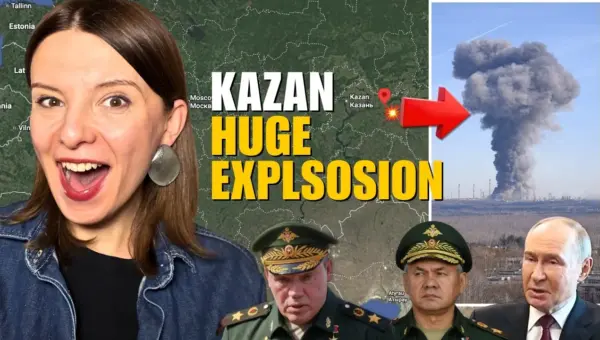
Ukraine has launched significant drone attacks on Russian oil refineries and a chemical plant in Tatarstan and Bashkortostan. These strikes target Russia's war economy and highlight growing discontent in rebellious regions. The attacks also come as Russia's key Ust-Luga oil export terminal remains crippled.


War Analyst Unveils Studio, Focuses on Ukraine
A war analyst has revealed his content creation studio, showcasing the setup behind his Ukraine-focused analyses. He discussed his equipment, personal memorabilia, and a new membership program aimed at supporting Ukraine and diversifying revenue.


West’s Tech Edge vs. Russia’s Combat Grit
Western technological superiority in air power faces Russia's battle-hardened forces and mobilized economy. While the West excels in precision strikes, Russia leverages combat experience and industrial output. The article also explores the complex role of nuclear deterrence and the urgent need for Western military readiness.