Build Wealth Faster: The Right Order to Invest Your Money
Prioritizing foundational financial steps like emergency funds and high-interest debt repayment before aggressive investing can significantly boost long-term wealth. Understanding the correct investment order, from emergency savings to taxable accounts, is key to outpacing peers.

Build Wealth Faster: The Right Order to Invest Your Money
Many Americans are struggling with basic financial security, with one in three having no emergency savings and the median amount for those who do dropping to $500. While some focus on complex investments like Bitcoin or individual stocks, they may be overlooking crucial foundational steps. The sequence in which you invest your money is as important as the amount, and getting it wrong can cost you tens of thousands of dollars over a lifetime.
The Power of an Emergency Fund
An emergency fund serves as a psychological safety net, preventing costly financial mistakes during unexpected events. Without one, a car repair or a broken boiler could force you to sell investments at a loss, locking in declines and potentially incurring debt. A study by Vanguard found that individuals with at least $2,000 in emergency savings reported financial well-being scores 21% higher than those with no savings. This boost was greater than the impact of a $500,000 income or a $1 million investment portfolio.
Building this fund should start with a manageable goal, such as reaching $1,000 quickly. This initial amount can cover minor emergencies and improve your financial outlook. The next step is to build up to one month of expenses, then gradually increase to three to six months of living expenses. This money should be kept in a liquid account, like a high-yield savings account, to protect against inflation while remaining accessible.
Eliminate High-Interest Debt First
Paying off high-interest debt offers a guaranteed, tax-free return that often surpasses investment gains. With average credit card interest rates exceeding 22%, carrying a balance while investing is a losing proposition. For example, $5,000 in credit card debt at 22% interest can cost nearly $3,000 in interest over five years. Every dollar paid towards this debt is like earning a guaranteed 22% return.
A general rule is to pay off any debt with an annual interest rate above 8% before investing aggressively. The debt avalanche method, which prioritizes paying off debts with the highest interest rates first, is the most mathematically efficient. While some prefer the debt snowball method for psychological wins, the avalanche method yields superior financial results. If a loan has a 0% interest rate, however, it makes sense to pay the minimums and invest the difference.
Don’t Miss Employer Retirement Matches
If your employer offers matching contributions to a retirement account, such as a 401(k), capturing this match is a top priority, even if you have high-interest debt. A typical employer match might be 50 cents for every dollar you contribute, up to 6% of your salary. For someone earning $50,000 who contributes $3,000 (6%), the employer adds $1,500, resulting in an immediate 50% return on investment.
This guaranteed 50% return is virtually impossible to beat elsewhere. It’s crucial to check your employer’s vesting schedule, which determines when the matching funds become fully yours. Even with a vesting schedule, taking the match is usually beneficial. The strategy is to contribute just enough to get the full employer match, then focus on eliminating high-interest debt. Once the debt is gone, you can increase your retirement contributions.
Prioritize Individual Retirement Accounts (IRAs)
After securing the employer match, the next step is to contribute to an Individual Retirement Account (IRA). IRAs offer more investment choices compared to many employer-sponsored plans, which often have limited, higher-fee mutual fund options. Over decades, the difference between a 1% expense ratio and a 0.03% index fund can amount to tens of thousands of dollars lost to fees.
For 2025, individuals under 50 can contribute up to $7,000 to an IRA, while those 50 and older can contribute $8,000. The choice between a Traditional IRA and a Roth IRA depends on your current and expected future tax bracket. A Traditional IRA offers a tax deduction now, with taxes paid upon withdrawal in retirement. A Roth IRA is funded with after-tax dollars, and qualified withdrawals in retirement are tax-free. Those in lower tax brackets early in their careers may benefit more from a Roth IRA, while those in peak earning years might prefer a Traditional IRA for the immediate tax deduction. Splitting contributions between both offers tax diversification.
Harness the Power of Health Savings Accounts (HSAs)
For those enrolled in a high-deductible health plan (HDHP), a Health Savings Account (HSA) is a powerful, often overlooked, investment vehicle. HSAs offer a triple tax advantage: contributions are tax-deductible, growth is tax-free, and withdrawals for qualified medical expenses are also tax-free. No other account offers this trifecta.
In 2025, contribution limits are $4,300 for individuals and $8,550 for families. If you can afford to pay current medical expenses out-of-pocket, allow your HSA funds to remain invested. You can keep receipts and reimburse yourself for medical expenses years later, tax-free. After age 65, HSA funds can be withdrawn for any purpose, taxed as ordinary income, similar to a Traditional IRA. With an estimated $300,000 in healthcare costs for couples in retirement, an HSA provides a significant tax-free buffer. Maxing out an HSA for 30 years at a 7% annual return could result in over $400,000 in tax-free money.
Maximize 401(k)s and Taxable Accounts
Once the employer match is secured, IRA and HSA are funded, the next step is to return to your 401(k) and max it out if possible. For 2025, the 401(k) contribution limit is $23,500 for those under 50 and $31,000 for those 50 and older. By filling these tax-advantaged accounts, individuals can shelter a substantial amount of income from taxes each year.
Only after maximizing these tax-advantaged options should you consider investing in a taxable brokerage account. While taxable accounts offer flexibility and no contribution limits, the earnings are subject to taxes on dividends and capital gains. Over 30 years, investing the same amount in a taxable account versus a tax-advantaged one could result in hundreds of thousands of dollars less due to taxes alone.
The Investor’s Roadmap
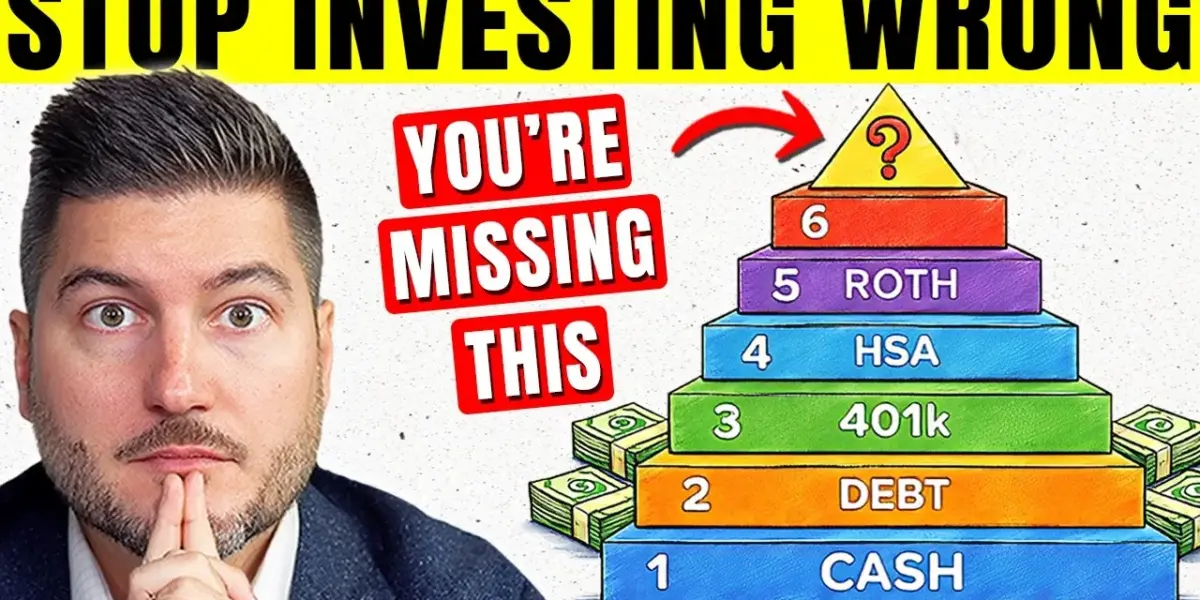
The recommended order for investing is as follows:
- Build an emergency fund.
- Pay off high-interest debt (above 8%).
- Contribute enough to get your full employer retirement match.
- Max out your IRA.
- Max out your HSA (if eligible).
- Max out your 401(k).
- Invest in a taxable brokerage account.
Following this sequence diligently, especially in your 20s and 30s, can lead to significant wealth accumulation. It emphasizes consistent, disciplined saving and investing over chasing speculative opportunities, placing disciplined savers in the top tier of financial performers.
Source: The Exact Order To Invest Your Money (Most People Get This Wrong) (YouTube)

Related Articles


Unlock Home Equity: Your 5-10 Year Wealth Building Plan
Homeowners can unlock significant wealth between years five and 10 of ownership as appreciation and mortgage payments build equity. This accumulated value can be accessed through tools like a HELOC, offering a strategic path for investors to expand their portfolios. Understanding key financial terms and economic factors is vital for making informed decisions.


Build Wealth on Average Income: The Money Guy Playbook
Financial experts Brian Preston and Bo Hanson reveal a strategy for building wealth on an average income. Their playbook emphasizes consistent saving, early and diversified investing, and disciplined financial planning to achieve long-term financial freedom.

Inflation Outpaces Pay Raises: How to Reclaim Your Financial Future
Inflation is outpacing wage growth, leaving many Americans feeling financially squeezed. This article outlines a six-step plan to regain control of your finances, starting with building an emergency fund and eliminating debt. It emphasizes creating a budgeting system, strategizing debt repayment, increasing income, protecting assets, and committing to continuous learning.