Trump Supporters Link Democrats to Slavery and Treason
A viral video captures a Trump supporter claiming Democrats are the true champions of slavery and fly the Confederate flag. This rhetoric attempts to redefine historical narratives and assign blame for past injustices. The exchange highlights the ongoing battle over historical interpretation in modern politics.


Trump Supporters Link Democrats to Slavery and Treason
A recent exchange captured on video highlights a recurring theme in some political circles: the attempt to associate the Democratic Party with historical injustices like slavery and the Confederacy. The conversation, though brief, reveals a strong conviction among some Trump supporters that the Democratic Party is actively working against American history and values. This perspective often involves reinterpreting historical facts to fit a modern political narrative.
The core argument presented is that Democrats, not Republicans, were historically the party of slavery and subsequently supported Jim Crow laws. This historical claim, while complex and debated by scholars, is used to frame the current Democratic Party as hypocritical. The video also touches on the symbolism of the Confederate flag. One individual claims that Democrats are the ones who fly the Confederate flag today, often alongside Trump flags. This assertion directly contradicts common perceptions, where the Confederate flag is more frequently associated with white supremacist groups and, by extension, the Republican party in recent decades.
Challenging the Narrative
The interviewer challenges this assertion, questioning whether Democrats are truly the ones flying the Confederate flag more. The response doubles down, stating that it’s simply “how it works nowadays.” This suggests a belief that the Democratic Party has co-opted or is closely aligned with symbols historically tied to the Confederacy. The idea is that Democrats are presenting themselves one way while secretly embracing symbols of the past that represent division and oppression.
Another point of contention is the removal of Confederate statues. The interviewer asks which party was trying to take down these monuments. The response is evasive, labeling those who want to remove them as “domestic terrorists.” This is a significant rhetorical move, as it attempts to delegitimise the movement to remove Confederate symbols by associating it with extremism. The interviewer then presses further, pointing out that if Democrats are pro-Confederate, why are they the ones trying to remove Confederate statues?
Reinterpreting History
The explanation offered is that Democrats are trying to remove these statues because they are “anti-Confederate.” However, the person being interviewed dismisses this, stating, “No, they’re not.” The subsequent question, “Why are they trying to remove the statues then?” is met with a claim that Democrats are attempting to “change the history of our country.” This suggests a belief that removing statues is an act of erasing or rewriting the past, rather than confronting its difficult and painful aspects.
The conversation ends with an invitation to interview Black people at the scene to gauge their opinions. This is presented as a way to get a more authentic perspective on the issue. However, the interviewer points out the limited sample size, “the three black people that are here,” implying that this small group may not represent the views of the broader Black community. The underlying implication of the initial statement is that Black people, if properly interviewed, would somehow validate the claim that Democrats are attempting to rewrite history by removing Confederate symbols.
Why This Matters
This exchange, while perhaps representing a fringe viewpoint, taps into deeper currents within American political discourse. The attempt to redefine historical legacies and assign blame for past injustices is a powerful rhetorical tool. By associating Democrats with slavery and treason, some Trump supporters aim to undermine the party’s moral standing and appeal to voters who feel a strong sense of national pride and historical continuity.
Historical Context
It is true that the Democratic Party of the 19th century was deeply divided, with a significant Southern wing supporting slavery. However, the Republican Party was founded on an anti-slavery platform. Over time, party platforms and demographics have shifted dramatically. The Civil Rights Movement of the mid-20th century led to a significant realignment, with many Southern Democrats moving to the Republican Party, and Black voters largely aligning with the Democratic Party. This historical complexity is often flattened in political rhetoric.
Implications and Future Outlook
The re-appropriation of historical narratives is a common tactic in political campaigns. When supporters of one party attempt to link the opposing party to historical sins like slavery, it’s an effort to create a moral contrast. It suggests that the opposing party is not just wrong on policy but fundamentally flawed in its historical identity. This can be effective in mobilising a base and potentially swaying undecided voters by framing the election as a choice between preserving a perceived national identity and succumbing to forces that seek to dismantle it.
The trend of using historical grievances and symbols to score political points is likely to continue. As political divisions deepen, the past becomes an ever more potent battleground. The interpretation of history, particularly concerning race and national identity, remains a highly charged issue. The way these narratives are framed and consumed by voters can have a significant impact on election outcomes and the broader direction of political discourse.
Source: Crazy Trump Voter Saying Democrats Support Slavery #politics #fyp #new (YouTube)

Related Articles

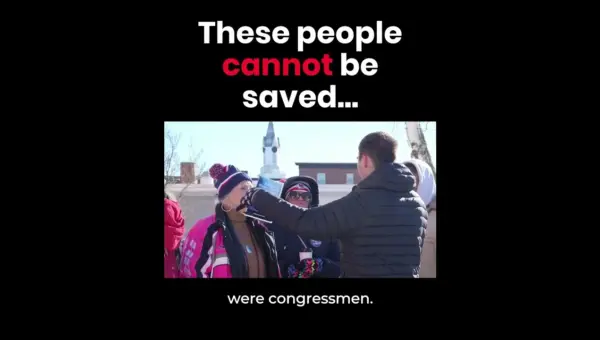
MAGA Movement’s Grip: Echoes of January 6th Persist
Audio from January 6th reveals a disturbing justification for the actions of Ashli Babbitt, highlighting the persistent and troubling narratives within parts of the MAGA movement. This mindset continues to pose challenges to democratic norms.

Pelosi Confident Woman President Will Emerge
Former House Speaker Nancy Pelosi believes a woman president will soon hold the highest office, describing the barrier as a "marble ceiling." She reflected on her career, praised Kamala Harris, and discussed her past influence on President Biden's decision not to seek reelection. Pelosi also shared concerns and plans for the midterm elections.

Pelosi Reflects on Legacy, Redistricting Battles, and Women in Politics
Speaker Emerita Nancy Pelosi recently shared her candid thoughts on redistricting battles, her political legacy, and the challenges facing women in leadership. In an exclusive interview, she highlighted the critical importance of fair representation and expressed optimism for the future of female politicians.