New Telescope Could Spot Earth-Like Worlds’ Life Signs
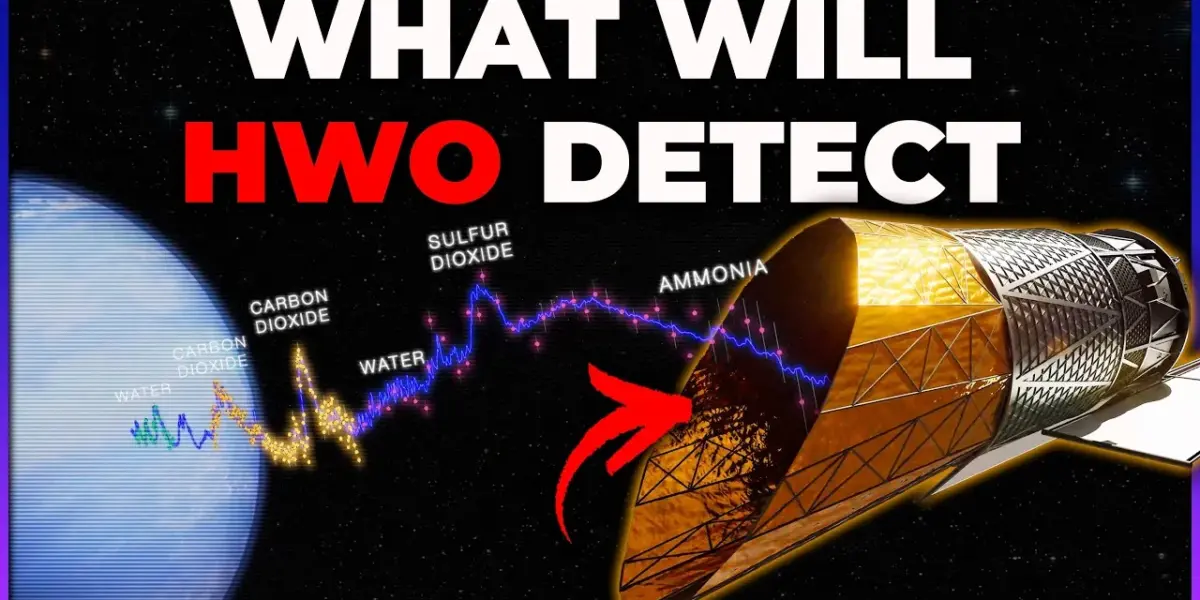
New research suggests the Habitable Worlds Observatory needs to observe wavelengths around 1.52 to 1.68 microns to effectively detect key biosignatures like carbon dioxide, water, and methane on Earth-like exoplanets. This optimal range avoids the need for complex telescope cooling systems.

New Telescope Could Spot Earth-Like Worlds’ Life Signs
Scientists are aiming to directly image Earth-sized planets orbiting distant sun-like stars and analyze their atmospheres for signs of life. The upcoming Habitable Worlds Observatory (HWO) promises to be a powerful tool in this quest, but new research suggests careful planning is needed to ensure it can detect the subtle clues we’re looking for.
Searching for Alien Atmospheres
The Habitable Worlds Observatory, a next-generation space telescope under development by NASA, is designed to achieve a monumental goal: capturing the first direct images of Earth-sized planets around sun-like stars. More importantly, it aims to study the atmospheres of these distant worlds, searching for biosignatures – chemical hints that life might be present.
Detecting these biosignatures is a complex challenge. Certain molecules, like water, methane, and oxygen, are key indicators. However, observing them requires detecting specific wavelengths of light. The further into the infrared spectrum a telescope needs to look, the more difficult and expensive the engineering becomes.
A PhD Student’s Calculations
Celeste Hegy, a PhD student at the University of California, Riverside, has been doing the crucial calculations. She analyzed the types of signals expected from Earth-like exoplanets orbiting sun-like stars. Her work focuses on the interplay between molecules like methane, carbon dioxide, and water in an exoplanet’s atmosphere. The big question is: can the HWO, with its planned coronagraph technology, actually detect these vital biosignatures?
What Scientists Hope to Find
“With the Habitable Worlds Observatory, we’re going to be trying to detect and characterize these Earth-like exoplanets around sun-like stars,” Hegy explained. “We really want to see these biosignatures, right? So, we could be looking for water, methane, oxygen, ozone, and even carbon dioxide.”
Scientists are also exploring novel biosignatures, such as methyl halides (like CH3Cl, CH3Br, CH3I). Detecting these molecules using direct imaging and spectroscopy would be a huge step in understanding how planets develop and how their atmospheres change over time. Comparing these findings to Earth as an example will be incredibly valuable.
Building on Past Successes
Current telescopes like the James Webb Space Telescope (JWST) can already detect many of these molecules. However, JWST primarily studies gas giants and hot Jupiters – planets far too hot and extreme for life as we know it. JWST has also struggled to detect atmospheres around planets orbiting red dwarf stars.
The HWO aims to be different. “This will be the first mission with a unique goal to detect life, characterize life on different planets,” Hegy noted. A key technology for HWO is its coronagraph, which will block out the blinding light of the host star. This allows the faint light reflected by planets to be seen. While existing coronagraphs are impressive, HWO needs to achieve a contrast ratio of 10 to the power of -10 – about 10 billion times fainter than the star’s light. This is a thousand times better than what current instruments can achieve, enabling the study of smaller, Earth-sized planets.
The Challenge of Infrared Light
A significant engineering challenge for telescopes observing in the infrared is keeping them extremely cold. The JWST, for instance, relies on a massive sunshield to maintain its frigid operating temperature. For HWO, the focus is shifting. While it will observe in visible and near-infrared light, pushing too far into the longer, near-infrared wavelengths requires cooling.
Hegy’s research specifically investigated this “long wave cut-off” in the near-infrared. “There has been a lot of discussion on how far we need to go to be able to detect all these molecules of interest… while also not making the engineering and the cost too complicated and costly,” she said. Research suggests that wavelengths beyond 1.7 microns necessitate cooling, leading to significant engineering hurdles and potential mirror stability issues.
BARBIE: A New Tool for Analysis
To tackle this, Hegy used a methodology called Bayesian Analysis for Remote Biosignature Identification on Exo-Earth, or BARBIE. Developed by her mentor, Dr. Natasha Latu, BARBIE helps scientists understand how easily a molecule can be detected based on signal-to-noise ratio, wavelength, and abundance.
BARBIE works by analyzing spectra – the breakdown of light into its component wavelengths. It uses statistical methods to determine the likelihood of different molecules being present in an exoplanet’s atmosphere. This is crucial because spectral lines from different molecules can overlap, making it difficult to tell them apart. It’s like trying to identify individual instruments in a complex orchestra just by listening to the combined sound.
“The main thing is that when you’re looking at a spectrum, it’s all of the molecules altogether, right? And so the goal is to disentangle them, you know, really distinguish what’s coming from what,” Hegy explained. BARBIE essentially predicts atmospheric compositions that best match the observed spectra.
Key Findings: The CO2 Puzzle
Hegy’s study focused on carbon dioxide (CO2) and its interaction with water and methane. She found that detecting CO2 was only possible with strong signals when CO2 levels were very high – specifically, at levels seen during Earth’s Proterozoic and Archean eras, or on Venus. Modern Earth-like levels of water and methane, combined with typical CO2 amounts, made CO2 detection difficult.
Surprisingly, increased levels of both water and methane negatively impacted CO2 detectability. Methane proved to be a stronger hindrance than water. This highlights the intricate chemical dance happening in exoplanet atmospheres.
The Optimal Wavelength Sweet Spot
Crucially, Hegy’s research identified an optimal wavelength range. A bandpass centered around 1.52 microns, extending to 1.68 microns, offered the best chance for detecting CO2, water, and methane at reasonable signal-to-noise ratios.
This finding is excellent news for the Habitable Worlds Observatory. This 1.68-micron cutoff is just before the point where telescope cooling becomes a major engineering challenge (around 1.7 microns). “We’re seeing these strong detections of all these different molecules and biosignatures without having to go past this cut-off where you’d have to start cooling the telescope,” Hegy stated.
Moving Beyond Single Signatures
The search for life is evolving. In the past, scientists focused on finding a single, definitive biosignature like ozone. However, it’s now understood that non-biological processes (abiotic methods) can also produce many of these molecules. Therefore, the focus is shifting towards understanding the interplay of multiple molecules and how they change over time, mimicking seasonal variations on Earth.
Hegy is also exploring novel biosignatures like methyl halides. These molecules are produced by microbes and plants on Earth, and their abiotic production is thought to be much lower, making them potentially more reliable indicators of life. However, more research is needed to understand their spectral signatures.
The Future of Exoplanet Exploration
The Habitable Worlds Observatory, with its advanced coronagraph and planned observing capabilities, is poised to revolutionize our search for life beyond Earth. Hegy’s work provides valuable insights into the telescope’s design and the scientific strategies needed to interpret its data.
While definitively proving the existence of extraterrestrial life will remain a complex challenge, requiring careful analysis and ruling out all possible non-biological explanations, the HWO represents a significant leap forward. It promises to bring us closer than ever to answering the age-old question: Are we alone in the universe?
Source: The Limits of The Habitable Worlds Observatory (YouTube)

Related Articles
Artemis II Crew Prepares for Historic Moon Mission Launch
NASA's Artemis II mission is set for launch this Wednesday, sending four astronauts on a ten-day journey around the Moon. This historic flight will test the Orion spacecraft and Space Launch System rocket, marking humanity's first return to lunar proximity in over 50 years. The crew will perform critical system checks and manual flight tests, paving the way for future deep space exploration.


NASA Confirms Artemis II Moon Mission Go for Launch
NASA has officially given the "go" for the Artemis II mission, preparing to launch a four-person crew on a historic journey around the Moon. Following a final mission management team review, all systems are confirmed ready for the April 1st launch attempt, marking a significant return to lunar space after over five decades.
Moon Race Ignites New Space Age Competition
Humankind is returning to the Moon after a 50-year absence with NASA's Artemis program. This renewed focus on lunar exploration signals a new era of global competition and cooperation in space. The stakes involve scientific discovery, resource control, and technological advancement.