Artemis II: A Giant Leap Back to the Moon
Artemis II will send four astronauts on a 10-day mission around the Moon, testing the Orion spacecraft and its life support systems. This crewed flight marks humanity's return to lunar space, validating critical technologies for future deep space exploration.

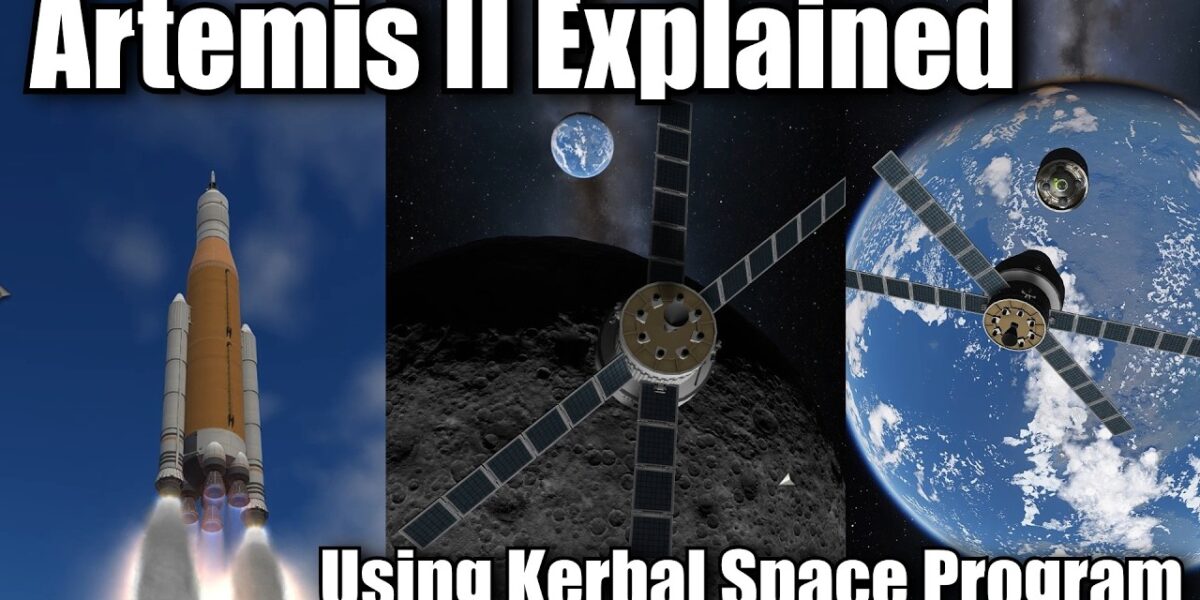
Artemis II: A Giant Leap Back to the Moon
The roar of the Space Launch System (SLS) rocket, a testament to human ingenuity and ambition, is set to echo once more as NASA prepares for the Artemis II mission. This pivotal journey, slated to launch in the coming months, will carry four astronauts on a daring circumlunar voyage, marking humanity’s first return to the vicinity of the Moon since the Apollo era. More than just a test flight, Artemis II is a crucial stepping stone, designed to validate the Orion spacecraft’s capabilities with a crew aboard, paving the way for future lunar landings and deep space exploration.
A Familiar Roar, A New Purpose
At the heart of the Artemis II launch is the formidable Space Launch System (SLS) rocket, a behemoth standing taller than the Statue of Liberty. Its core stage, powered by four veteran RS-25 engines, ignites with a ferocity that has been refined over decades. These engines, each a piece of spaceflight history, have flown numerous missions on the Space Shuttle. Engine 2047, for instance, has logged 15 flights since its debut in 1998. They are joined by two five-segment solid rocket boosters, themselves constructed from components that once flew on the Space Shuttle. The oldest segment of these boosters dates back to STS-5 in 1982, a time when the most experienced astronaut on the upcoming Artemis II mission would have been a toddler. Unlike the Space Shuttle, the SLS boosters are expendable, designed to burn up upon re-entry over the Atlantic Ocean, a stark contrast to the reusable nature of its predecessor.
These boosters are the workhorses of the initial ascent, generating 70% of the rocket’s thrust and propelling the massive vehicle to approximately 3,000 mph and an altitude of 148,000 feet before separating just over two minutes into the flight. Following the boosters’ separation, the core stage continues its ascent, carrying the Orion spacecraft and its vital launch abort system. This system, a critical safety feature, is designed to pull the crew capsule away from the rocket in case of an emergency during the initial ascent. It employs a series of solid rocket motors to achieve this rapid escape, accelerating the astronauts to speeds of up to 400 mph in mere seconds.
Orion’s Odyssey: From Earth Orbit to Lunar Proximity
Once the core stage completes its burn and separates, the Interim Cryogenic Propulsion Stage (ICPS) takes over. This is the second stage for the initial SLS Block 1 configuration. It’s a relatively compact stage, but it is tasked with a monumental job: pushing the Orion spacecraft, with its four-person crew, into an orbit that will eventually send them towards the Moon. The ICPS is fueled by liquid hydrogen and liquid oxygen, utilizing an RL10 engine equipped with an extendable nozzle for enhanced efficiency. Its design is a derivative of the Delta IV heavy upper stage, prompting some to playfully refer to the SLS as a ‘Delta V’ in Roman numerals.
A key aspect of the Artemis II mission profile is the initial insertion into a highly eccentric orbit. This orbit is designed to be energy-efficient for the boosters, ensuring they don’t achieve orbit themselves but rather re-enter predictably over the Pacific. The ICPS then performs a ‘perigee raise maneuver’ approximately 50 minutes after launch, firing its engine to circularize the orbit, placing Orion into a stable path around Earth. This initial orbit is strategically chosen to allow the crew ample time—nearly 24 hours—to test the Orion spacecraft’s systems. During this period, the spacecraft will travel out to an apogee of about 74,000 kilometers (46,000 miles), ensuring that if any critical issues arise, Orion can easily return to Earth with minimal propellant expenditure.
Testing the Waters: Proximity Operations and Beyond
A critical phase of the Artemis II mission will be the proximity operations demonstration, scheduled to occur about three hours and 20 minutes after launch, shortly after Orion separates from the ICPS. This maneuver involves the Orion spacecraft flying in close proximity to the spent ICPS, a vital test for future missions that will require docking with other spacecraft in lunar orbit, such as the human landing system for Artemis III. Astronaut Victor Glover will take command, performing a series of precise maneuvers to test Orion’s control systems and its ability to operate with the required precision. This entire process is conducted within the safety of the high Earth orbit, ensuring a safe return path should any problems emerge.
Following this demonstration, the ICPS will execute its final task: deploying four CubeSats. These small satellites, developed by international partners, will utilize the ICPS’s trajectory to conduct their own experiments in high-energy orbits before inevitably re-entering Earth’s atmosphere. This contrasts with Artemis I, which deployed ten CubeSats, and highlights lessons learned from previous missions, including issues with battery life and deployment into a trans-lunar injection trajectory.
The Lunar Voyage: A Free Return to the Moon
With the ICPS having completed its primary role, Orion will then perform its Trans-Lunar Injection (TLI) burn, propelling itself towards the Moon. The mission profile utilizes a ‘free return trajectory,’ a classic astrodynamic maneuver employed by the Apollo missions. This means that if the spacecraft’s propulsion system were to fail entirely, the Moon’s gravity would naturally swing it around and send it back towards Earth. This provides an inherent safety net for this early crewed test flight.
The journey to the Moon will take approximately four days, a more leisurely pace than the Apollo missions. This extended transit allows for slower speeds upon arrival, necessitating less thrust to achieve the free return trajectory. Consequently, Artemis II will not fly as close to the lunar surface as Apollo did. Depending on the launch window, the spacecraft will reach an apogee of roughly 400,000 to 460,000 kilometers (250,000 to 286,000 miles) from Earth. During its lunar flyby, the crew will experience a unique perspective: the far side of the Moon will be fully illuminated, appearing as a vast, bright disc, while Earth will be a distant, receding blue marble. This vantage point, combined with the specific timing of the mission, may offer views of the lunar surface never before witnessed by human eyes.
A Shared Future: International Collaboration and Future Prospects
The Artemis II mission embodies international collaboration. While the Orion capsule is a product of Lockheed Martin in the United States, its service module, which provides primary propulsion and attitude control, was developed by the European Space Agency (ESA). This module leverages technology from ESA’s now-retired Automated Transfer Vehicle (ATV) cargo spacecraft, a key component of the International Space Station program. This partnership also explains the presence of Canadian astronaut Jeremy Hansen on the crew, underscoring the global nature of lunar exploration.
During the roughly 10-day mission, the crew will conduct numerous experiments, testing life support systems, including the spacecraft’s toilet and food preparation facilities. They will utilize an exercise machine to combat muscle atrophy, a critical concern for longer deep-space missions. A significant aspect will be radiation monitoring and practicing emergency procedures, including sheltering in a designated area if a solar flare event occurs. The crew will also practice photography, capturing detailed images of the lunar surface, honing skills essential for future lunar explorers.
The Descent and Return
As the mission concludes, the service module will be jettisoned, and the Orion capsule will begin its fiery re-entry into Earth’s atmosphere. The heat shield, a critical component designed to withstand the extreme temperatures of atmospheric entry, will be put to the ultimate test. Engineers and scientists are confident in its ability to protect the crew, but former astronauts have voiced caution, emphasizing the inherent risks involved. The re-entry profile includes a ‘skip’ maneuver, using the capsule’s aerodynamic lift to control its descent and minimize stress on the heat shield.
The landing is planned for splashdown in the Pacific Ocean, west of San Diego, California. Recovery teams will be on standby to retrieve the capsule and its precious cargo, bringing the crew safely back to Earth. The success of Artemis II will not only be measured by the data collected and systems tested but by the inspiration it ignites, reaffirming humanity’s drive to explore the cosmos and take its next giant leap outwards.
Source: Artemis II Explained – With Kerbal Space Program (YouTube)

Related Articles

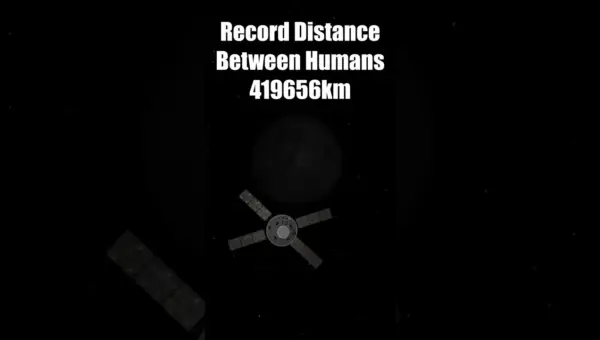
Artemis II Astronauts Set New Human Distance Record
The Artemis II mission set a new human distance record, reaching 413,145 km from Earth. The mission also established a record for the greatest distance between two groups of humans, with astronauts on China's Tiangong space station being 419,656 km away from the Artemis II crew.


Artemis II: Humanity Reaches for the Moon Again
Artemis II marks humanity's return to lunar exploration, sparking public excitement and practical questions. The mission signifies progress and inspires future generations. It's a crucial step toward deeper space exploration.


Artemis II Rocket Sheds Escape System at Liftoff
Curious objects seen speeding away from the Artemis II rocket at liftoff were part of the Emergency Egress System. This high-tech zipline is designed to rapidly remove astronauts from danger in the event of a launchpad emergency before the rocket commits to flight.