Starliner Failures: A Deep Dive into NASA’s Scathing Report
NASA's latest report on Boeing's Starliner Crew Flight Test reveals significant management and technical failures. From thruster malfunctions to helium leaks, the spacecraft's journey highlighted critical issues that led to a 'Type A mishap' designation.

Starliner Failures: A Deep Dive into NASA’s Scathing Report
NASA has released a comprehensive, albeit heavily redacted, report detailing the numerous issues that plagued Boeing’s Starliner spacecraft during its Crew Flight Test (CFT). The findings go beyond isolated incidents, pointing to systemic problems in management, communication, and adherence to critical requirements within both NASA and Boeing. The agency has officially reclassified the mission’s outcome as a “Type A mishap,” signifying a significant failure with substantial financial and operational consequences.
Understanding the ‘Type A Mishap’ Designation
A Type A mishap, in NASA’s lexicon, typically involves loss of life, severe injury, or property damage exceeding $2 million. For the Starliner CFT, the financial impact is estimated to be far greater. The report highlights that the extended stay of astronauts Butch Wilmore and Suni Williams aboard the International Space Station (ISS) – necessitated by Starliner’s issues – caused two other astronauts to delay their launch. This ripple effect represents a significant financial loss, easily exceeding the $200 million mark, by displacing valuable launch opportunities.
A Troubled History: OFT-1 and OFT-2
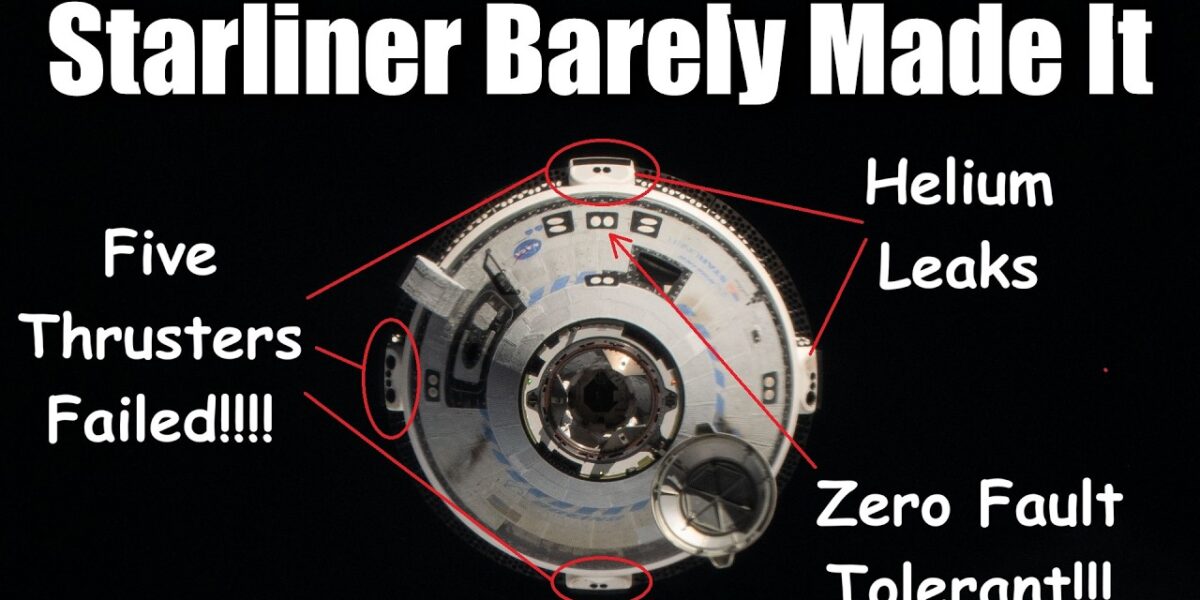
The report delves into the failures experienced during both the uncrewed Orbital Flight Test (OFT-1) and the crewed Orbital Flight Test (OFT-2). OFT-1, launched in December 2019, was plagued by software errors. A misconfigured clock led to the spacecraft attempting maneuvers with incorrect parameters, resulting in the firing of its Service Module Reaction Control System (RCS) thrusters far more than intended. This over-firing caused nine of the ten thrusters to fail, with one experiencing a permanent failure. Boeing’s investigation concluded that the failures were primarily due to the pressure transducers in the thruster chambers being overused, leading to sensor malfunctions rather than catastrophic engine failure. While thermal issues were noted, they were not the primary focus of the investigation.
Despite software fixes and addressing other identified problems, OFT-2, launched in May 2022, also encountered significant difficulties. While the spacecraft eventually reached the ISS, several RCS thrusters failed during its approach and docking maneuvers. These failures, designated with codes like B1, A3, S2, and A2, are central to the report’s findings.
Decoding the Thruster Designations
The report’s use of cryptic thruster codes (e.g., B1 A3, S2 A2) prompted an in-depth analysis. Based on Starliner’s design, these codes appear to relate to the thruster’s location, propellant manifold, and orientation. The spacecraft’s Service Module houses numerous thrusters within pods, often referred to as “doghouses.” These pods contain a mix of small RCS thrusters for maneuvering and larger Orbital Maneuvering and Attitude Control (OMAC) thrusters for larger orbital changes.
- Location: Letters like ‘P’ (Port) and ‘S’ (Starboard) likely indicate the side of the spacecraft, while ‘B’ (Bottom) and ‘T’ (Top) might refer to positions within a pod or relative to the spacecraft’s orientation.
- Manifold: The number ‘1’ or ‘2’ following the location designation is presumed to indicate the propellant manifold number, suggesting a redundant system for fuel delivery.
- Direction: Subsequent letters like ‘A’ (Aft), ‘F’ (Forward), ‘U’ (Upward), ‘D’ (Downward), and ‘R’ (Right) denote the direction the thruster is firing relative to the spacecraft. ‘L’ for Left might be implied or absent in certain configurations.
The Service Module features four pods, each containing a specific arrangement of thrusters. While most pods have seven small RCS thrusters, the configuration varies, with some pods having forward-facing thrusters used only during launch aborts. The report notes that these thrusters, though off-the-shelf hardware, are housed in a non-standard configuration, potentially contributing to the failures.
The Critical Loss of Six-Degree-of-Freedom Control
A pivotal moment during OFT-2 was the loss of six-degree-of-freedom control. This capability allows a spacecraft to move and rotate in all three dimensions (translation and rotation). During an approach maneuver, Starliner lost control in the “X direction” – its ability to thrust forward towards the ISS. This occurred when multiple aft-facing RCS thrusters failed in opposing pods. Without balanced thrust, any attempt to move forward would have caused the spacecraft to rotate uncontrollably. This situation left the crew manually piloting the spacecraft for an extended period, keeping its sensors pointed at the ISS while troubleshooting.
Investigating the Root Causes: Two-Phase Flow and Valve Issues
The report identifies two primary suspected causes for the thruster failures:
- Two-Phase Flow of Oxidizer: This refers to the oxidizer (nitrogen tetroxide) transitioning between liquid and gas states within the propellant lines. When the oxidizer becomes gaseous, its density decreases, leading to reduced thrust. The report suggests that excessive heating within the thruster pods, possibly due to thermal soak-back from engine firings, ambient heat, or plume recirculation from OMAC thrusters, caused the nitrogen tetroxide to boil. This created gas pockets, impeding proper flow to the combustion chamber. The starboard pods, in particular, showed a higher failure rate, potentially linked to a flange design associated with the Atlas V rocket’s stage separator, which might have exacerbated plume recirculation.
- Poppet Valve Extrusion: The valves controlling propellant flow utilize Teflon seals. Nitrogen tetroxide, while chemically inert to Teflon, can plasticize it, causing it to swell. This swelling, exacerbated by heat, can restrict the flow of propellant through the valve. The report indicates that the specific O-ring material used may have been outside standard engineering guidelines (Parker handbook), leading to potential leaks and performance degradation.
These issues resulted in reduced chamber pressure, triggering the spacecraft’s fault detection system to mark the thrusters as unavailable. The lack of functional thrusters in critical orientations led to the inability to perform necessary maneuvers.
Helium Leaks: A Looming Threat
Beyond the thruster failures, the report also details significant helium leaks from the Service Module’s pressurization system. Helium is crucial for pressurizing the fuel tanks and operating valves. Leaks were detected in seven out of eight manifolds in the RCS3 system, posing a risk to the spacecraft’s ability to function. Despite a dissenting engineering opinion highlighting the inadequacy of the O-ring seals for the applied conditions, the launch proceeded based on Boeing’s proposed workarounds and management strategy for these leaks.
What Comes Next?
The Starliner CFT’s findings present a critical juncture for both Boeing and NASA’s Commercial Crew Program. The detailed analysis in the report is intended to inform corrective actions. Boeing is expected to implement further modifications to the Starliner spacecraft, addressing the identified design and manufacturing issues. NASA, in turn, will likely enhance its oversight and verification processes to ensure future missions are conducted safely and successfully. The long-term viability of the Starliner program hinges on its ability to reliably transport astronauts to and from the ISS, complementing SpaceX’s Crew Dragon and providing crucial redundancy for human spaceflight operations.
Why It Matters
The success of the Commercial Crew Program is vital for maintaining a continuous human presence on the ISS and enabling future deep-space exploration. Starliner’s development challenges underscore the complexities of human-rated spaceflight and the importance of rigorous testing, transparent communication, and unwavering adherence to safety standards. Learning from these setbacks is paramount to ensuring the safety of astronauts and the advancement of space exploration.
Source: Explaining Why NASA's Starliner Report Is So Bad (YouTube)

Related Articles


Artemis II: Humanity Reaches for the Moon Again
Artemis II marks humanity's return to lunar exploration, sparking public excitement and practical questions. The mission signifies progress and inspires future generations. It's a crucial step toward deeper space exploration.

Artemis II Rocket Sheds Escape System at Liftoff
Curious objects seen speeding away from the Artemis II rocket at liftoff were part of the Emergency Egress System. This high-tech zipline is designed to rapidly remove astronauts from danger in the event of a launchpad emergency before the rocket commits to flight.


NASA Rockets to Moon’s South Pole After Crew’s Victorious Return
NASA's Artemis II astronauts have returned safely from lunar orbit, marking a major milestone after 50 years. The agency is now setting its sights on Artemis III, which aims to land humans on the moon. This program is building towards a sustained lunar presence and future Mars missions.