China’s EV Surge: A UK Trade Rethink?
Discussions on biofuels, European overcapacity, and UK-China trade relations reveal the complex challenges and opportunities facing the automotive industry. Analysis suggests biofuels are inefficient, while overcapacity pressures European manufacturers, prompting a re-evaluation of global trade dynamics.


UK-China Automotive Relations Under Scrutiny Amidst Global EV Overcapacity
The global automotive landscape is in constant flux, and recent developments highlight a significant shift in power dynamics, particularly concerning China’s burgeoning electric vehicle (EV) sector and its implications for the UK and Europe. Discussions around biofuels, industrial consolidation, and international trade relations paint a complex picture for the future of car manufacturing and uptake.
Biofuels: An Inefficient Distraction?
The debate surrounding alternative fuels continues, with biofuels occasionally resurfacing as a potential solution to decarbonize transport. However, groundbreaking analysis from Hannah Richie of ‘Sustainability and Numbers’ (a newsletter associated with Our World in Data) starkly illustrates the inefficiency of biofuels.
Richie’s research indicates that the 32 million hectares of land currently used globally for biofuel production (an area roughly the size of Poland) could, if utilized for solar panels, generate enough electricity to power all the world’s cars and trucks on electricity. This staggering figure, which required multiple checks by Richie herself, suggests that biofuel production yields only a fraction of the energy obtainable from solar on the same land, rendering it a ‘fool’s errand’ in the pursuit of sustainable transport.
The efficiency comparison is stark: solar energy conversion to usable electricity is vastly superior to that of biofuels. This data is a powerful counterargument for those advocating for biofuel solutions, reinforcing the dominance of battery-electric technology, coupled with renewables like solar and wind, as the most viable path forward.
The Spectre of Overcapacity in Europe and China
A significant buzzword for the automotive industry in the coming year is ‘overcapacity.’ While often associated with China’s massive EV production capabilities, the issue is also acutely felt in Europe. Manufacturers like Volkswagen Group are grappling with significant overcapacity, leading to radical cost-cutting programs, including 35,000 job losses in Germany.
The group is reportedly 500,000 vehicle sales short of its annual targets, a deficit equivalent to two full manufacturing plants. Stellantis is facing similar challenges.
This overcapacity, partly driven by misjudged forecasts and the rapid market shifts, creates immense pressure. For manufacturers and their employees, the uncertainty is deeply unsettling. The transition from internal combustion engines to EVs, coupled with broader macroeconomic factors, is leading to a ‘banquet of consequences,’ as described by EV expert Roger Atkins.
The industry is witnessing a shift where some manufacturers will shrink, while others may face existential threats. This transition is not just about technology but also about livelihoods, necessitating careful consideration of policies that support the workforce through this period of change.
The data also shows a clear trend: battery electric vehicles are increasingly outselling petrol cars in Europe, with battery EVs gaining market share across numerous European nations. While diesel is in steep decline and petrol usage has likely peaked, the industry’s response to overcapacity and the influx of competitive vehicles, particularly from China, remains a critical concern.
UK-China Diplomatic and Trade Relations: A New Automotive Frontier?
The recent visit of UK Prime Minister Rishi Sunak to Beijing, following a similar trip by Canadian Premier Mark Carney, highlights the growing importance of diplomatic and trade relations with China. For the UK, a nation seeking to forge its post-Brexit identity, engaging with China is crucial, especially given that China is already a significant trading partner, ranking second only to Germany for UK imports and sixth for exports.
The automotive sector, in particular, is watching these developments closely. The current UK Electric Vehicle Grant scheme, for instance, technically excludes carmakers whose manufacturing bases are too distant, effectively acting as a tariff on Chinese EVs without imposing one. This has fueled speculation about potential new arrangements between the UK and Chinese automotive manufacturers.
One intriguing rumour involves Jaguar Land Rover (JLR) potentially partnering with Chinese automotive giant Chery. Chery, already present in the UK market with brands like Omoda and Jaecoo, has a substantial global export trade and existing joint venture experience with JLR.
Such a partnership could address JLR’s capacity issues in the UK and signify a deeper integration of Chinese manufacturing capabilities within the UK automotive industry. This comes at a time when the perception of Chinese automotive brands has dramatically shifted from being seen as lower quality to technologically advanced and highly competitive.
The potential for increased inward investment, manufacturing collaborations, and the creation of jobs in areas like sales, marketing, and research is significant. However, the evolving nature of car manufacturing, with a trend towards highly automated ‘dark factories,’ means that job creation might not directly correlate with the scale of manufacturing output. The concept of ‘brands without factories,’ where design and marketing are central while manufacturing is outsourced, is becoming increasingly plausible, especially with the rise of software-defined vehicles.
Volkswagen’s challenges in regaining market share in China, despite admitting they will sell more Chinese-made EVs overseas, further highlight the dominance of local brands and the competitive prowess of Chinese manufacturers. The entire automotive chessboard appears to be in flux, making it a fascinating, albeit challenging, time to be involved in the industry.
Source: What does KEIR's CHINA 'TRIP' mean for UK automotive?' Glut Instinct? Biofools? (YouTube)

Related Articles


Chinese Brands Storm UK Market, Shaking Up Auto Industry
Chinese EV manufacturers like BYD and Chery Group are rapidly taking market share in the UK, outperforming established brands and challenging traditional perceptions. Their aggressive marketing and competitive products are reshaping the automotive landscape.


Porsche Patents a Manual for Electric Cars
Porsche has filed a patent for a manual transmission system designed for electric vehicles. This innovative system would allow drivers to choose between automatic mode and a traditional H-pattern manual shifter, offering an engaging driving experience for EV enthusiasts.

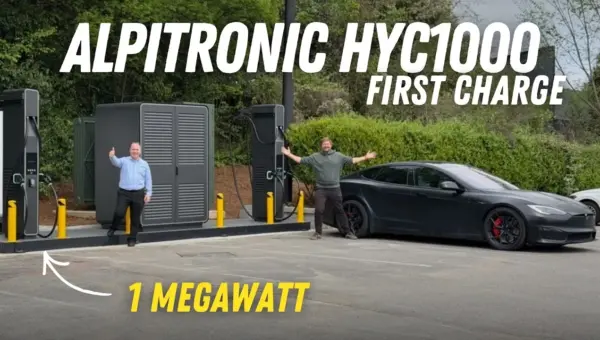
Alpitronic Unveils 1MW Hypercharger 1000 in US
Alpitronic has launched its powerful 1MW Hypercharger 1000 (HYC 1000) system in North America, promising significantly faster EV charging. This split DC fast charger introduces megawatt power, MCS standard support, and a flexible distributed architecture designed for CPOs and fleets.