Trump’s Conflicting Iran Statements Spark Concern
Donald Trump's recent statements on Iran have been marked by stark contradictions, shifting from calls for annihilation to claims of successful negotiations within days. This inconsistency raises concerns about U.S. foreign policy clarity and public trust. The disconnect between his rhetoric and observable reality is a key point of analysis.

Trump’s Iran Stance Shifts Rapidly, Raising Questions
In a matter of days, Donald Trump’s public statements on Iran have swung wildly, leaving observers confused and concerned. This inconsistency, some suggest, points to deeper issues. The former president has offered sharply different views on negotiations and the state of affairs with Iran, sometimes within minutes of each other.
Contradictory Messages Emerge
At one point last week, Trump declared that Iran was seeking a deal while the United States did not, stating a desire for Iran’s complete destruction. Yet, shortly after, he presented a different picture, claiming that negotiations were underway and progressing exceptionally well. He described these talks as the “best negotiations ever” with “perfect conversations.” He also added that many people were involved in these discussions, and the other side was eager to reach an agreement.
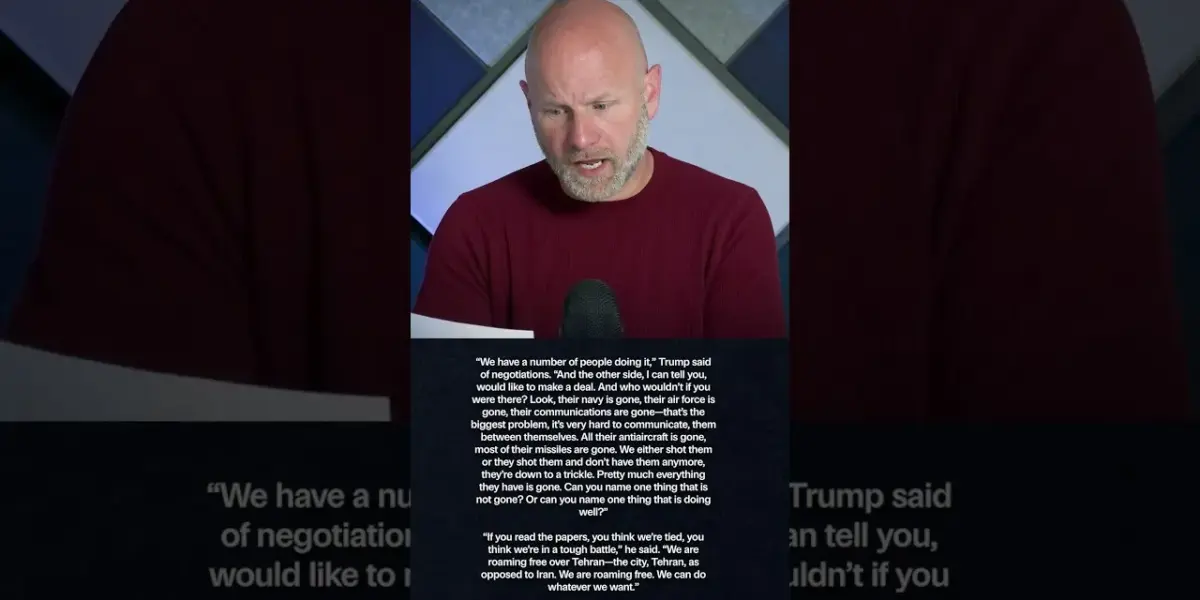
“We’ve had quote perfect conversations. But then he added this. We have a lot of people doing it. Uh and the other side, I can tell you would like to make a deal.”
Assessing Iran’s Military Strength
Trump went on to describe Iran’s military capabilities as severely diminished. He stated that their navy and air force were gone, along with most of their communications systems, which he called their biggest problem. He also claimed that Iran’s anti-aircraft defenses and missiles were largely depleted, either destroyed by U.S. forces or used up. The implication was that Iran was in a weakened state, struggling to function.
However, this assessment clashes with another observation Trump made. He noted that Iran still controlled the Strait of Hormuz. This seemed odd to him, given his claims about their lack of air force, navy, or missile capabilities. He expressed bewilderment that they could maintain control of such a strategic waterway under those supposed conditions, calling it “weird” that reality didn’t match his descriptions.
Discrepancy Between Rhetoric and Reality
The speaker in the video points out a significant disconnect between Trump’s pronouncements and the observable situation. While not supporting Iran, the speaker emphasizes that the facts on the ground appear different from what Trump is communicating. This gap between his words and reality is highlighted as particularly troubling.
Freedom of Movement Over Iran
The situation becomes even more perplexing when considering Trump’s claims about U.S. freedom of movement. He suggested that instead of Iran controlling anything, the United States was “roaming free” over Iran, able to do as it pleased. This paints a picture of complete dominance, yet it sits uneasily with the earlier descriptions of Iran’s continued control over the Strait of Hormuz.
Why This Matters
The erratic nature of these statements is significant for several reasons. Firstly, it raises concerns about the stability and clarity of U.S. foreign policy, especially regarding a volatile region like the Middle East. When a leader’s public stance shifts so dramatically and frequently, it can create uncertainty for allies and adversaries alike. This can make diplomatic efforts more difficult and potentially increase the risk of miscalculation.
Secondly, the discrepancy between Trump’s claims and apparent reality can erode public trust. When leaders present information that doesn’t align with what people can observe or understand, it can lead to cynicism and a questioning of the information provided. This is especially critical in matters of national security and international relations, where clear and honest communication is paramount.
Historical Context and Future Outlook
This pattern of shifting rhetoric is not entirely new in politics, but the speed and intensity of the changes observed in Trump’s recent statements are noteworthy. Historically, foreign policy has often relied on consistent messaging to maintain credibility and achieve objectives. Sudden reversals or contradictory statements can undermine a nation’s standing on the global stage.
Looking ahead, the implications of such communication styles are considerable. For international diplomacy, it suggests a challenging environment where consistent engagement and predictable policy are harder to establish. For domestic audiences, it raises questions about the reliability of information and the decision-making processes within leadership. The future outlook likely depends on whether a more stable and consistent approach to foreign policy communication can be adopted, ensuring that actions and words are aligned to foster greater understanding and reduce potential conflict.
Source: Trump has GONE MAD (YouTube)

Related Articles
Polls Spell Doom: Republicans Face Voter Backlash
New polling data reveals a sharp decline in public confidence regarding the economic impact of Republican policies, particularly under Donald Trump. A significant majority now feel financially worse off, a trend that is especially pronounced among independent voters. This economic discontent poses a major challenge for the Republican party heading into future elections.
Iran’s Missile Threat Reduced by 90%, Analyst Says
An analyst reports that Operation Epic Fury has degraded Iran's missile launchers by 90%, despite challenges in targeting hidden sites. The conflict's duration and media coverage are also discussed, with implications for global energy markets and investor confidence.

Iran Missile Strikes Injure US Troops, Raise War Concerns
Iranian missile strikes have injured U.S. service members, escalating tensions as the conflict nears one month. The attacks are raising concerns about the effectiveness of U.S. military strategy and the depletion of crucial missile stockpiles. Global oil prices have surged, impacting economies worldwide.