DOJ’s Secret Admission Undermines Trump-Era Prosecutions
A recent admission from the Department of Justice reveals prosecutors pursued a case against Jerome Powell without evidence of a crime. This raises serious questions about the weaponization of legal tools for political purposes during the Trump administration and erodes judicial trust.

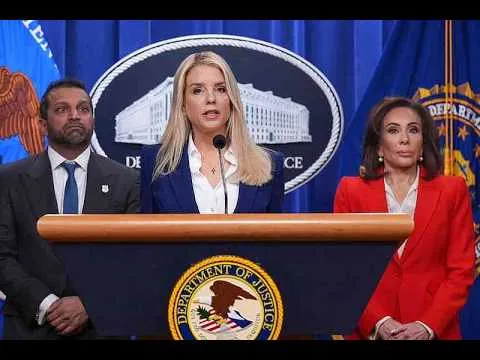
DOJ’s Secret Admission Undermines Trump-Era Prosecutions
The U.S. Department of Justice (DOJ) recently made a quiet admission that has significant implications for how Donald Trump’s administration used its power. This admission, made behind closed doors, suggests that prosecutors may have pursued cases without solid evidence of wrongdoing, particularly when targeting individuals Trump viewed as enemies.
Subpoenas Issued Without Evidence
The issue came to light when a federal judge in Washington D.C., Judge James Boasberg, threw out two grand jury subpoenas. These subpoenas were issued by prosecutors under the Trump administration’s DOJ. The targets were related to a renovation project at the Federal Reserve. Judge Boasberg ruled that these subpoenas were not being used to investigate a real crime. Instead, he concluded they were used to pressure Federal Reserve Chairman Jerome Powell.
Donald Trump had publicly criticized Powell for more than a year, demanding he lower interest rates. Powell, however, based his decisions on economic data, not political pressure. Following Trump’s complaints that his prosecutors weren’t aggressive enough, the DOJ issued subpoenas. The stated reason was cost overruns on a Fed renovation project, which was reportedly $1.2 billion over budget. However, there was no evidence that a crime had actually been committed.
A Prosecutor’s Damning Testimony
During a closed-door hearing on March 3rd, the prosecutor in charge, G.A. Masuko Lee, was questioned by Judge Boasberg. Lee is now the chief of the criminal division in the D.C. U.S. Attorney’s Office. He admitted that they did not know at the time what evidence of fraud or criminal misconduct existed. When pressed about the basis for the investigation, Lee argued that the project being so far over budget was reason enough, stating, “It doesn’t seem right.” He also suggested there were “1.2 billion reasons to open an investigation,” implying one dollar for each million over budget.
When asked about Jerome Powell’s congressional testimony regarding the cost overruns, Lee stated they had no evidence that Powell had lied. This admission revealed that the subpoenas were issued without a clear basis in suspected criminal activity. Prosecutors cannot legally issue grand jury subpoenas without investigating a crime. The power of the grand jury, and thus the subpoenas it issues, is controlled by the court, not solely by the prosecutor’s office.
Implications for Future Prosecutions
This case highlights a pattern of alleged misuse of the DOJ’s power. Critics argue that the Trump administration’s DOJ was willing to target political opponents. This incident, where prosecutors admitted to lacking evidence, could weaken future cases brought by those associated with this approach. Judges are increasingly aware of such tactics. As more cases are dismissed due to lack of evidence or apparent political motivation, the credibility of the DOJ under that leadership erodes.
Judge Boasberg himself noted in his ruling that Donald Trump and his DOJ leadership had a history of targeting perceived enemies. Each failed attempt to bring such a prosecution adds to a list of prior actions. This growing record makes it harder for prosecutors to convince judges that new investigations are legitimate and evidence-based. It can make future attempts to bring politically charged cases more difficult to win.
Erosion of Trust and the Presumption of Regularity
The principle of “presumption of regularity” means courts usually assume the government is acting in good faith. For years, the DOJ has benefited from this assumption due to its perceived integrity. However, incidents like this lead some judges to question that assumption. Several judges have begun to author opinions stating they will not automatically trust DOJ prosecutors to be candid or to have supporting evidence.
One federal judge in New Jersey dramatically stated that it took just one year for the U.S. Attorney’s Office there to destroy the credibility it took generations to build. While not all U.S. Attorney’s offices are seen as tainted, and many career prosecutors continue their work diligently, the leadership’s actions cast a shadow. This erosion of trust is a serious concern for the justice system. If judges can no longer presume good faith, it could fundamentally change how federal cases are handled.
Why This Matters
This situation is critical because it speaks to the integrity of the justice system. When prosecutors are perceived as using their power to target political rivals rather than uphold the law, public trust suffers. The admission that subpoenas were issued without evidence of a crime suggests a willingness to abuse legal processes for political ends. This undermines the principle that justice should be blind and applied equally to all.
The increasing skepticism from judges is a sign that the legal system is pushing back against perceived abuses. It also means that future administrations will face greater scrutiny. The actions of one administration can have long-lasting effects on the institutions they lead. The “presumption of regularity” is a cornerstone of the legal process. Its decline could lead to a more adversarial and less efficient system for everyone.
Looking Ahead
The trend suggests that judges will continue to scrutinize the motivations behind government investigations. This increased skepticism could act as a check on potential abuses of power. However, it also presents a challenge for legitimate investigations. The hope is that the focus will return to evidence-based prosecutions, free from political influence. The legal system’s ability to self-correct, as seen with judges pushing back, offers a path forward. But the damage to public trust may take time to repair.
Source: Justice Department makes SECRET CONFESSION about prosecution (YouTube)

Related Articles
MAGA Base Questions Trump’s Grip at Chaotic CPAC
A conservative gathering revealed surprising dissent within the MAGA base, with attendees booing impeachment. This, coupled with government shutdowns and electoral losses, signals potential shifts in the party's direction and priorities.
Trump’s Iran Gambit: Can He Claim Victory in a Full Retreat?
Could President Trump claim a victory by withdrawing U.S. forces from Iran? This analysis explores how a retreat could be framed as a success, focusing on weakened Iranian capabilities and broader regional shifts. The core issue remains Iran's financing of proxy groups, a challenge that persists regardless of U.S. presence.
Trump Blunders Into Iran Conflict, Lacks Strategy
Journalist David Cay Johnston argues that President Trump lacks a clear strategy in dealing with Iran, driven by falling poll numbers and personal ambition. Johnston warns of potential disaster, citing Trump's inexperience and the dangerous influence of Christian nationalism on U.S. policy.