Credit Card Secrets: From CIA Spy Tech to Your Wallet
Explore the surprising origins of credit card technology, tracing its lineage from a Cold War CIA spy device to the sophisticated NFC chips in your wallet. Discover how innovations like the magnetic stripe and EMV chip revolutionized payments while battling ever-evolving fraud.

Credit Card Secrets: From CIA Spy Tech to Your Wallet
Credit cards are more than just plastic rectangles; they are sophisticated pieces of technology with a surprising history. Their journey from simple payment tools to the complex devices we use today is a story that winds through Cold War espionage, technological innovation, and a constant battle against fraud.
The Dawn of Invisible Listening: ‘The Thing’
The story of modern credit card technology has roots in a top-secret CIA counter-surveillance operation. In 1945, Soviet schoolchildren gifted the U.S. ambassador to the Soviet Union a hand-carved plaque of the Great Seal of the United States. Unbeknownst to the ambassador, this gift concealed a revolutionary listening device, nicknamed ‘The Thing.’ This bug was remarkable because it had no battery or power source, making it virtually undetectable by standard surveillance equipment.
For years, ‘The Thing’ remained hidden, spying on conversations within the ambassador’s office. It was only in 1951 and 1952 that a signal was detected. Soviet operators remotely activated the device by sending specific radio waves. These waves interacted with the bug’s antenna and a resonant cavity, causing the electrons within to oscillate. Around 900 megahertz, this oscillation created a strong, resonant signal that could be detected and decoded.
The device worked by using sound waves to vibrate a diaphragm within a resonant cavity. This vibration changed the cavity’s electrical properties, which in turn altered the resonant frequency. When the Soviets beamed radio waves at the plaque, the cavity re-radiated a signal that contained the original radio wave, but modulated by the sound waves from the room. This technique, called amplitude modulation, is similar to how AM radio works. The Soviets could then extract the audio from the re-radiated signal.
The bug was the brainchild of Russian inventor Leon Theremin, famous for the contactless musical instrument, the Theremin. Despite its advanced nature, the Americans kept its discovery secret, recognizing its technological superiority. They began developing their own enhanced versions, marking a pivotal moment in the history of electronic surveillance and communication.
The Birth of Plastic Money: Making Payments Easy
Meanwhile, in the post-war United States, the economy was booming. People wanted to buy more, but paying for expensive items was cumbersome. Carrying large amounts of cash was risky, and checks could take days to clear. Banks saw an opportunity to simplify spending.
In 1958, Bank of America launched the BankAmericard, the first universal credit card. It allowed customers to buy items on credit, and by the end of the decade, millions of cards were in circulation. However, early cards had significant drawbacks. Sellers had to manually imprint card details onto paper slips, and manually send them to the bank. This process was slow, taking days for merchants to receive payment, and it was prone to fraud. Criminals could use stolen or counterfeit cards, and by the time banks detected the fraud days later, the culprits were long gone.
The Magnetic Stripe Revolution: Speed and Security
To address these issues, the credit card industry needed a faster and more secure system. Around the same time, the CIA was looking for a more secure ID card system. IBM engineer Forrest Parry, inspired by audio cassette technology, experimented with storing data on magnetic tape. After struggling to attach the tape to cards, his wife suggested ironing it on, and the magnetic stripe was born.
Magnetic stripes store data as a series of ones and zeros, which can be read by a magnetic stripe reader. The first magnetic stripe credit cards appeared in 1970. These cards drastically sped up transactions and made it easier for banks to quickly identify and block suspicious payments. However, the magnetic stripe had a critical flaw: the data was static and could be easily copied, or ‘skimmed.’ Fraudsters could clone cards and use them repeatedly, leading to massive financial losses.
Tony Sales, a former fraudster, described how simple it was: ‘grabbers’ (card readers) could swipe card details, which were then used to create cloned cards. By the early 2000s, magnetic stripe skimming was a major cause of credit card fraud, costing the UK hundreds of millions of pounds annually.
The Chip Era: A Digital Guardian
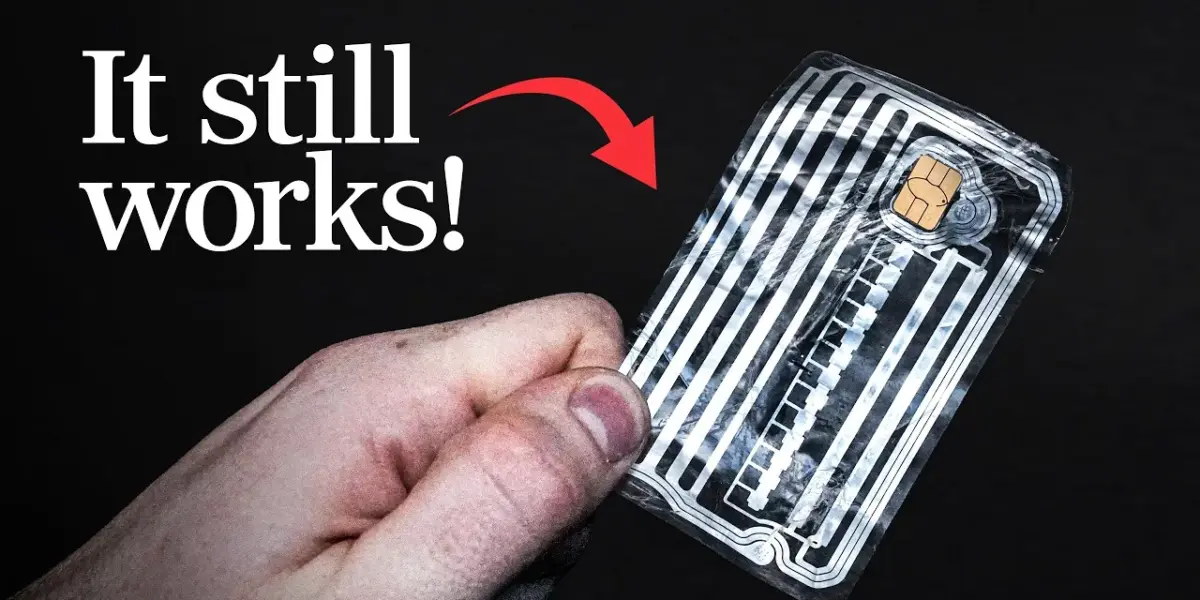
The solution to magnetic stripe vulnerabilities came in the form of the chip, standardized by the EMV (Europay, Mastercard, and Visa) initiative. These chips, essentially mini-computers, brought a new level of security. Unlike static magnetic stripes, the chip encrypts transaction information using a secret key shared only with the issuing bank.
When you insert a chip card, it communicates with the payment terminal, generating a unique, one-time code for each transaction. This process, known as ‘chip and PIN,’ makes it incredibly difficult to clone a card or reuse stolen transaction data. Extracting the chip’s secret key would require highly specialized equipment and days of work, making it impractical for most criminals.
The rollout of chip and PIN technology significantly reduced counterfeit fraud. In the UK, counterfeit fraud dropped by 63% within seven years of its introduction in 2003. However, chip and PIN transactions were slower, adding an average of 10 seconds per transaction, which accumulated into millions of lost hours annually.
Contactless Payments: The NFC Evolution
Seeking to regain speed, the industry turned to technologies inspired by earlier spy devices. Radio Frequency Identification (RFID) technology, first developed for toll booths and inventory tracking, evolved into Near-Field Communication (NFC) for payments.
NFC allows cards to communicate wirelessly with payment terminals over very short distances, typically just a few centimeters. This is achieved through a magnetic field generated by the reader, which powers the card’s chip and antenna. The chip then modulates this field to send back transaction data. This ‘tap to pay’ system offered the speed that consumers and businesses desired.
Contactless payments saw a massive surge in adoption around 2020 due to health concerns about touching payment terminals. However, this convenience also introduced new vulnerabilities. While NFC transactions themselves are cryptographically secure and cannot be cloned without the chip’s secret key, the card number and expiration date can be read by close-proximity devices. This ‘digital pickpocketing’ or ‘ghost tapping’ allows criminals to make small fraudulent transactions. While most countries have transaction limits for contactless payments, the US does not, posing a higher risk.
The Future of Payments: Mobile Wallets and Beyond
To combat these evolving threats, mobile wallets on smartphones offer a compelling blend of security and convenience. When you add a card to a mobile wallet, your actual card number is not stored on the phone. Instead, a unique digital token is created, protecting your real card details. Even if your phone is lost or stolen, your card information remains secure, protected by your phone’s biometric security like fingerprint or facial recognition.
The journey of the credit card, from a simple piece of plastic to a complex technological marvel, highlights humanity’s persistent drive for convenience and security. The technology hidden within your wallet has a lineage that stretches back to Cold War ingenuity, proving that even the most mundane objects can hold extraordinary stories.
Source: I Dissolved My Credit Card To Understand How It Works (YouTube)

Related Articles


Murray and Vikings: An NFC Super Bowl Contender?
One analyst believes Kyler Murray's incredible talent and proven NFL track record could make him the key to transforming the Minnesota Vikings into an NFC Super Bowl contender. The argument suggests that past concerns about Murray are surmountable with the right situation.


Consumer Debt Surge Signals Economic Vulnerability
American consumers are increasingly relying on debt, such as car loans and credit cards, driven by a "tomorrow is not promised" mentality. This growing financial burden could reduce future spending power and increase default risks, signaling potential economic vulnerabilities.

The Perilous Allure of 0% APR Credit Card Offers
Deceptively attractive 0% APR credit card offers can serve as a sophisticated entry point into high-interest debt. Financial experts warn these promotions are strategic tools designed to ensnare consumers, often leading to significant financial burdens.