LaGuardia Crash: Runway Handoff, Missing Alerts Investigated
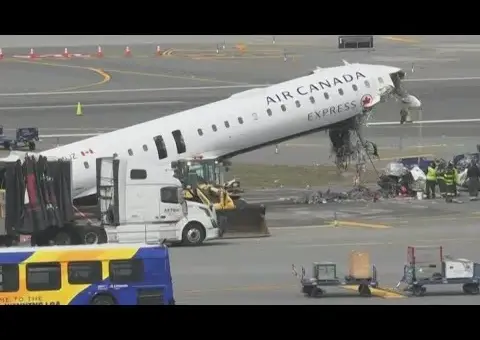
Investigators are examining the final moments before a fatal crash at LaGuardia Airport, where an Air Canada jet collided with a fire truck. Key focuses include air traffic control communication, the failure of runway safety systems, and the absence of a transponder on the fire truck. The cockpit voice recorder reveals a pilot control transfer just before impact.

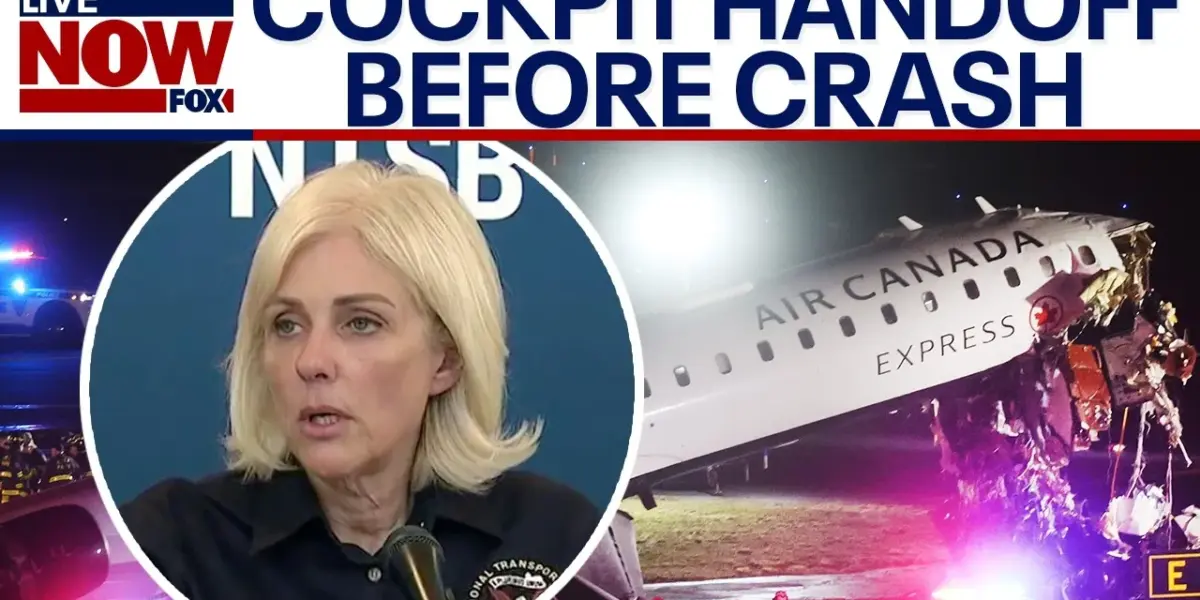
NTSB Probes LaGuardia Crash: Runway Handoff, Missing Alerts Under Scrutiny
In the wake of a fatal collision at LaGuardia Airport, investigators are piecing together the final, chaotic seconds leading to the crash between an Air Canada jet and a fire truck. The National Transportation Safety Board (NTSB) revealed crucial details Wednesday, including that an air traffic controller cleared the fire truck to cross the runway just moments before the aircraft landed. The cockpit voice recorder has provided a timeline of events, highlighting a pilot control transfer just seconds before impact.
Conflicting Information and System Failures
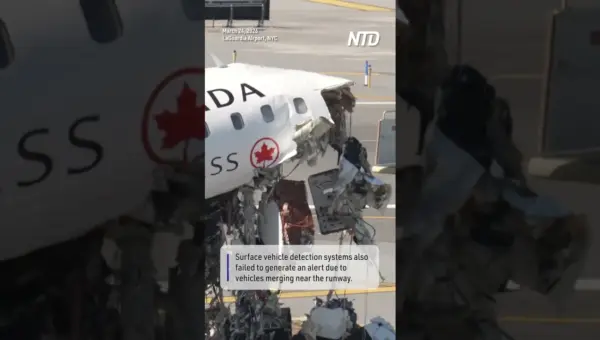
Investigators are working through conflicting and inconsistent information from various logs and reports. “We do have logs but there’s also conflicting information including dates and times on the logs,” an official stated. The runway safety system, designed to alert about potential collisions, failed to trigger an alarm. Compounding this, the fire truck involved in the crash was not equipped with a transponder, a device that would have connected it to the runway safety system and alerted controllers to its presence.
Tower Staffing and Fire Truck Protocols Questioned
The incident occurred while two controllers were on duty in the tower during an overnight shift. One was a local controller, and the other was the controller in charge. However, it remains unclear which controller was specifically responsible for ground control at the time. Both were reportedly at the beginning of their shift. Investigators are also examining why other fire trucks in a caravan held back while the lead truck proceeded, and why the truck that crashed apparently did not respond to repeated stop orders from air traffic control. Firefighters had reportedly received clearance to cross the runway about 20 seconds before the collision.
Expert Concerns Over Staffing Levels
An aviation expert told Fox 5 that the mandated two controllers might not be sufficient for an airport as busy as LaGuardia, even during off-peak hours. “Just because there were two people up there, it doesn’t mean that there could have been a controller using the bathroom or something or taking a 15-minute break or something,” the expert explained. “They’re not going to work straight, obviously, straight through 8 hours with two people up there. For these airports, I think you need more than two people.” The absence of a transponder on the lead fire truck is also expected to be a significant focus of the ongoing investigation.
The Final Seconds: A Timeline of Tragedy
The NTSB detailed the sequence of events leading up to the crash based on the cockpit voice recorder. At 54 seconds before impact, the flight crew acknowledged being 500 feet above the ground on a stable approach. Truck 1, the fire truck, made a radio transmission to the tower. At 26 seconds, the tower acknowledged this transmission. At 25 seconds, Truck 1 requested to cross Runway 4, and the tower cleared it to do so. However, the tower then instructed Truck 1 to stop. At 8 seconds before impact, the sound of the airplane’s landing gear touching down was recorded. Six seconds before impact, a pilot transfer of controls occurred, with the co-pilot handing over to the captain. At 4 seconds, the tower issued another stop instruction to Truck 1. The recording ended at 0 seconds, coinciding with the moment of impact.
Pilot Actions and Potential for Survival
Investigators are still determining if the two firefighters heard the stop directives. The NTSB chair also noted that it is unknown if the pilots saw the fire truck on the runway. A former pilot suggested that the transfer of control from the co-pilot to the captain at touchdown may have been an instantaneous reaction to seeing the truck. “The pilots themselves took the brunt of that impact and they shifted control from the co-pilot to the captain instantaneously upon touching down,” the pilot explained. “So I think the captain saw the truck out in front. Probably said my aircraft or didn’t have time to even say that. Just slammed on the brakes.” He added that the pilots’ quick braking likely saved the lives of others on board.
A System Designed with Layers of Safety
The NTSB emphasized that aviation systems are designed with multiple layers of defense. “Our aviation system is incredibly safe because there are multiple multiple layers of defense built in to prevent an accident,” an investigator stated. “So, when something goes wrong, that means many many things have gone wrong. And so here, that’s why we’re here. We’re here to prevent this from reoccurring.” The investigation’s next phase involves interviewing air traffic controllers and the firefighters who were on duty during the incident.
Broader Implications and Future Recommendations
The NTSB’s findings are expected to take several months to complete. The investigation aims to identify all contributing factors and develop recommendations to prevent similar disasters at LaGuardia and other airports. The incident underscores the critical importance of clear communication, functioning safety systems, and adequate staffing in air traffic control. The fact that the fire truck was responding to another aircraft’s emergency adds another layer of complexity to the investigation, highlighting the coordination challenges during simultaneous incidents.
Source: LaGuardia plane crash: Last seconds reveal cockpit handoff before aircraft hit fire truck (YouTube)

Related Articles
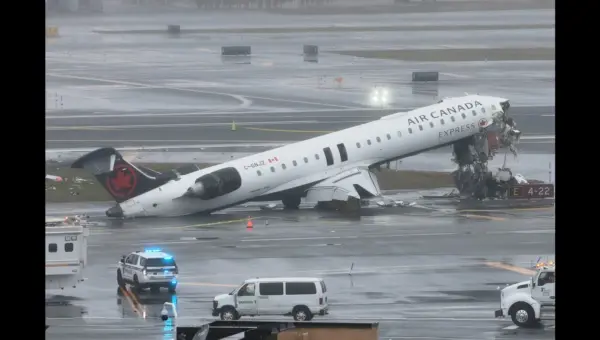
LaGuardia Runway Reopens After Deadly Crash, Safety Lapses Exposed
LaGuardia Airport's main runway has reopened after a fatal crash involving an Air Canada Express jet and a fire truck. The incident, which killed two pilots, exposed critical failures in airport safety systems, including ground surveillance and transponder use.
Air Safety Fears Soar After Deadly Crash
A fatal crash at LaGuardia Airport has triggered a national review of air safety, revealing a pattern of close calls and communication issues at U.S. airports. Investigators are examining technology and staffing, as calls grow for urgent safety upgrades.
Missing Transponder Fueled LaGuardia Near-Disaster
A fire truck lacking a crucial transponder was involved in a near-collision at LaGuardia Airport. The NTSB is investigating this and other issues, highlighting potential gaps in ground vehicle safety protocols. This incident serves as a stark reminder of the importance of technology in preventing airport accidents.