TSA Agents Quitting Amid Shutdown; LaGuardia Crash Underway
TSA agents are quitting due to missed paychecks amid a federal funding fight, leading to long airport lines and the deployment of ICE agents for support. Meanwhile, the NTSB is investigating a deadly crash at LaGuardia Airport involving an Air Canada jet and a fire truck, while President Trump has postponed U.S. strikes on Iran amid conflicting reports about potential negotiations.


DHS Funding Fight Sparks Airport Chaos, ICE Agents Deployed
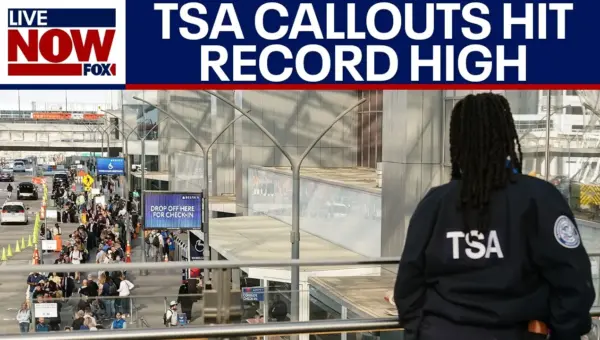
A months-long federal funding dispute is causing significant disruptions at U.S. airports, with Transportation Security Administration (TSA) agents calling out and quitting in record numbers due to missed paychecks. The ongoing partial government shutdown has led to increasingly long security lines, particularly as the busy spring break travel season gets underway.
In an attempt to alleviate the growing problem, President Trump announced the deployment of U.S. Immigration and Customs Enforcement (ICE) agents to assist at major airports across the country. These agents are tasked with helping TSA staff with crowd control and identification checks, though their ability to operate the specialized screening equipment is limited.
Despite the challenges, a glimmer of hope emerged overnight. A small group of Senate Republicans met with President Trump at the White House, and some emerged sounding optimistic about a potential agreement on Homeland Security funding. Senator Katie Britt of Alabama suggested that a solution might be within reach, stating that efforts would continue through the night to find a resolution.
The core of the funding impasse lies in disagreements over immigration enforcement. Democrats have refused to allocate additional funds to Immigration and Customs Enforcement (ICE) and Border Patrol without significant changes to immigration policies. They propose separating funding for agencies like FEMA and the TSA from broader border security measures.
Meanwhile, President Trump has been pushing Republicans to tie Department of Homeland Security (DHS) funding to stricter voter identification laws, as outlined in the “Save America Act.” Democrats have labeled this a non-starter, making a bipartisan agreement difficult to achieve.
The situation is further complicated by the confirmation of Oklahoma Republican Senator Markwayne Mullin as the new Secretary of Homeland Security. Mullin, who is set to be sworn in soon, faces the immediate challenge of resolving the shutdown. While he has relationships within the Senate that could prove beneficial, Democrats have made it clear their concerns are with DHS policy, not personnel, and are skeptical that Mullin, a close Trump ally, will be open to the policy changes they demand.
LaGuardia Airport Crash Investigation Intensifies
The National Transportation Safety Board (NTSB) is leading the investigation into a horrific collision at New York’s LaGuardia Airport. An Air Canada jet crashed into a Port Authority fire truck late Sunday night, resulting in the deaths of two pilots and injuries to dozens of others.
Investigators have obtained audio from the air traffic control tower, providing crucial insights into the moments leading up to the crash. Surveillance video also captured the chilling impact. NTSB Chair Jennifer Hammond stated that 25 specialists are on the ground, meticulously inspecting the aircraft and the debris field.
The flight data recorder and cockpit voice recorder have been recovered and sent to the NTSB lab in Washington D.C. Hammond confirmed that both recorders were preserved and undamaged, which is critical for the investigation. The NTSB is also gathering all available surveillance footage and interviewing witnesses.
Questions remain about staffing levels in air traffic control on the night of the incident, but the NTSB has not yet released that information, stating it is part of the ongoing probe. A press conference is expected later today.
The crash has caused significant disruption at LaGuardia, one of the nation’s busiest airports. The FAA anticipates reopening one of the two runways by Friday, but hundreds of flight cancellations have already occurred, and fewer flights are expected for several more days. The plane remains on the tarmac.
Victims and Survivor of LaGuardia Crash Identified
Details are emerging about the pilots who tragically lost their lives. One of the pilots has been identified as Antoine Foray, who, according to his Facebook page, graduated in 2013, making him approximately 30 years old. The other pilot, Mackenzie Gunther, was honored by his alma mater, Seneca Polytechnic, where he graduated with honors from the aviation program. Flags will be flown at half-mast on campus.
The flight attendant, Solange Tremblay, miraculously survived the crash. She was found several hundred feet from the aircraft after being ejected from her jumpseat. Her daughter reported that Tremblay suffered multiple fractures to one leg and required surgery but is expected to recover, attributing her survival to a “guardian angel.”
Travel Expert Offers Advice Amid Airport Delays and Crash Disruptions
In light of the ongoing TSA shortages and the LaGuardia crash, travel expert Katie Dunn Castro of Going.com provided advice for travelers facing potential disruptions.
Regarding the LaGuardia crash, Castro noted that the airport, with only two runways, will take an estimated four to five days to clear the debris. This will continue to affect flight operations, especially with spring break travelers still active. She advised travelers to opt into all forms of communication from their airline and to check social media for real-time updates.
For those heading to airports dealing with TSA delays, Castro stressed the importance of arriving much earlier than usual. She recommended checking airport websites and social media channels directly for the most up-to-date information on wait times and terminal status, including whether TSA PreCheck or CLEAR are fully operational.
Castro also touched on airport etiquette, urging patience and kindness towards TSA officers who are working under difficult circumstances. She advised travelers to be prepared, have their belongings organized, and pack their patience, acknowledging that the situation is stressful for everyone involved.
Trump Postpones Iran Strikes Amid Conflicting Reports
President Trump announced a surprising postponement of U.S. strikes against Iranian energy sites, citing “productive conversations” aimed at ending the conflict. However, Iranian officials quickly downplayed this claim, stating that no direct talks had occurred and accusing the U.S. of attempting to buy time and lower energy prices.
The announcement initially caused oil prices to drop, but strikes continued across the Middle East. Israel’s Defense Forces reported strikes in central Israel, though with remarkably few injuries, largely due to effective early warning systems and widespread safe rooms.
Israeli officials indicated they would follow President Trump’s directive regarding Iranian energy installations, but expressed skepticism about any negotiated deal, suggesting they were not aware of such talks. This follows a pattern where Israeli responses have sometimes contradicted U.S. pronouncements about de-escalation.
Semi-official Iranian news reported that energy facilities in Iran were struck, adding to the conflicting narratives. While the U.S. and Israel have targeted Iranian energy facilities, Iran has not yet launched its promised retaliation, a contrast to the tit-for-tat exchanges seen over the weekend.
Washington Weighs In on Iran Diplomacy and Potential Regime Change
From Washington, NBC News political reporter Megan Leibowitz discussed the U.S. perspective. President Trump suggested that if the pause on strikes went well, the conflict could be settled. He declined to name the specific Iranian individuals involved in the discussions, referring to them only as respected figures, not the Supreme Leader.
On the U.S. side, Special Envoy Steve Witkoff and President Trump’s son-in-law, Jared Kushner, are reportedly involved in these discussions. President Trump also floated the possibility of using U.S. troops to secure Iran’s enriched uranium, a statement that contrasts with previous assurances that no U.S. troops would be deployed on the ground.
The timing of these developments coincided with the expiration of President Trump’s deadline for Iran to open the Strait of Hormuz. He expressed optimism about the strait’s potential reopening and even suggested joint control by the U.S. and Iran. Notably, President Trump also mentioned the possibility of “serious regime change” in Iran, a statement that has drawn attention given previous U.S. official positions against regime change wars.
Israeli Prime Minister Netanyahu spoke with President Trump, acknowledging an opportunity to leverage military achievements for an agreement that would safeguard vital interests. White House Press Secretary Karoline Leavitt described the situation as very fluid, declining to provide specifics on future U.S.-Iran discussions.
Expert Analysis: Iran Conflict and Global Opinion War
Joel Rubin, former Deputy Assistant Secretary of State, offered analysis on the situation. He suggested that Iran is experiencing internal power struggles, with figures like Mohammad Ghalibaf potentially involved in backchannel diplomacy through allied nations like Egypt, Pakistan, and Turkey. Rubin emphasized that the conflict is also a “war on global opinion” alongside the fighting on the ground.
Rubin believes President Trump is seeking an “off-ramp” to claim measurable goals, such as addressing Iran’s ballistic missile program and nuclear file. However, he noted that Iran’s current stance does not indicate a willingness to de-escalate, suggesting the conflict is likely to continue in its current stage.
Regarding regime change, Rubin explained that there is no single model, and while Iran’s leadership has been “decimated,” the population has not yet engaged in mass protests. He concluded that while the regime is “seriously wounded” and destabilized, it remains in place, and any potential change would likely not resemble interventions in Iraq or Afghanistan.
Hawaii Grapples with Devastating Floods and Costly Recovery
Hawaii is beginning the arduous task of cleaning up after experiencing some of the worst flooding in decades. Days of heavy rainfall caused widespread damage, with estimated costs expected to exceed $1 billion. Residents are also concerned about the risk of further mudslides.
Surging floodwaters swept through communities, destroying homes and leaving families to deal with the aftermath. Many residents, including Erin Burnett and her family, had to be rescued by surfboards, finding their homes in ruins.
Some residents are questioning the timing and effectiveness of official warnings. They report that sirens were activated too late, leaving them with insufficient time to evacuate. Officials stated sirens were activated shortly after 4 a.m., but residents claim this was hours after the danger had become apparent.
West Coast Heatwave and National Weather Contrasts
The nation’s weather remains a mixed bag. While parts of the Northeast and Great Lakes are experiencing chilly conditions with temperatures feeling much colder than average, the West Coast is bracing for record-breaking heat.
New York City is feeling like 27 degrees, and Detroit like 23 degrees, with little improvement expected throughout the day. Temperatures are running below normal along the East Coast, with cities like Brunswick and Columbia seeing highs in the 60s, and Boston only reaching 46 degrees.
In stark contrast, the West Coast is on track to experience significant heat, with temperatures expected to break records. Angie Lassman will provide the full forecast.
Music’s Power to Unlock Teenage Memories
A fascinating report suggests that a person’s favorite songs from their teenage years could be the key to unlocking significant memories. Researchers believe that the music we listened to during formative years often becomes deeply intertwined with our most important life experiences.
The phenomenon is so potent that people can often recall lyrics decades later, regardless of how much time has passed. This connection highlights the powerful role music plays in memory formation and retrieval.
Source: Morning News NOW Full Episode – March 24 (YouTube)

Related Articles


LaGuardia Runway Reopens After Deadly Crash, Safety Lapses Exposed
LaGuardia Airport's main runway has reopened after a fatal crash involving an Air Canada Express jet and a fire truck. The incident, which killed two pilots, exposed critical failures in airport safety systems, including ground surveillance and transponder use.
TSA Workers Get Paid After Record Absences
TSA agents will finally receive paychecks after working nearly six weeks without salary, following a directive from President Trump. Record high absences had strained airport operations and caused significant passenger delays. The situation has sparked calls for better protections for essential workers during government shutdowns.


House Republicans Reject Senate Deal, Sparking Government Funding Clash
House Republicans have rejected a Senate bill to end the government shutdown, citing insufficient border security measures. Congressman Randy Fine called the Senate deal a "disgrace" and highlighted the ongoing fight for full government funding. President Trump's executive order to pay TSA agents offers temporary relief, but the core disagreement over border security continues to paralyze Washington.