Trump’s Iran Move: Genuine De-escalation or Strategic ‘Mind Games’?
President Trump's decision to postpone strikes on Iran is analyzed as strategic 'mind games' rather than simple de-escalation. Expert Nicholas Wright suggests these actions may be aimed at influencing China, leveraging U.S. military prowess against manufacturing dominance. The move highlights ongoing global power dynamics and resource competition.

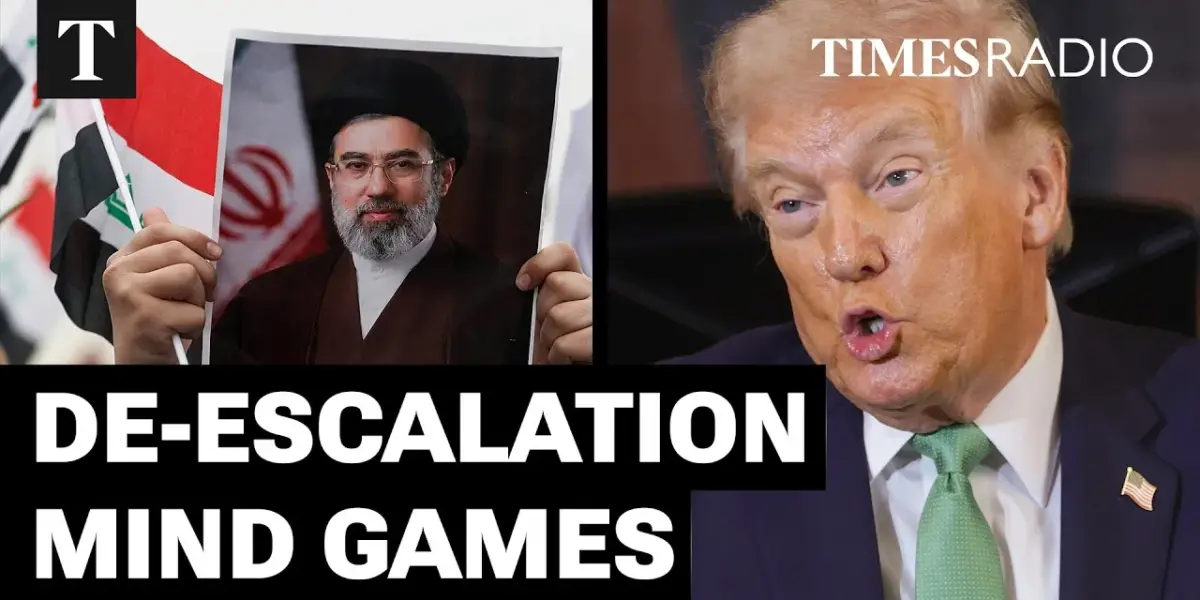
Trump Postpones Iran Strikes Amidst Conflicting Reports
President Donald Trump recently announced the postponement of planned military strikes on Iran’s infrastructure, citing “productive talks.” However, Iran has denied any such discussions took place, accusing the U.S. of attempting to manipulate global oil markets. This situation raises questions about whether the events represent genuine de-escalation or a complex strategic maneuver, often referred to as ‘mind games.’
Expert Analysis: A Battle of Minds, Not Just Missiles
Nicholas Wright, a neuroscientist, former Pentagon advisor, and author of “Warhead: How the Brain Shapes War and War Shapes the Brain,” suggests that the current situation is indeed a form of ‘mind games.’ He explains that in conflicts where neither side can achieve a decisive victory, the focus shifts to influencing the opponent’s decisions. This involves directly targeting the minds of key leaders and the broader decision-making structures within each country.
“Neither side can definitively win. So what they have to do is try and change what the other side is going to choose to do. And that necessarily involves the minds of key leaders.”
The China Factor: Iran as a Proxy Stage?
Wright proposes that the U.S. actions concerning Iran might serve a larger strategic purpose: countering China. He argues that while the Middle East is important, the primary focus for the U.S. administration is currently China. The United States faces challenges against China, particularly in manufacturing, where China holds a significant advantage. Wright suggests that the U.S. can use its advanced military capabilities, which few other nations possess, to build influence and project power. This projection of power, demonstrated in actions like those in Venezuela and Iran, can be seen as a way to bolster its position against China.
U.S. Military Strength vs. Chinese Manufacturing
The U.S. military’s ability to execute complex, high-end operations is highlighted as a key relative advantage. Unlike Russia’s performance in Ukraine, which Wright describes as lacking effective execution, the U.S. demonstrates superior planning and operational capabilities. This is contrasted with China’s manufacturing prowess, which is crucial for sustained warfare. The uncertainty surrounding the Chinese military’s ability to conduct such operations effectively, even to its own leadership, presents an opportunity for the U.S. to leverage its own strengths as a deterrent.
Global Alliances and Economic Implications
The article also touches upon the broader geopolitical and economic consequences of the U.S. approach to Iran. While some argue that U.S. actions have appeared chaotic and have potentially weakened global alliances, Wright offers a different perspective. He points out that five years ago, Iran commanded significant influence through regional proxies like Hezbollah and Hamas. The U.S. actions, he suggests, have exploited a window of opportunity to degrade Iran’s capabilities and weaken its ties to Russia and China.
Oil Markets and Shifting Economic Power
Regarding the impact on oil markets and economies, Wright notes that the U.S. is a significant hydrocarbon exporter due to its advanced fracking industry. This positions the U.S. differently from China, which relies heavily on imports. Therefore, it’s not definitively clear that actions against Iran will harm the U.S. economy more than China’s. Russia’s position is also considered; while China seeks stability for resource access, Russia may benefit from increased turmoil, potentially funding its operations in Ukraine.
A World of Empires, Then and Now
The discussion concludes by reflecting on the nature of global power dynamics. Wright argues that the focus on resources like oil is not an outdated concept but rather a fundamental aspect of international relations that has always existed. He draws a parallel to the Cold War, describing it as a global conflict between superpowers managing quasi-empires. This historical perspective suggests that the current geopolitical landscape, driven by competition for resources and influence, is a continuation of long-standing patterns of global power struggles.
Source: Trump And Iran Deploy ‘Mind Games’ To De-Escalate War (YouTube)

Related Articles


Iran Targets US With Cyberattacks, Escalating Digital Warfare
Iran is increasingly using cyberattacks to challenge the U.S., as seen in a recent hack of the FBI director's account. Experts say this is a strategic shift due to Iran's limitations in conventional warfare. The U.S. needs to strengthen its digital defenses, focusing on encryption and cloud computing, rather than solely relying on traditional security measures.


Iran Hacks FBI Chief, Exposing U.S. Cyber Vulnerabilities
A recent hack of FBI Director Kash Patel's personal email by an Iran-linked group highlights Iran's growing cyber threat to the U.S. Experts explain how simple security oversights are exploited, emphasizing the need for basic defenses like two-factor authentication to protect against propaganda and potential infrastructure attacks.

Ukraine Strikes Russian Oil Refinery, Eyes Iran Threat
Ukrainian forces struck a key Russian oil refinery, disrupting Moscow's war capabilities. Meanwhile, Finland's president urged continued U.S. support for Ukraine, as Kyiv shares its air defense expertise globally amid growing geopolitical complexities involving Iran and potential sanctions against Hungary.