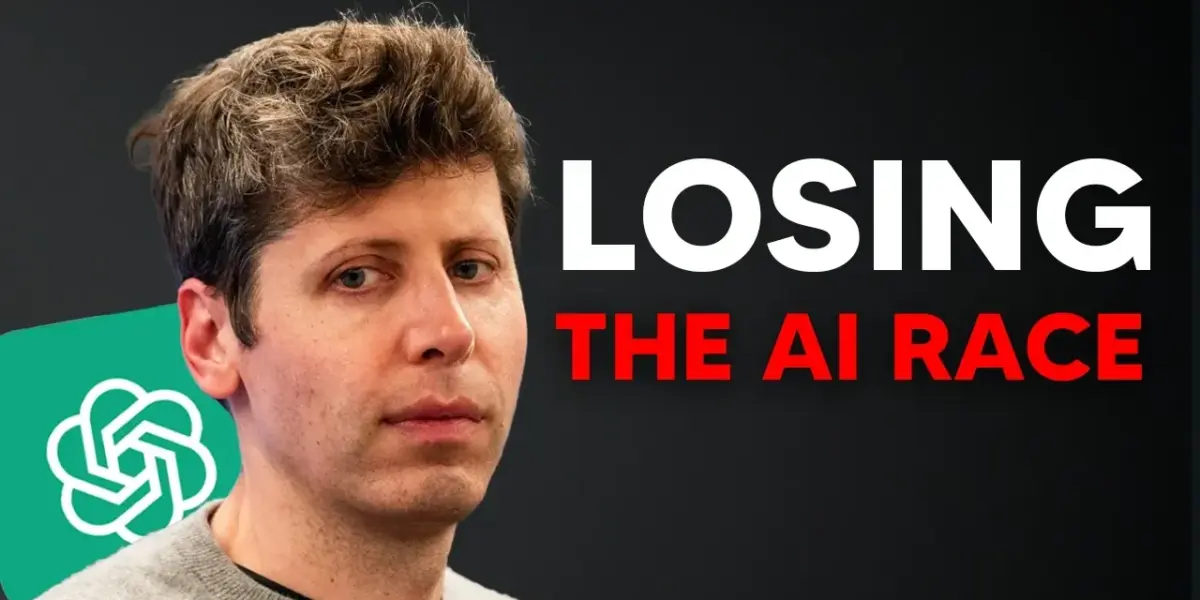
OpenAI’s Lead Evaporates As Rivals Surge Ahead
OpenAI, once the leader in AI, is losing ground to rivals Anthropic and Google. Facing declining market share, massive financial losses, and a loss of public trust, the company's future is uncertain. Meanwhile, Anthropic focuses on enterprise, and Google pushes multimodal AI, positioning themselves for long-term dominance.

OpenAI’s Lead Evaporates As Rivals Surge Ahead
OpenAI, the company that once defined the AI revolution with ChatGPT, is facing a serious challenge. Once the undisputed leader, OpenAI is now scrambling to keep pace with competitors like Anthropic and Google, who have developed more focused and effective strategies. This shift has led to a significant drop in OpenAI’s market share and mounting financial losses.
The “Code Red” Moment
In December 2025, OpenAI CEO Sam Altman sent an internal memo to employees, labeling the situation a “code red.” The message urged the team to halt ongoing projects and concentrate all efforts on saving ChatGPT. This emergency measure highlighted the company’s urgent need to address its declining position in the rapidly evolving AI landscape.
Just three years prior, OpenAI was synonymous with AI. ChatGPT wasn’t just a product; it was the market. Today, however, the company that sparked a massive technological shift is watching its once-dominant lead shrink. This begs the question: how did a company with such a substantial head start, strong brand recognition, and a massive valuation end up in this position?
New Strategies Emerge
The answer lies in the strategic choices made by its rivals. Anthropic, the company behind the Claude AI, focused on serving paying customers like developers and businesses. Google, on the other hand, made a bold bet on multimodal AI. This approach integrates text, vision, audio, video, and code into a single, cohesive AI system.
While Anthropic and Google honed their specific strengths, OpenAI attempted to be everything to everyone, leading to significant financial strain. The core difference is clear: OpenAI created an impressive demo, Anthropic built a strong product for work, and Google established a powerful platform. The gap between a demo, a product, and a platform is at the heart of this story.
OpenAI’s Declining Market Share and Financial Woes
OpenAI’s struggles are evident in its shrinking market share. ChatGPT’s app market share fell from 69% in January 2025 to 45% by January 2026. On the web, its share dropped from nearly 87% to around 65%, a 22-point decrease in just one year.
While OpenAI still boasts around 800 million weekly users, only about 5% of them are paying customers. Each free query costs the company money. Furthermore, its ambitious video generation tool, Sora, reportedly incurred costs of roughly $15 million per day, with its own head admitting the economics were unsustainable. Projections show OpenAI losing $14 billion in 2026 alone, with cumulative losses through 2028 potentially reaching $44 billion and no profits expected until 2029.
Talent Drain and Internal Frustration
The challenges extend beyond finances, with talent departing the company. In 2025, Meta recruited at least seven top researchers for its AI initiatives. Key figures like the Chief Technology Officer, Chief Research Officer, and VP of Research left OpenAI. Sam Altman is now one of only two original founding members remaining.
In early 2026, more senior staff departed, reportedly frustrated that OpenAI was prioritizing short-term fixes for ChatGPT over long-term research. One former employee noted that while OpenAI is still making progress, it faces intense competition from Google and Anthropic, who possess stronger, more unified AI models. This forces OpenAI to constantly play catch-up.
The “Sam Altman Problem” and Reputation Damage
OpenAI’s reputation has also taken a hit, partly due to its CEO. In early 2026, Sam Altman drew criticism for comparing the energy cost of training an AI model to raising a human child. Although he later clarified his remarks, the out-of-context clip went viral, leading to accusations of downplaying AI’s environmental impact and dehumanizing human development.
These controversies are compounded by past allegations from a former OpenAI board member, who claimed Altman withheld information and misrepresented safety processes. For a company seeking global trust with powerful technology, such headlines are damaging.
Product Stumbles and Public Backlash
Recent product launches have also faced criticism. Sam Altman himself admitted the GPT-5 launch was “totally screwed up.” Users described the model as colder and harsher, with some reporting negative impacts on their social interactions. GPT-5.2 experienced issues with writing quality, tone, and translation accuracy.
The decision to partner with the Pentagon in late February 2026 sparked immediate backlash. Following the announcement, ChatGPT uninstalls surged, and app store reviews plummeted. A boycott campaign gained millions of signatures, and many users canceled their subscriptions. In contrast, Anthropic, which refused a similar deal, saw its Claude app climb to the top of the app store.
OpenAI’s head of robotics resigned over the Pentagon deal, citing concerns about surveillance and autonomous weapons. The public’s reaction was clear: a loss of trust that is difficult to regain.
Anthropic’s Focused Growth
While OpenAI has been dealing with internal and external crises, Anthropic has pursued a focused strategy. By concentrating on enterprise clients and coding assistance, Anthropic has experienced remarkable growth. Its annual revenue jumped from $1 billion in late 2024 to $9 billion by the end of 2025, and nearly $20 billion by early March 2026—a nearly tenfold increase year-over-year.
Anthropic’s coding agent alone generated $2.5 billion in annual billings within nine months. Business subscriptions quadrupled in the weeks following January 1st, 2026. Developers are building their workflows around Claude, particularly due to its impressive one million token context window, which allows it to process entire codebases. On real-world coding benchmarks like sbench, Claude Opus leads with 81% accuracy.
Anthropic’s enterprise focus has led to major clients like Devoid, employing 470,000 people. Eight of the top ten Fortune 10 companies are now Claude customers, with over 500 companies spending more than $1 million annually on Anthropic products. The company recently closed a $30 billion Series G funding round at a $380 billion valuation. Analysis suggests Anthropic could overtake OpenAI in total revenue by mid-2026.
Google’s Multimodal Offensive
Google’s approach differs from Anthropic’s depth, focusing instead on breadth with its multimodal AI strategy. The company believes the future of AI involves systems that can understand and process all forms of data simultaneously.
Google’s Gemini 3 Pro, launched in late 2025, marked a turning point. This highly capable multimodal model set new records for visual reasoning and can process high-frame-rate video, understanding spatial relationships and converting long-form video into structured code. This allows Gemini to extract knowledge, generate summaries, and even build applications based on video content.
In March 2026, Google released Gemini Embedding 2, its first natively multimodal embedding model. This infrastructure-level AI maps text, images, video, audio, and documents into a single space, reshaping industries behind the scenes. Gemini’s user numbers reflect this success, growing from 350 million monthly active users in early 2025 to over 750 million by year-end. Its app market share doubled, and web traffic surpassed two billion monthly visits.
A potential partnership with Apple to embed Gemini into Siri could expose the AI to 2.5 billion active devices, dwarfing OpenAI’s reach. Unlike OpenAI, Google can afford to invest heavily in AI without immediate profitability, as its vast revenue stream supports long-term development. Google is also quietly expanding its defense sector involvement and building foundational multimodal technology for future AI applications.
Why This Matters
OpenAI’s path to an Initial Public Offering (IPO) is contingent on justifying its massive valuation and showing investors a clear route to $200 billion in annual revenue by 2030. This requires a fifteenfold increase from its current standing, at a time when its market share is declining, costs are soaring, and competitors are growing faster.
If OpenAI falters, the consequences will be widespread. Microsoft, which has invested billions in OpenAI, would need to find new AI solutions. The startup ecosystem reliant on OpenAI’s API would face significant uncertainty. The narrative of a small startup out-innovating tech giants would be challenged.
Historically, companies that ignite a revolution don’t always lead the subsequent market. Netscape pioneered the web browser, but Google came to dominate it. OpenAI sparked the AI revolution with its chatbot, but the question remains whether it can maintain its lead or will be remembered as the company that started it all but couldn’t hold on.
Anthropic has built a powerful engine for the enterprise market, demonstrating focused growth and trust. Google is constructing a multimodal platform, integrating AI across its vast ecosystem and backed by immense financial resources. OpenAI, meanwhile, appears to be still running on the initial spark, a strategy that is proving incredibly costly. The AI race is not about who starts first, but who builds the most effective solution for the right customers, and OpenAI is currently struggling to define its path.
Source: Why OpenAI Is Losing The AI Race (YouTube)

Related Articles

Anthropic’s ‘Mythos’ AI Leaks, Sparking Security Fears
Anthropic's powerful new AI model, Claude Mythos, was accidentally leaked online, raising concerns about its advanced cybersecurity capabilities. While Anthropic emphasizes its role in helping defenders prepare for future AI threats, the leak has also sparked debate about its intentionality and impact on the cybersecurity market.

Sora’s Future Uncertain Amidst AI Video Strife
OpenAI's highly anticipated Sora text-to-video model may be facing internal delays, casting doubt on its public release. This comes as competitors rapidly advance their own AI video generation technologies, intensifying the race for AI supremacy in content creation.

ChatGPT Adds Library Tab, Google Overhauls AI Studio
This week's AI news highlights significant updates from major players. ChatGPT now features a Library tab for easier document management, while Google has overhauled its AI Studio, merging it with an app builder to simplify the creation of multiplayer experiences. We also look at Midjourney V8's performance, user hopes and fears about AI from an Anthropic study, and quick updates from Gamma, OpenAI, and Claude.