Trump’s Iran Threat: Power Plant Strikes Could Wreck Global Economy
Donald Trump's threat to obliterate Iran's power plants if the Strait of Hormuz isn't reopened could trigger devastating retaliation, warns foreign policy expert Sir Robin Niblett. Such an attack risks crippling the global economy and even impacting America's AI sector, he stated. Niblett also discussed Iran's evolving missile capabilities and the strategic importance of Qeshm Island.


Trump’s Iran Ultimatum Sparks Global Economic Fears
Former President Donald Trump has issued a stark warning to Iran, threatening to obliterate its power plants if it does not reopen the Strait of Hormuz within 48 hours. This ultimatum, however, carries significant risks, with experts cautioning that such an action could trigger devastating retaliatory strikes on Gulf states, potentially crippling the global economy and even impacting America’s own burgeoning AI sector.
Expert Warns of Devastating Economic Fallout
Sir Robin Niblett, former director of Chatham House and a foreign policy expert, expressed grave concerns about the potential consequences of Trump’s threat. “If he were to obliterate Iran’s power plants, Iran will do really serious damage to the Gulf,” Niblett stated. He emphasized that this damage would extend to the entire global economy, which, while less critical to the U.S. than to other regions, is still vital for its technological advancements.
Niblett highlighted the interconnectedness of the global economy, noting that even America’s AI revolution, currently a key driver of its economic growth, would suffer. “America relies less on the global economy than many parts of the world, but even its AI revolution… will be badly hit,” he explained. The AI sector’s reliance on imported computer chips from regions like Taiwan and South Korea means that energy and resource disruptions in the Gulf could severely impact this critical industry.
Iran’s Evolving Missile Capabilities
The conflict, now in its fourth week, has seen Iran demonstrate increasingly sophisticated missile capabilities. Niblett pointed to recent strikes, including one targeting an Israeli town near its nuclear reactor and another on Qatar using a ballistic missile that evaded defenses by moving during its trajectory. He noted that this evasive technology is notably being employed more effectively by Russia, suggesting a potential source of technological transfer.
While reports indicate that some of Iran’s long-range missile tests have failed, Niblett acknowledged the difficulty in fully assessing their capabilities. “We don’t know if it can really hit that whole trajectory,” he said, referencing the missiles fired towards Diego Garcia. He suggested that Iran’s testing of such capabilities over vast ocean stretches minimizes immediate risk, as any failures would simply land in the sea.
London and European Cities Unlikely Targets
Concerns have surfaced regarding Iran’s potential to strike European cities, including London. However, Niblett believes such an attack is unlikely. “I would not expect an attack on London or other European cities,” he stated. He reasoned that the UK possesses significant military power and that Iran’s primary focus is regime survival.
Niblett characterized Iran’s attacks as diplomatic statements, carefully calibrated to avoid provoking overwhelming retaliation. “The regime is all about survival, about weighing up their types of attacks such that they’re trying, the Iranians, to calibrate what they do to survive,” he explained. He added that Iran “does not want to be destroyed.”
Strait of Hormuz Standoff Continues
The dispute over the Strait of Hormuz remains a central point of contention. Iran asserts that the strait is open, with ships continuing to transit to destinations like China and India, albeit with fees. However, Iran has restricted passage for vessels linked to the United States or its allies.
Niblett described the situation as a standoff, warning that further escalation by Trump could lead to domestic backlash within the U.S. due to the immense economic damage. He noted the significant $200 billion supplemental defense request before Congress, intended to fund the ongoing conflict and replenish depleted resources.
Taking Qeshm Island: A ‘Last Option’?
Niblett also discussed the potential U.S. military operation to seize Qeshm Island, a move he described as a “very risky operation” but one that could provide significant leverage. Control of Qeshm Island would severely impact Iran’s ability to export oil, thereby cutting off its primary source of revenue.
“Iran can only export its oil from Qeshm Island,” Niblett explained. “And without exporting its oil, it won’t have money coming in.” He suggested that the Iranian regime’s primary concern is survival, and the prospect of widespread domestic unrest following economic devastation is a major threat. “The most dangerous moment for the Iranian revolutionary regime will be when the war stops, depending on the amount of damage that has been done,” he stated.
Amphibious Assault on Qeshm Island
The feasibility of a U.S. amphibious assault on Qeshm Island involves deploying approximately 5,000 Marines with supporting equipment and air cover. Niblett suggested that Iran is unlikely to destroy its own oil infrastructure, unlike Saddam Hussein’s actions in Kuwait during the first Gulf War.
While acknowledging the potential for casualties and the risk of becoming targets from the shoreline, Niblett believes the operation is achievable given the available military assets. He noted that such a move would represent “boots on the ground,” something Trump has previously stated he would avoid, although he predicted Trump would rationalize the decision by emphasizing the protection of the global economy.
Trump’s Legacy and the Risk of Escalation
Niblett expressed concern that Trump might be driven by a desire to secure his legacy, potentially leading him to escalate the conflict rather than seeking de-escalation. “My view is he probably thinks he’s lost the midterms,” Niblett commented, suggesting that Trump’s actions might be influenced by political considerations. He concluded, “What I’m worried is going to chase the rabbit down the hole rather than know when to stop.”
The situation remains volatile, with the potential for further escalation carrying profound global economic implications. The coming days will be critical in determining whether diplomatic solutions can prevail over military action.
Source: Donald Trump Warned Against ‘Last Option’ of Iran Power Plant Strikes | Sir Robin Niblett (YouTube)

Related Articles

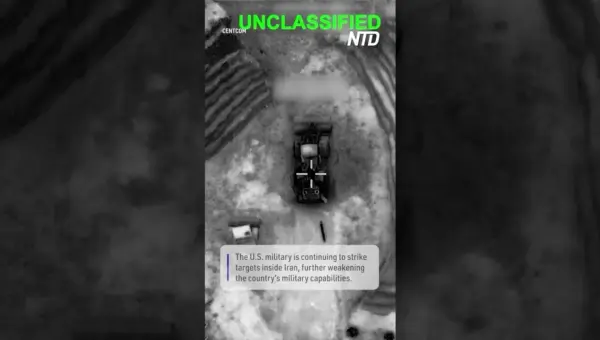
US Strikes Cripple Iran’s Military Might, CENTCOM Reports
U.S. Central Command reports ongoing strikes inside Iran are significantly weakening its military power. This direct action aims to reshape regional security dynamics, but carries risks of escalation. The long-term impact depends on Iran's response and ability to adapt.

U.S. Iran Tensions Rise Amid Shifting Alliances
Rising tensions between the U.S. and Iran are creating a volatile geopolitical situation. With conflicting signals on de-escalation and potential shifts in alliances like NATO and U.S.-Israel relations, the path forward remains uncertain. The global economy and regional stability hang in the balance.


Iran Targets US With Cyberattacks, Escalating Digital Warfare
Iran is increasingly using cyberattacks to challenge the U.S., as seen in a recent hack of the FBI director's account. Experts say this is a strategic shift due to Iran's limitations in conventional warfare. The U.S. needs to strengthen its digital defenses, focusing on encryption and cloud computing, rather than solely relying on traditional security measures.