Baltic Nations’ Mine-Sweeping Skills Crucial for Strait of Hormuz
The Baltic nations' expertise in mine sweeping is highlighted as critical for securing the Strait of Hormuz. President Trump's criticism of NATO allies for not contributing more to operations in Iran underscores global dependencies on the Strait. The situation also impacts US leverage over China and may cause Gulf Arab nations to reassess their ties with China.


Baltic Nations’ Mine-Sweeping Skills Crucial for Strait of Hormuz
President Trump recently criticized NATO allies for not helping more with operations in Iran. He specifically mentioned the Strait of Hormuz, calling it the main reason for high oil prices. Trump stated that without US help, NATO is like a “paper tiger.” He expressed disappointment, saying, “We will remember.”
Several countries have promised to help open the Strait of Hormuz, but actions haven’t followed. The President is looking for concrete support from these allies. Many European countries rejected the request to help too quickly. It would have been better to consider the request and explain the need for debate in democratic countries with parliaments and voters to answer to. These countries also depend on the Gulf for oil and gas, more than the US does.
Trump’s harsh words, not just recently but also about Greenland and Ukraine, have created distance between Washington and its European allies. It’s important for everyone to focus on the current challenge. We need to see if European NATO countries will commit resources like personnel or equipment. The Baltic countries, for example, are very skilled at mine sweeping. This expertise will be needed to secure the Strait of Hormuz. Over time, more countries are expected to make commitments, building a stronger coalition.
It’s also vital for Gulf Arab allies to step up for their own defense. They need to contribute personnel and equipment to the US-led effort. The US itself doesn’t rely heavily on oil from the Strait of Hormuz, with less than 2% of its total oil consumption coming from there. President Trump pointed out that the US doesn’t need the Strait, but Europe, Korea, Japan, and China do. These nations will have to get more involved.
Global Impact and Shifting Alliances
The recent strikes on ships in the Strait of Hormuz have affected global politics. The President is correct that East Asian and European allies depend heavily on oil from the Persian Gulf. While this isn’t a core US interest anymore, the US does have an interest in keeping its allies’ economies strong. Protecting these shipping routes ensures energy supplies for their societies and supports global industrial output. This is part of the alliance system built after World War II, as Asian and European allies cannot protect these lanes alone.
Since the end of the Cold War, European countries have focused more on social programs than defense. This became clear when Russia invaded Ukraine, and Europe asked the US for help. This situation is complex. Russia might benefit if Europe has to reconnect pipelines from sanctioned Russian facilities. However, if Iran is defeated, Russia will lose a key ally in the Gulf. China has benefited greatly from discounted Iranian oil, making up about 10% of its oil imports. China has also used its own currency, the Yuan, to buy this oil, trying to reduce reliance on the US dollar.
If the Strait of Hormuz is reopened, China’s reliance on Iranian oil will decrease. The US military is currently performing very well against Iran. However, political and economic victories are needed. These will come with the regular flow of oil and natural gas out of Hormuz in the coming weeks and months. If this happens, China’s economic model could be significantly impacted, especially after losing oil supplies from Venezuela.
US Leverage and China’s Position
A loss of oil from Iran could significantly affect China’s economy. However, it’s more likely that the US will gain more influence over oil flowing to China. This could be President Trump’s main goal, especially after China threatened to cut off rare earth elements in 2018 when Trump raised tariffs. Rare earth elements are crucial for US defense and technology industries. Many products, from electronics to magnets and semiconductors, rely on these elements from China.
If the summit between President Trump and Chinese leader Xi Jinping is rescheduled, Trump could use this leverage. He could say that if China threatens with rare earth elements, the US can control oil flow to China. This would give Trump more power than if the US had no influence over oil from the Gulf. Furthermore, China might have to use US dollars to buy that oil.
Gulf Nations Reconsider Ties with China
China has invested heavily in Iran for decades. Iran has been attacking oil and gas infrastructure in Gulf nations. China has also been building influence in these same Gulf countries and is closely allied with Iran, even providing weapons technology. Iran’s attacks on civilian infrastructure in Gulf nations could harm relations between these countries and China.
Gulf Arab leaders are likely to seriously rethink their ties with China. They may have believed they were safe from China-backed Iranian attacks on their infrastructure. However, China is now exposed not just as an ally of Iran but also as a strong supporter. China has provided Iran with massive infrastructure, including the Huawei surveillance system. This system has enabled the Iranian regime to suppress its own people. This kind of technology, used for surveillance and control, is what China happily sells to Iran. This sends a negative message to countries like the UAE, Saudi Arabia, Bahrain, and Qatar. It shows that China may not be a reliable partner that has their best interests at heart. This could lead to a significant shift in Chinese diplomacy with these Arab nations, moving in a negative direction due to the China-Iran alliance.
It remains to be seen how these countries will react, especially with Chinese-built infrastructure in some areas. It’s possible they might remove and replace it.
Source: Baltic Nations Extraordinarily Experienced at Minesweeping; US Needs That to Open Strait of Hormuz (YouTube)

Related Articles


US Must Block China’s Tech Access for Security
US national security experts are raising alarms about China's access to advanced AI chips, arguing it threatens strategic advantages. This, coupled with charges against Chinese entities for fentanyl precursor sales and a ban on foreign routers, signals a growing effort to prioritize security over business ties.

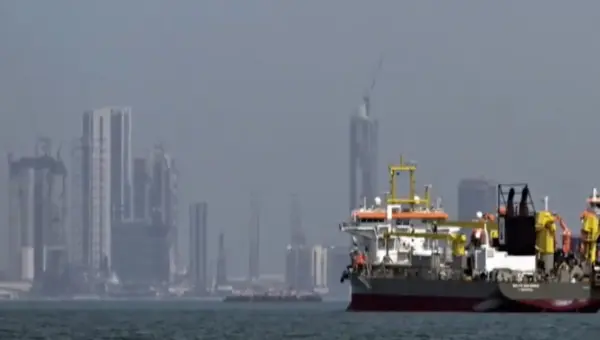
Iran Blocks China Ships, Exposing Beijing’s Weak Grip
Iran's recent decision to block Chinese ships at the Strait of Hormuz is exposing the limits of Beijing's influence in the Middle East. This action is causing delays and cancellations for Chinese manufacturers, turning a perceived geopolitical win into an economic strain.
Rubio: US Can Achieve Iran War Goals Without Troops
Senator Marco Rubio outlined a strategy to counter Iran without deploying U.S. ground troops, focusing on weakening the regime and enhancing maritime security. He also criticized Cuba's economic system and expressed concerns about West Bank violence.