US-UK ‘Special Relationship’ Tested by Historic Disagreements
The historical "special relationship" between the US and UK has seen numerous significant disagreements, from the Suez Crisis to the Vietnam War and the Falklands. These moments highlight how national interests can strain even the closest alliances. As the US pivots focus to Asia, Europe, including the UK, faces the growing need for "strategic autonomy."


US-UK ‘Special Relationship’ Tested by Historic Disagreements
The long-standing alliance between the United States and the United Kingdom, often called the “special relationship,” has faced significant challenges and disagreements throughout history. From the Suez Crisis of 1956 to more recent political tensions, leaders on both sides of the Atlantic have navigated moments of friction, proving the relationship is not always smooth.
The Suez Crisis: A Post-War Rift
One of the most significant early tests occurred in 1956 with the Suez Crisis. Britain, France, and Israel secretly planned to seize the Suez Canal from Egypt. Then-British Prime Minister Anthony Eden defended the action, stating it was necessary to prevent a wider conflict in the Middle East and protect British interests.
“Was it likely to lead to a widespread flare up in the Middle East? In the judgment of the government, it was. Was it likely to endanger widespread British and international interests? It was.”
Anthony Eden, British Prime Minister
However, the United States, under President Eisenhower, strongly disagreed. Lord Derek Kim Darrick, British Ambassador to the US from 2016 to 2019, explained the US opposition. Vice President Nixon noted the hypocrisy of condemning Soviet actions in Hungary while Britain and France acted against international law in Egypt.
“This was, I think, not merely the first big rift post World War II, but arguably the biggest of them all because what you saw was the United Nations, sorry, the United States leading the condemnation of the British, French, Israeli actions in the UN,” Lord Derek recalled. “It was a moment which brought down the then prime minister. And it reminded the UK… that there was nothing guaranteed about the relationship.”
Vietnam War Strains Ties
Later, the Vietnam War created another point of contention. British Prime Minister Harold Wilson resisted intense pressure from US President Lyndon B. Johnson to join the conflict directly. While Australia committed troops, Britain stayed out.
President Johnson reportedly wanted even a small symbolic contribution, with Wilson famously suggesting “a platoon of bagpipers would have been enough.” However, facing opposition from his own party and personal judgment that the US was making a mistake, Wilson refused. This led to a famously poor relationship between the two leaders, with Johnson reportedly calling Wilson “the little creep.” Lord Derek commented, “History would probably say that Wilson was right.”
Grenada Invasion: A Surprise Attack
In the 1980s, the relationship between Margaret Thatcher and Ronald Reagan was often seen as a high point. However, a significant disagreement arose when the US invaded the Caribbean island of Grenada in 1983 without informing Britain beforehand.
President Reagan stated the action was to protect American lives, restore law and order, and prevent further chaos. Despite their close personal ties, Thatcher was reportedly furious. Lord Derek described how Thatcher “famously called him, phoned him up to give him a thorough handbagging for what he had done,” as Grenada’s head of state was the British monarch.
While the incident caused immediate anger, it did not cause lasting damage to the overall relationship, partly due to Reagan’s admiration for Thatcher, even during her tirade.
Falklands War: A Neutral Stance
During the Falklands War in 1982, the US initially adopted a neutral stance, seeking a negotiated settlement. This approach frustrated Prime Minister Thatcher, who felt it did not adequately condemn Argentina’s actions.
The US Ambassador to the UN at the time, Jeane Kirkpatrick, was known for her strong views. While the US eventually supported Britain’s military action, their initial position was a point of friction.
Northern Ireland Peace Process: A Visa Controversy
A different kind of strain emerged in 1994 when US President Bill Clinton granted a visa to Gerry Adams, leader of Sinn Féin. This move angered the British government under Prime Minister John Major, who had been trying to prevent Adams from traveling to the US.
Jamie Rubin, Clinton’s press spokesman, confirmed the visa approval. Lord Derek explained that Major was not only opposed to the decision on principle but also saw it as a significant personal blow to his already struggling premiership. The fallout was so severe that Major reportedly refused to take calls from Clinton for weeks.
Balkans Conflict: Pushing for Intervention
Conversely, during the Balkan conflicts in the 1990s, British Prime Minister Tony Blair pushed President Clinton for greater US involvement. Blair feared a humanitarian catastrophe in Kosovo unless NATO intervened with ground troops.
In a 1999 speech to the House of Commons, Blair outlined the heavy responsibility of military action but stressed the greater consequences of inaction. “But in my judgment, the consequences of not acting are more serious still for human life and for peace in the long term,” he stated.
Despite their “Third Way” political alignment and generally good relationship, Clinton was reportedly angry with Blair’s team for allegedly briefing against him, suggesting he was reluctant to commit ground forces. Lord Derek, who was a press spokesman at the time, confirmed that while not directly from Number 10, there was indeed briefing from within the British government to encourage tougher action.
Post-9/11 and Shifting Alliances
The successes in the Balkans, particularly in Kosovo, and Blair’s advocacy for humanitarian intervention may have emboldened him. This could have influenced his strong support for the US following the 9/11 attacks, leading to the UK’s involvement in Afghanistan and, more controversially, the Iraq War.
Modern Tensions and Strategic Autonomy
Looking at the present day, Lord Derek highlighted concerns about former President Donald Trump’s approach. Unlike previous leaders who might express anger or disagreement, Trump has used economic measures as a tool of coercion.
Furthermore, a fundamental shift is occurring with the US military redeploying resources towards Asia, driven by the challenge of China. This trend, Lord Derek noted, is likely to continue regardless of who wins the US presidency.
“The challenge for all the Europeans, us, but also the mainland Europeans is we’ve basically got to achieve strategic autonomy, be able to look after ourselves,” he concluded. This suggests a future where European nations, including the UK, must increasingly rely on their own capabilities rather than assuming automatic US military support.
Looking Ahead
The history of US-UK relations reveals a dynamic partnership, marked by deep cooperation but also by significant moments of disagreement. As global power dynamics shift, particularly with the US refocusing on Asia, both nations will need to adapt. The concept of “strategic autonomy” for Europe is likely to become a central theme, requiring a redefinition of the special relationship in a changing world.
Source: Not-So Special Relationship: A Breakdown Of Historic Tension Between The US And UK (YouTube)

Related Articles
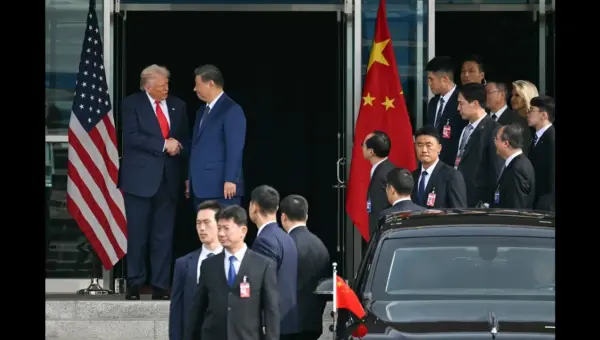
Trump’s “Walk Away” Tactic Signals Tougher Stance on China
Retired Air Force Brigadier General David Stillwell believes President Trump's strategy of being willing to walk away from negotiations puts pressure on China. This tactic, combined with US global actions and strengthened alliances, signals a more assertive American foreign policy.

Trump’s War Talk Stuns Financial Crowd
Donald Trump's recent speech in Miami focused on his foreign policy, particularly his critical views on NATO and his vision for international relations. He declared the U.S. would no longer defend NATO allies, questioned the value of existing alliances, and suggested renaming the Strait of Hormuz. The speech also touched on his personal views of success, his allies, and his perceived role as a global peacemaker.
Trump’s Warpath: New Threats Signal Imperial Ambitions
Recent statements from Donald Trump reveal a potential embrace of increased military action and interventionist foreign policy. This approach, characterized by critics as "imperialism 2.0," contrasts with his past promises of peace and has even drawn criticism from parts of his own base. The implications for U.S. global engagement and domestic priorities are significant.