AI Fuels Russian Propaganda Machine
Artificial intelligence is amplifying Russia's propaganda efforts, making it easier to create convincing fake videos and images. This evolution in disinformation tactics complicates the fight for truth in global conflicts and underscores the need for enhanced media literacy.


AI Fuels Russian Propaganda Machine
Artificial intelligence is rapidly changing how fake news is created and spread, offering powerful new tools to nations like Russia. These advanced technologies are making it easier than ever to produce realistic fake videos and images. This development complicates the already challenging task of discerning truth from fiction in global conflicts and information warfare.
The Evolution of Deception
The use of manipulated images for deception is not new. A century ago, two young cousins, the Hall sisters, famously presented photographs they claimed showed real fairies. These images, taken in 1920, convinced many people of the supernatural. It wasn’t until the 1980s that the sisters admitted the fairies were made from cardboard and the photos were staged. This early example highlights how new technologies, whether photography or AI, can be used to create convincing falsehoods.
The key takeaway from the Hall sisters’ deception is not the quality of the fake, but how easily people believed it. In the early days of photography, trick photography was not widely understood. People were more likely to trust an image because the methods of manipulation were unknown and seemingly impossible. Today, AI offers even more sophisticated ways to create fake content, making it harder for the average person to tell what’s real.
Russia’s History of Information Warfare
Russia has a long history of using manipulated media for propaganda, long before the advent of AI. For years, state-controlled television has been a primary tool for shaping public opinion. Channels like Russia Today often present a carefully curated version of reality, blending news with emotional narratives and staged events. This control over media ensures a consistent message from the Kremlin.
The Russian government under Vladimir Putin has actively worked to consolidate control over television networks. This strategy underscores a deep understanding of the power of visual media. The attacks on television towers in Ukraine are a stark reminder of this focus. Russia’s propaganda efforts are now increasingly directed outward, targeting Western audiences. Domestically, they still employ more traditional methods, such as using AI to create dehumanizing images of Ukrainians, comparing them to animals.
AI as a Propaganda Accelerator
AI has significantly amplified Russia’s propaganda capabilities. While older methods involved staging scenes or taking footage out of context, AI allows for the creation of entirely fabricated scenarios. This includes voice cloning and highly realistic deep fakes. The technology is becoming increasingly accessible, enabling individuals and state actors to produce sophisticated disinformation with relative ease.
The difference between older forms of manipulation and AI-generated content is the speed and scale at which it can be produced. Tools that once required significant technical skill and resources are now available through simple text prompts. This accessibility means that the creation of hyperrealistic fake videos is no longer confined to a few specialists. Anyone with a smartphone and an internet connection can potentially create convincing fake content.
Demonstrating AI Capabilities
Experts have demonstrated the power of modern AI tools. Previously, face-swapping technology produced noticeable glitches and looked unnatural. Videos like the one showing Will Smith eating spaghetti, which went viral in 2023, were considered “cursed” and “cringe” due to their poor quality. However, current AI can now generate videos that are nearly indistinguishable from reality.
Using only text prompts, AI can create high-definition, movie-quality videos featuring individuals like Tom Cruise or entirely fictional characters. These generated videos can be produced in a matter of hours, or even minutes for shorter clips. While some subtle errors might exist upon close inspection, they are often undetectable to the casual viewer, especially older audiences who may be less familiar with AI technology.
Tactics and Exploitation
Russia leverages AI for various propaganda purposes. This includes fabricating battlefield news, such as fake victories or defeats, which can influence real-world military operations and public panic. AI is also used to discredit Ukraine internationally and undermine morale domestically. Videos depicting Ukrainian soldiers begging for help or claiming illegal mobilization have been widely shared, playing on sensitive issues to create negative perceptions.
These AI-generated campaigns are designed to trigger emotional responses rather than withstand factual scrutiny. Even videos with visible AI watermarks can be effective if they evoke the desired emotional reaction. Ukrainian officials report an increase in these types of campaigns, featuring fake soldiers, interviews, and AI-generated influencers designed to mimic legitimate news sources.
Combating Disinformation
The ease with which AI can create fake content raises questions about the authenticity of online media. News organizations must prioritize verification and educate audiences on how to critically assess information. The core question when encountering suspicious content should be: why was this created and shared?
While AI makes deception easier, it does not mean all content is fake. The benefit for propaganda machines like Russia’s lies in fostering a general sense of chaos and distrust. Building societal resilience against disinformation requires strengthening institutional trust and media literacy. Independent journalism plays a crucial role in providing reliable information in a complex media environment.
Strategic Implications
The proliferation of AI-generated disinformation poses a significant threat to global stability and democratic processes. It erodes trust in institutions and makes it harder for citizens to make informed decisions. The ability to create convincing fake videos on demand means that propaganda can be tailored and deployed with unprecedented speed and efficiency.
Russia’s use of these tools is not about creating new problems but exploiting existing societal divisions and weaknesses. In countries with lower levels of institutional trust, Russian disinformation campaigns tend to be more effective. Addressing this requires a broader societal effort to rebuild trust and promote critical thinking, alongside efforts to counter specific disinformation campaigns.
Conclusion
AI is a powerful tool that can be used for both constructive and destructive purposes. In the context of information warfare, it serves as a potent accelerant for propaganda. While the technology itself is neutral, its application by state actors like Russia highlights the urgent need for enhanced media literacy and robust verification mechanisms. The battle for truth in the digital age is becoming increasingly complex, underscoring the vital importance of credible journalism.
Source: How AI is supercharging Russian propaganda | Ukraine This Week (YouTube)

Related Articles
Russia Targets Estonia With Disinformation in Border City
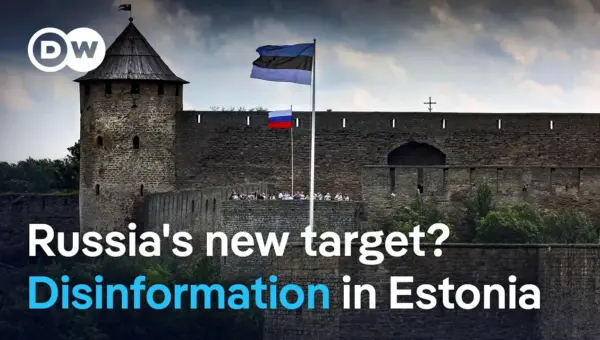
Russia is reportedly conducting a disinformation campaign targeting Estonia's border city of Narva, aiming to sow discord among its Russian-speaking population. The online operation promotes separatist ideas, though residents largely dismiss the claims as fake. Estonian authorities view the campaign as a low-cost effort to undermine trust, with no concrete evidence of direct Russian government involvement.


US & Iran at ‘Inflection Point’ as Global Energy Markets Threatened
Global tensions have reached a critical 'inflection point' as Iran's actions threaten energy markets and vital shipping lanes. While the US military reports progress on its objectives, diplomatic uncertainty and global economic impacts loom large. Experts discuss the challenges of reopening key waterways and the broader threat of disinformation campaigns.

AI News Anchors: A Threat to Truth in Reporting?
The increasing use of AI-generated news anchors raises concerns about media authenticity and public trust. While AI offers convenience, it risks sacrificing accuracy and can be exploited for propaganda, blurring the lines between real and fake reporting.