Trump Threatens ICE Deployment to Airports
President Trump has threatened to deploy ICE agents to U.S. airports if Democrats do not agree to fund the Department of Homeland Security. This statement, linked to debates over immigration and the "SAVE Act," is seen by critics as inflammatory and unlikely to be carried out. The conversation also addressed escalating tensions with Iran and the critical role of the Strait of Hormuz.


Trump Threatens ICE Deployment to Airports
President Donald Trump has issued a strong warning on social media, stating he would deploy U.S. Immigration and Customs Enforcement (ICE) agents to airports if Democrats do not agree to fund the Department of Homeland Security (DHS). This move comes amid ongoing debates about border security and immigration policy, sparking significant discussion about its potential impact and feasibility.
Details of the Threat
In a post on Truth Social, Trump declared, “If the radical left Democrats don’t immediately sign an agreement to let our country, in particular our airports, be free and safe again, I will move our brilliant and patriotic ICE agents to the airports where they will do security like no one has ever seen before.” He further specified that this would include “the immediate arrest of all illegal immigrants who have come into our country,” with a particular focus on those from Somalia. He blamed Governor, Attorney General, and Congresswoman Ilhan Omar for the situation in Minnesota, stating they have “destroyed the once great state.” Trump concluded the post with “I look forward to seeing ICE in action at our airports. Make America Great Again.”
Analysis of the “SAVE Act” and Broader Issues
The statement is linked to the ongoing debate over the “SAVE Act,” which is presented by proponents as a measure to secure the voting system. However, critics argue that the act is a collection of unrelated provisions. Geraldo Rivera, a NewsNation correspondent, described the SAVE Act as a “grab bag” of issues from various political viewpoints, including voter ID, transgender rights, and girls’ sports. He called the bundling of these distinct topics into one bill “insulting” and suggested it makes it difficult for Democrats to support. Rivera emphasized that the primary goal should be ensuring only citizens vote in federal elections, a point already covered by existing law. He proposed simplifying the process by focusing on free, government-offered photo IDs for all citizens, rather than including unrelated social issues in the voting legislation.
ICE’s Role and Public Perception
Rivera characterized Trump’s threat to deploy ICE agents to airports as “bogus and insulting.” He pointed out that ICE is currently one of the least popular law enforcement agencies in the U.S. He referenced recent events in Minneapolis, where ICE reportedly faced conflict with the public and was asked to leave the area. Rivera suggested that deploying ICE agents to airports, especially after such incidents, would create unnecessary conflict with the American public. He viewed the threat as “empty rhetoric” that is unlikely to materialize and compared it to the fable of the boy who cried wolf.
Geopolitical Tensions: Iran and the Strait of Hormuz
The discussion also touched upon the escalating tensions with Iran. Rivera noted that while Trump initially called for Iranians to take control of their government, his administration later stated that regime change was not a primary goal. He expressed concern about the potential for a major escalation in the Middle East, drawing parallels to past conflicts. Rivera described the situation as a cycle where military deployments often lead to a surge of optimism that the current action will resolve the issue, only for the conflict to continue.
Regarding the Strait of Hormuz, a vital waterway for global oil transport, Rivera acknowledged it as an international problem. He criticized the response from allies like Italy, France, Germany, and Japan, stating that sending “stern letters” to Iran is meaningless. He argued that the United States bears the burden and must take decisive action, comparing it to how Houthi rebels were dealt with in the Red Sea. However, he cautioned against a purely military approach, suggesting that escalating bombing campaigns or assassinations would not end the war or lead to stable negotiations. Instead, he proposed focusing on Iran’s nuclear program and enriched uranium, advocating for a more targeted strategy rather than broad military escalation.
Economic and Political Ramifications
The potential for prolonged conflict raises economic concerns. Rivera mentioned that the stock market has already seen a decline, impacting retirement savings. He stressed the need for measured, bipartisan support to address these complex issues. He suggested that Trump could use his popularity with his base to foster cooperation on critical matters like funding the TSA, rather than using divisive tactics like threatening ICE deployments.
Future Scenarios
The deployment of ICE agents to airports, as threatened by Trump, appears unlikely according to Rivera, who views it as political posturing. The situation with Iran remains volatile, with a risk of further escalation if diplomatic solutions are not found. The effectiveness of international cooperation in resolving the Strait of Hormuz crisis is also in question, with the U.S. likely facing the primary responsibility. The overall political climate suggests a continuation of partisan divides, making bipartisan solutions to pressing issues challenging.
Source: Trump’s threat to send ICE to airports across US ‘bogus and insulting': Rivera | NewsNation Live (YouTube)

Related Articles


US Cardinal’s Papal Upset Redraws Vatican Influence
Pope Francis's election defied expectations, including his own, as an American cardinal believed an "American" Pope was unthinkable. The swift conclave surprised many, highlighting the unpredictable nature of papal selections and signaling a potential shift in the Church's global direction.

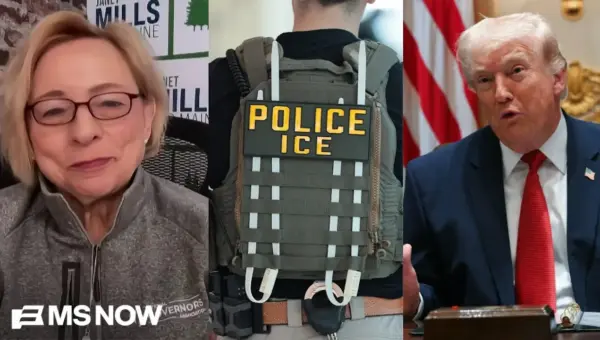
Maine Governor Vows to Block ICE at Polling Places
Maine Governor Janet Mills has declared she will "over my dead body" block any federal attempt to place ICE officers at polling locations. She vowed to protect the voting rights of Mainers and uphold democratic principles against perceived federal overreach and intimidation tactics. Her strong stance highlights concerns about potential voter suppression and the importance of preserving free and fair elections.

Bannon’s Airport Plan Hints at Election Intimidation Tactics
Steve Bannon suggested using ICE presence at airports as a 'test run' for deploying agents at 2026 midterm polling stations. This controversial idea raises concerns about voter intimidation and the potential suppression of legitimate votes, particularly among minority communities. Critics question the premise and highlight the legal and ethical implications of such tactics.