OpenAI’s GPT 5.2: A Leap in AI Performance, But Questions Remain
OpenAI has launched GPT 5.2, showcasing significant performance gains on various benchmarks, including claims of human-expert level capabilities. The release highlights advancements in knowledge work and long-context recall, while also raising discussions about the role of computational resources in benchmark results and direct model comparisons.

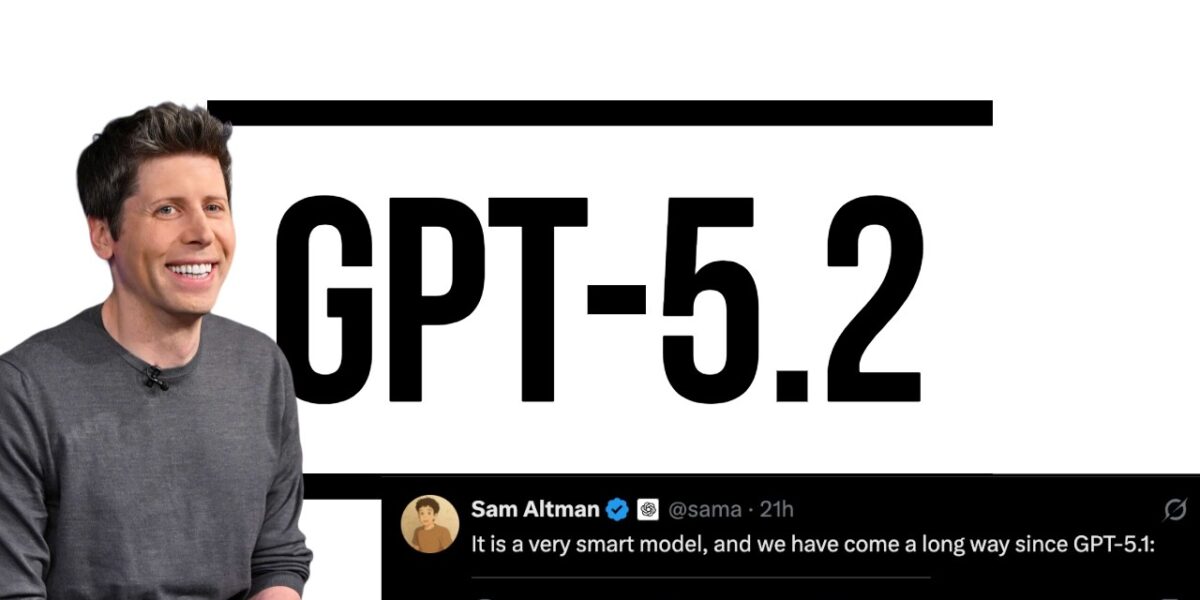
OpenAI Unveils GPT 5.2, Setting New Benchmarks But Sparking Debate
OpenAI has once again captured the AI world’s attention with the release of its latest model, GPT 5.2. The announcement, accompanied by a suite of record-breaking benchmark results, positions GPT 5.2 as a significant advancement in large language model (LLM) capabilities. However, beneath the impressive performance figures lie nuanced discussions about the nature of AI progress, the methodologies of benchmarking, and the true cost of achieving state-of-the-art results.
GPT 5.2 Claims Human-Expert Level Performance
A central claim surrounding GPT 5.2 is its performance on the GDP-Vow benchmark, which assesses specialized knowledge work tasks across 44 occupations. OpenAI asserts that GPT 5.2 is the first model to perform at or above a human expert level on this benchmark, outperforming or tying top industry professionals in 71% of comparisons. This benchmark, curated by industry experts, focuses on digital-first professions and provides models with full task context beforehand. While this indicates a remarkable leap in AI’s ability to handle complex, knowledge-intensive tasks, it’s crucial to understand the benchmark’s specific parameters. The evaluation excludes tasks requiring significant tacit knowledge—information that is difficult to articulate or transfer—and does not heavily weigh the impact of catastrophic errors, a factor that can be critical in real-world applications.
The Role of “Thinking Time” in AI Performance
A recurring theme in the analysis of GPT 5.2’s performance is the concept of “thinking time,” or the computational resources allocated to a model for generating a response. This is often measured by the number of tokens processed or the “test time compute” used. OpenAI’s own researchers acknowledge that benchmark results are increasingly influenced by these factors. For instance, on the ARG1 benchmark, designed to test fluid intelligence, performance consistently improves with increased token or dollar expenditure. GPT 5.2, particularly in its “extra high reasoning effort” configuration, achieves over 90% on ARG1. However, this highlights a challenge in direct model comparison: is a higher score a reflection of a fundamentally superior model, or simply a result of more extensive computation?
This “thinking time” factor also affects accessibility. While the highest-performing versions of GPT 5.2 may require substantial computational resources, more accessible versions, like the one available on the standard ChatGPT tier, have a smaller token budget and less “thinking time.” This can lead to differences in capability, as demonstrated when GPT 5.2 on the standard tier could generate accurate results but not the complex interaction matrix created by its more powerful counterpart.
Benchmarking Battles: GPT 5.2 vs. Competitors
The competitive landscape of AI development means that direct comparisons between leading models are keenly watched. While OpenAI previously demonstrated intellectual honesty by comparing its models against competitors like Claude Opus 4.1, the GPT 5.2 release notably omits direct comparisons with current top-tier models such as Claude Opus 4.5 and Gemini 3 Pro. This has spurred independent analyses and “cheeky” comparisons from industry figures.
For example, while OpenAI showcased GPT 5.2’s motherboard segmentation capabilities, Logan Kilpatrick of Google (formerly of OpenAI) countered with Gemini 3 Pro’s superior segmentation of the same image, highlighting Gemini 3 Pro’s continued strength in multimodal understanding. Similarly, on benchmarks like MMU Pro for chart and table analysis, Gemini 3 Pro achieved a slightly higher score (81%) than GPT 5.2 (80.4%). Conversely, on a newer benchmark, Charchive Reasoning, GPT 5.2 demonstrated a significant lead (88.7% vs. 81%). These divergent results underscore the difficulty in selecting a single, definitive benchmark for evaluating complex AI capabilities.
Efficiency and Cost Improvements
Despite the intense computational demands for peak performance, the AI industry continues to see improvements in the price-performance ratio. OpenAI notes a 390 times efficiency improvement in cost-performance compared to models released a year prior. Furthermore, the API pricing for GPT 5.2 has been described as “admirably restrained,” remaining cheaper than Claude Opus for input tokens and competitive with Gemini 3 Pro. This focus on efficiency is critical for making advanced AI capabilities more accessible to a wider range of users and developers.
Long Context and Memory Recall
One of GPT 5.2’s standout capabilities is its enhanced ability to recall details across long contexts. OpenAI reports that the model achieves near 100% accuracy on the “four needle in a haystack” challenge, successfully retrieving specific pieces of information embedded within approximately 200,000 words. This performance rivals that of Gemini 3 Pro, which has long been a leader in long-context processing, particularly up to 400,000 tokens. GPT 5.2’s strong performance in this area, up to 400,000 tokens, makes it a compelling option for applications requiring deep understanding of extensive documents or conversations.
Broader Implications and the Path to Superintelligence
The release of GPT 5.2 occurs as OpenAI celebrates its 10th anniversary, with CEO Sam Altman expressing confidence in achieving superintelligence within the next decade. While GPT 5.2 represents an incremental step forward, particularly in areas like code generation and machine learning engineering benchmarks, it doesn’t signal a sudden leap towards artificial general intelligence (AGI) or recursive self-improvement in the way some might anticipate. Instead, the progress is characterized by a series of task-specific improvements, akin to counting sheep one by one.
The analogy of counting sheep serves to illustrate the current approach to AI development: incrementally mastering individual tasks. While some hoped for a singular “flash of inspiration” leading to AGI, the reality may be a more gradual, albeit inevitable, progression. Even if a sudden breakthrough doesn’t materialize, the continuous refinement and expansion of AI capabilities across a vast array of human endeavors suggest that, eventually, all “sheep”—all tasks—will be accounted for.
Why This Matters
GPT 5.2’s advancements, particularly in complex knowledge work, long-context recall, and refined reasoning, signal a maturing of LLM technology. The benchmark results, while requiring careful interpretation, demonstrate AI’s growing competence in professional and analytical tasks. The competitive pricing and improved efficiency make these powerful tools more accessible, potentially accelerating adoption across industries. However, the ongoing debate around benchmarking methodologies highlights the need for transparency and standardized evaluation to accurately gauge true AI progress. As AI continues its incremental march, the implications for automation, problem-solving, and the future of work become increasingly profound.
Source: GPT 5.2: OpenAI Strikes Back (YouTube)

Related Articles


Google Rethinks AI Intelligence Testing
Google DeepMind has introduced a new framework for testing artificial general intelligence (AGI) that functions like an IQ test for AI. It evaluates systems across 10 cognitive abilities, comparing them to human performance to create a detailed profile rather than relying on single scores. This aims to bring scientific rigor to the debate on AI progress.


AI Data Centers Spark Rural Uprising
Rural American towns are fighting back against a surge of AI data centers. These massive facilities threaten water supplies, farmland, and local infrastructure. Residents and lawmakers are pushing for new rules to control their growth and ensure companies bear more of the costs.


AI Misdiagnoses Medical Cases 80% of the Time
A recent U.S. study reveals that AI chatbots are misdiagnosing medical conditions in 80% of cases, highlighting significant risks in relying on artificial intelligence for health advice. Personal stories shared by individuals demonstrate how online self-diagnoses led to incorrect treatments and prolonged suffering, underscoring the irreplaceable value of human medical professionals.