New Fluid Solver Solves Decades-Old Simulation Problem
A novel fluid simulation technique, developed a decade ago, has been highlighted for its ability to perfectly conserve liquid volume. This breakthrough addresses a long-standing issue in digital graphics and scientific modeling, promising enhanced realism and efficiency.

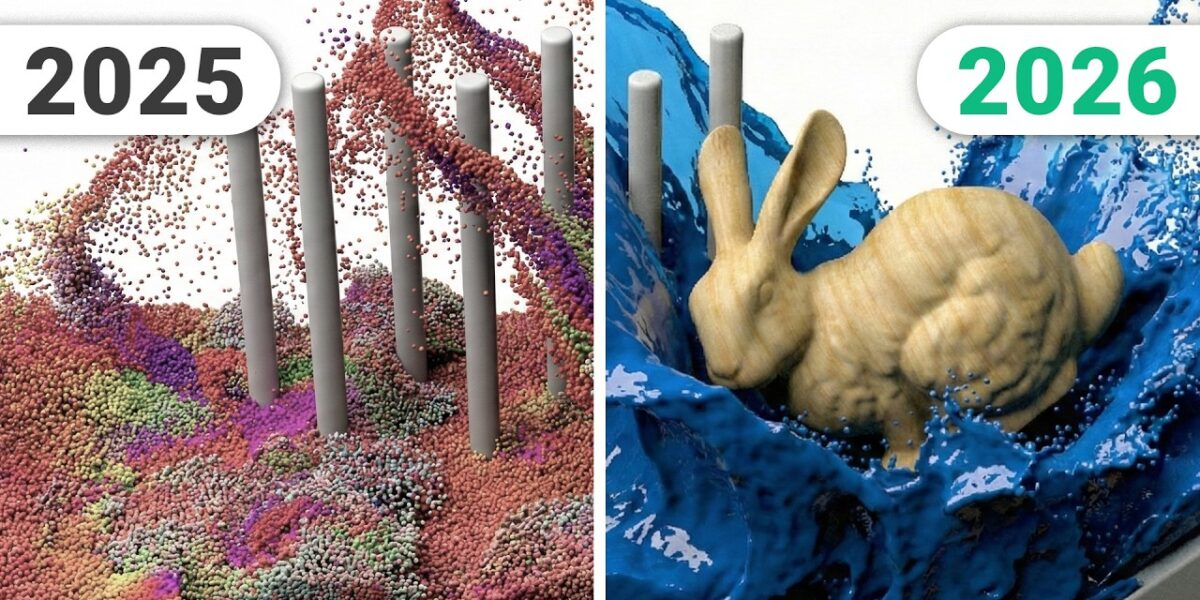
Revolutionary Fluid Simulation Technique Promises Unprecedented Realism
In a breakthrough that could redefine digital visual effects and scientific simulations, researchers have unveiled a novel fluid simulation method that addresses a long-standing challenge: the accidental loss of liquid volume over time. This innovative approach, developed by Dr. Ryoichi Ando, Professor Nils Thürey, and advised by Professor Chris Wojtan, not only prevents this unrealistic disappearance of liquid but also enhances simulation speed, accuracy, and visual fidelity.
The Problem of Disappearing Water
Traditional fluid simulators, widely used in video games and film production, have a persistent flaw. Due to minute inaccuracies in calculations that accumulate with each step, simulations often exhibit a gradual loss of liquid volume. Over time, this can lead to a noticeable depletion of water, a phenomenon described as a digital form of ‘theft’ from the simulated environment. Previous attempts to combat this involved applying mathematical filters that averaged particle velocities, effectively slowing down the simulation to prevent rapid changes. While this method could conserve volume, it often resulted in sluggish, unrealistic fluid motion, akin to freezing an economy to prevent theft – a solution that cripples its dynamism.
A New Paradigm: Volume Conservation by Design
The newly presented research tackles this issue head-on by fundamentally changing how fluid dynamics are calculated. Instead of trying to correct errors after they occur, the new method is designed from the ground up to prevent them. At its core, the technique ensures that liquid volume is conserved by construction, meaning the mathematical framework itself forbids the liquid from vanishing. This is achieved not through artificial constraints but through a sophisticated mathematical formulation that maintains the integrity of the simulated liquid.
Key Innovations and Benefits
This groundbreaking solver offers several significant advantages over existing methods:
- Volume Conservation: The primary achievement is the elimination of accidental liquid loss, ensuring simulations remain physically accurate over extended periods.
- Realistic Dynamics: Unlike older methods that slowed simulations to conserve volume, this new approach maintains crisp splashes and beautiful swirls without sacrificing performance. It allows for dynamic fluid behavior, keeping the ‘economy’ of the simulation alive.
- Smart Resource Allocation: While the precise calculations are more computationally intensive, the system employs adaptive techniques. It focuses computational resources on areas where the most detail is happening, such as the surface of the water, rather than wasting processing power on less dynamic, deeper sections. This ‘smart budgeting’ makes it practical for complex simulations.
- Accurate Bottleneck Handling: The solver excels at simulating challenging scenarios, such as the ‘glugging’ effect when liquid pours from a container. This involves managing the complex interaction of liquid rushing out and air rushing in through a narrow opening – a common point of failure for traditional simulators. The new method handles this chaotic two-way traffic seamlessly, producing natural-looking results.
- Practical Application of Advanced Theory: For decades, scientists have understood that certain mathematical theories could yield more accurate fluid simulations, but implementing them in 3D proved exceptionally difficult due to challenges in defining boundary conditions. This research provides the missing piece, making complex, previously impractical theories applicable in real-world scenarios.
Visualizing the Invisible: The Vector Potential
To help visualize the complex mathematics at play, the researchers employed a unique coloring system. The vibrant colors seen in demonstrations represent the ‘Vector Potential,’ an underlying mathematical field. By assigning red, green, and blue to different directions of force, these colors act as an invisible guide, illustrating how the simulation’s forces are being applied to make the water move. It’s akin to seeing the ‘strings’ that control a puppet, revealing the hidden mechanics behind the fluid’s dance.
The Underlying Mathematics
For those with a deeper understanding of physics and mathematics, the technical explanation involves a shift in calculation. Instead of directly solving for velocity, the solver calculates the Vector Potential. Since velocity is derived as the ‘Curl’ of this potential, the resulting velocity field is inherently ‘Divergence-Free’ by construction. This mathematical elegance ensures that the fluid remains a closed system, preventing any unintended loss or gain of volume.
Limitations and Future Directions
While this new solver represents a significant leap forward, it is not without its limitations. The current mathematical model may struggle with complex topological features, such as toroidal (donut-shaped) domains, where the flow circulates around a ring. The absence of a ‘Harmonic Field’ component in the current formulation means it might not accurately capture such intricate circulating flows. This suggests that while it’s a genius solution for splashes and general fluid motion, applications requiring liquid bagels might need further development.
A Decade-Old Secret Unveiled
Remarkably, the foundational research for this advanced fluid solver was published approximately ten years ago. Despite its profound implications, the work has remained largely obscure, with very few people having read the original paper. This situation highlights a common challenge in scientific research: the gap between theoretical breakthroughs and widespread adoption and recognition. The researchers behind this work, masters in the field of fluid dynamics, have created a solution that has the potential to elevate the realism of digital content and scientific modeling for years to come.
Why This Matters
The implications of this advanced fluid simulation technique are far-reaching. For the entertainment industry, it promises more believable and visually stunning water effects in movies and video games, reducing the labor and cost associated with fixing simulation artifacts. In scientific research, particularly in fields like meteorology, oceanography, and astrophysics, accurate fluid simulations are crucial for understanding complex phenomena. This new method could lead to more precise climate models, better predictions of weather patterns, and deeper insights into cosmic fluid dynamics. Furthermore, its efficiency and accuracy could benefit engineering applications, such as designing more effective cooling systems or understanding blood flow in medical simulations.
Source: The Bug That Ruined Game Physics For Decades (YouTube)

Related Articles


S&P 500 Hits Highs Amid War Fears
The S&P 500 has unexpectedly reached all-time highs despite global conflicts and economic worries. Meanwhile, the crypto market faces regulatory delays, and AI's impact remains a mixed bag of innovation and public concern.


AI Finds Thousands of Crypto Security Flaws
A new AI model, Mythos, has discovered thousands of critical security flaws in software, posing potential risks to cryptocurrency platforms. The threats are more likely to target centralized exchanges and applications rather than the core blockchain technology itself.


AI Reshapes Economy: New Wealth Opportunities Emerge
Artificial intelligence is set to dramatically reshape the global economy within five years, creating both challenges and significant wealth-building opportunities. Experts emphasize the need to adapt by learning AI skills, drawing parallels to how past technological shifts democratized access to knowledge and investment strategies.