AI Revolutionizes Fluid Simulations with Branchless Octrees
A new approach using "branchless" Octrees revolutionizes fluid simulations, enabling unprecedented detail and efficiency. This technique overcomes limitations of traditional methods, paving the way for more realistic visual effects and scientific research.

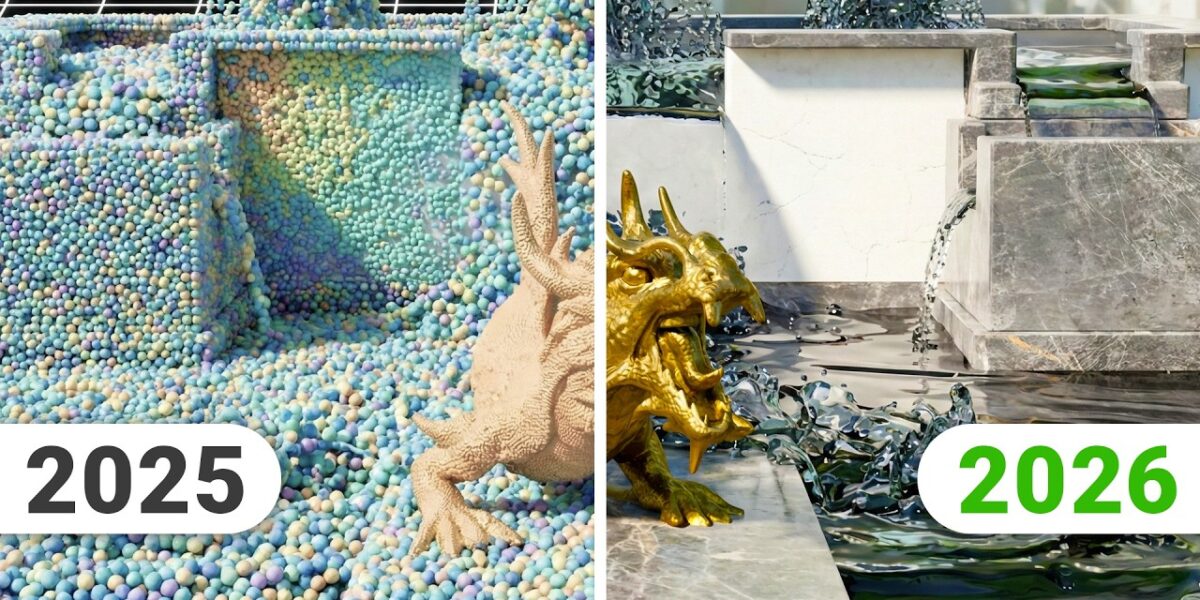
AI Revolutionizes Fluid Simulations with Branchless Octrees
Computer simulations of fluid dynamics have long been a cornerstone of scientific research and visual effects, enabling everything from weather forecasting to blockbuster movie scenes. However, achieving photorealistic and complex fluid behavior, such as crashing waves or intricate water fountains, has been computationally demanding, often requiring immense processing power and time.
Now, a groundbreaking research paper, though published a few years ago, is gaining renewed attention for its innovative approach that dramatically enhances the efficiency and realism of fluid simulations. This new method leverages a specialized data structure and a novel processing technique to overcome limitations of traditional simulation methods.
The Challenge of Simulating Fluids
Simulating fluids computationally typically involves tracking the behavior of a vast number of individual particles. For instance, a simulation of a wave generator might involve up to 9 million particles, while a fountain scene could require 3.5 million particles. A key challenge in these simulations is determining the interactions between particles.
To do this efficiently, traditional methods often employ a uniform grid overlaid on the simulation scene. This grid helps identify neighboring particles whose forces (like pressure or density) influence each other.
However, uniform grids present significant drawbacks as the complexity of the simulation increases. As fluids spread out and occupy more space, the number of particles and the computational cost of finding neighbors escalate. The uniform grid approach struggles with this scalability.
It can be inefficient, either by dedicating processing power to checking empty grid cells or by becoming overloaded in cells containing a high density of particles. This leads to a computational bottleneck, making it difficult to achieve highly detailed simulations in a reasonable timeframe.
Introducing Branchless Octrees for Enhanced Efficiency
The new research proposes a solution that moves away from rigid, uniform grids. Instead, it utilizes a specialized data structure known as an Octree. Octrees are hierarchical, tree-like structures that divide space into smaller, nested cubes.
The key innovation here is not the Octree itself, which has existed for decades, but how it is implemented and processed. The researchers have developed a method that makes these Octrees highly adaptive to the simulation scene, ensuring that each cell contains an optimal number of particles for processing.
The most significant advancement lies in the processing technique, described as “branchless.” Traditional algorithms often involve “branching” – where the computational process must make decisions and take different paths based on data, similar to a driver stopping at every intersection to consult a map. This constant decision-making slows down processing, especially on modern computer hardware that thrives on predictable, sequential operations.
The new “branchless” approach is akin to a perfectly designed road system where the lanes guide the vehicle directly to its destination without the need for constant stops or navigational checks. This allows the computer hardware to process data in large, clean batches, leading to substantial speed improvements.
Challenging the “Golden Rule” of Fluid Simulation
Beyond the efficient data structure and processing, the research also challenges a long-standing “golden rule” in fluid simulations. Previously, it was believed that the size of the grid cells should match the “neighborhood” radius of a particle – the area within which a particle can influence its neighbors.
The researchers have demonstrated that using slightly larger grid cells, approximately 1.5 times the support radius, can actually accelerate the simulation. This is analogous to using a slightly larger scoop for coffee beans; while a few extra beans might be scooped incidentally, the overall task of scooping is completed much faster due to fewer, larger movements.
Advanced Techniques for Complex Scenarios
The paper showcases several advanced simulation capabilities made possible by this new approach:
- Variable Particle Resolution: The method allows for the use of different particle densities within the same simulation. For example, in a “Double Dam Break” scene, fine, yellowish particles are used for high-detail surface motions, while coarser, blue particles represent the bulk of the fluid underneath. This optimizes computational resources by focusing detail where it’s visually important and using less intensive calculations for areas where detail is less perceptible.
- Mixed Viscosity Fluids: The simulations can accurately depict interactions between fluids of vastly different viscosities. A compelling example involves simulating thick, gooey slime mixing with splashing water. The slime deforms slowly, while the water interacts dynamically, demonstrating the system’s ability to handle complex material properties and their interactions.
- Fluid-Solid Interactions: The technique also extends to complex scenarios involving fluid-solid interactions, such as deformable objects being tossed and affected by fluid dynamics. Simulations of bunnies interacting with 5.6 million fluid particles highlight the system’s robustness.
Why This Matters
This breakthrough has significant implications across various fields. For the entertainment industry, it promises more realistic and complex visual effects in movies and games, achievable with potentially less rendering time.
In scientific research, it could enable more accurate and faster simulations for weather patterns, ocean currents, and fluid dynamics in engineering applications. The ability to achieve high detail with greater efficiency means that simulations previously requiring weeks of computation might now be feasible in much shorter timeframes, democratizing access to high-fidelity fluid simulations.
While the research paper was published approximately three years ago, its potential impact is only now being fully recognized. The researchers, hailing from Germany, have provided a powerful algorithmic solution that significantly pushes the boundaries of what is computationally possible in fluid simulation. This work represents a leap forward, enabling the creation of incredibly detailed and dynamic fluid behaviors that were once considered borderline impossible.
Source: This Fluid Simulation Should Not Be Possible (YouTube)

Related Articles


S&P 500 Hits Highs Amid War Fears
The S&P 500 has unexpectedly reached all-time highs despite global conflicts and economic worries. Meanwhile, the crypto market faces regulatory delays, and AI's impact remains a mixed bag of innovation and public concern.


AI Finds Thousands of Crypto Security Flaws
A new AI model, Mythos, has discovered thousands of critical security flaws in software, posing potential risks to cryptocurrency platforms. The threats are more likely to target centralized exchanges and applications rather than the core blockchain technology itself.


Google Rethinks AI Intelligence Testing
Google DeepMind has introduced a new framework for testing artificial general intelligence (AGI) that functions like an IQ test for AI. It evaluates systems across 10 cognitive abilities, comparing them to human performance to create a detailed profile rather than relying on single scores. This aims to bring scientific rigor to the debate on AI progress.