AI Missions to Mars: Overcoming Latency Challenges
The immense communication latency between Earth and Mars necessitates the deployment of artificial intelligence directly onto spacecraft. This onboard AI would enable autonomous decision-making, overcoming delays and accelerating interplanetary exploration.


AI Missions to Mars: Overcoming Latency Challenges
The prospect of deploying artificial intelligence on missions to Mars is no longer science fiction. Recent discussions and potential developments are highlighting the critical role AI could play in overcoming the immense communication delays inherent in interplanetary exploration. This advancement signifies a major leap in our ability to conduct complex operations remotely and pushes the boundaries of what’s possible in space exploration.
The core challenge with current Mars missions, and indeed any deep space exploration, is latency. Signals traveling between Earth and Mars can take anywhere from 4 to 24 minutes to complete a one-way journey, depending on the planets’ positions. This means that real-time control of rovers or spacecraft is impossible. Commands must be pre-programmed, and any unexpected situation requires a lengthy round trip for data and instructions, significantly slowing down scientific discovery and increasing mission risk.
The Need for Onboard Intelligence
Artificial intelligence offers a compelling solution to this latency problem. By embedding sophisticated AI capabilities directly into the spacecraft or rover, missions can achieve a degree of autonomy. This onboard intelligence would allow the AI to:
- Analyze sensor data in real-time.
- Make independent decisions based on pre-defined parameters and learned behaviors.
- Identify and react to unforeseen circumstances.
- Optimize operations without constant human input.
Imagine a rover encountering an unexpected geological formation or a sudden dust storm. With onboard AI, the rover could assess the situation, adjust its path, or take protective measures immediately, rather than waiting for instructions from Earth that might arrive too late. This not only enhances mission safety but also accelerates the pace of scientific data collection and analysis.
Inspiration and Future Possibilities
The idea of AI operating autonomously on another planet is profoundly inspiring. It represents a significant step forward in humanity’s quest to explore the cosmos. This concept moves beyond simple remote control and ventures into true intelligent exploration, where robotic emissaries can act with a level of sophistication previously unimaginable.
While specific AI models or companies involved in these potential Mars AI initiatives were not detailed in the initial discussions, the underlying principle is clear: leveraging advanced AI to enable more robust, efficient, and ambitious interplanetary missions. This could involve utilizing advanced machine learning algorithms for navigation, scientific instrument operation, and even self-repair or adaptation.
Why This Matters
The implications of putting AI on Mars, or any celestial body with significant communication lag, are far-reaching:
- Accelerated Discovery: AI-powered autonomy means missions can operate more continuously and react faster, leading to quicker scientific breakthroughs.
- Enhanced Safety: The ability for AI to handle emergencies autonomously drastically reduces the risk of mission failure due to communication delays.
- More Complex Missions: Future missions could undertake more intricate tasks, such as complex sample collection, in-situ analysis, or even preliminary construction, without the constraints of real-time human oversight.
- Foundation for Future Exploration: Success in deploying AI on Mars would lay the groundwork for even more ambitious human and robotic exploration of the solar system and beyond.
This development is not just about Mars; it’s about redefining the limits of robotic exploration. As we look towards exploring moons like Europa or Titan, or even venturing further into the solar system, the need for intelligent, autonomous systems will only grow. The challenges are immense, but the potential rewards—expanding our understanding of the universe and our place within it—are even greater.
This initiative, if realized, would be a testament to human ingenuity and our ever-increasing capacity to develop and deploy sophisticated AI technologies in the most demanding environments imaginable. It’s a glimpse into a future where our robotic proxies can operate with a significant degree of independent intelligence, pushing the frontiers of exploration further and faster than ever before.
Source: Claude on Mars!? (YouTube)

Related Articles


AI’s Economic Shift: Ownership is the New Wage
Artificial intelligence is projected to significantly reduce the economic value of human labor within a decade. Experts suggest that capital ownership, rather than wages, will become the primary means of wealth accumulation. Investors are urged to consider this shift in their long-term strategies.


Nvidia Earnings Signal AI Revolution’s Next Phase
Nvidia's latest earnings report reveals accelerating revenue growth and profitability, signaling a new phase in the AI revolution driven by sophisticated AI agents. The company's strong performance underscores the growing demand for computational power as AI transitions into a core digital infrastructure component.
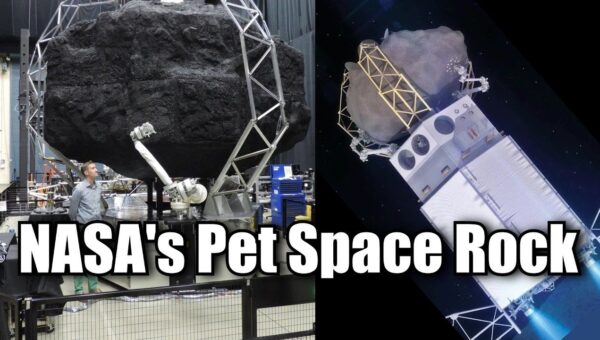
NASA’s Asteroid Mission: From Mars Dream to Lunar Gateway
NASA's ambitious Asteroid Redirect Mission (ARM), designed as a stepping stone to Mars, aimed to capture a small asteroid boulder and tow it to lunar orbit for astronaut testing. Though cancelled, its advanced propulsion and robotic technologies live on in NASA's Lunar Gateway and future deep space exploration plans.