Google Genie: AI Creates Interactive Worlds from Text
Google has launched Genie, an AI model that generates interactive 3D worlds from text prompts. This technology allows users to explore environments akin to video games, with potential applications in game development, VR/AR, and education.

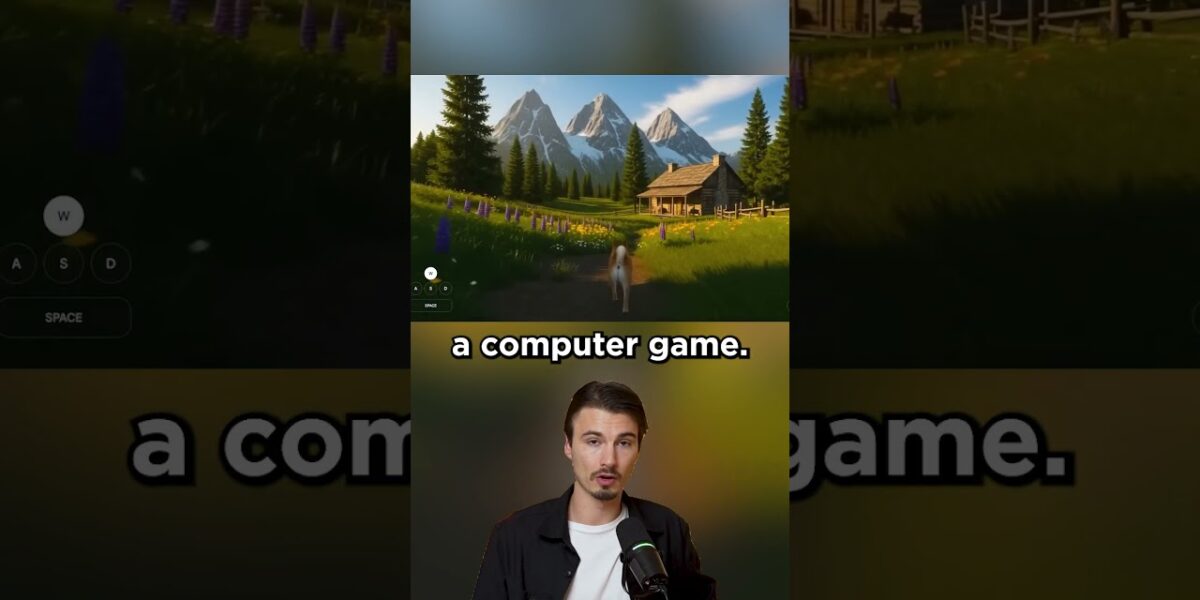
Google Unveils Genie: A Leap in AI-Generated Interactive Worlds
In a significant advancement for artificial intelligence, Google has introduced Genie, a groundbreaking text-to-world generator. This new AI model allows users to create fully navigable, interactive 3D environments simply by providing a text prompt. Imagine describing a dreamscape, a historical setting, or a fantastical realm, and then being able to explore it as if you were in a video game. That’s the reality Google Genie is aiming to deliver.
How Genie Works: From Prompt to Playable World
The core innovation behind Genie lies in its ability to translate textual descriptions into complex, interactive 3D spaces. Unlike previous AI models that might generate static images or short video clips, Genie creates environments with depth and interactivity. Users can input a prompt, such as “a lush forest with a winding river” or “a bustling medieval marketplace,” and Genie constructs a world that can be explored. This exploration isn’t limited to a simple walkthrough; the generated worlds possess three-dimensional properties, allowing for a sense of presence and navigation akin to modern video games.
Impressive Capabilities and Early Examples
The examples showcased by Google demonstrate the impressive scope of Genie’s capabilities. Users can interact with the generated environments, moving through them and observing the details rendered by the AI. This goes beyond simple image generation, offering a glimpse into a future where virtual environments can be created with unprecedented ease and speed. The fidelity and complexity of these worlds, even in early demonstrations, suggest a powerful new tool for creators, developers, and even researchers.
Technical Underpinnings: Understanding the AI
While the user experience is designed to be simple – a text prompt and an interactive world – the technology behind Genie is complex. At its heart, Genie is a large AI model. These models are trained on vast datasets, allowing them to learn patterns, relationships, and structures. In Genie’s case, the training data likely includes a combination of text descriptions and corresponding 3D environments or representations of them. This allows the model to understand how textual concepts translate into spatial and visual elements. The “parameters” of an AI model refer to the internal variables the model learns during training. A higher number of parameters often indicates a more complex and potentially capable model, though it also requires more computational power to train and run.
The ability to generate not just static content but interactive, navigable worlds suggests that Genie is operating on a different level than previous generative AI models. Tools like DALL-E or Midjourney excel at creating stunning 2D images from text, while models like Sora are pushing the boundaries of AI-generated video. Genie, however, focuses on creating persistent, explorable spaces, which requires a deeper understanding of spatial relationships, physics, and object interaction within a 3D context.
Accessibility and Pricing
Google has indicated that access to Genie will be available for $250 within the United States. This pricing structure suggests a targeted release, possibly aimed at developers or professional users initially, though wider consumer access may follow. The availability being limited to US customers at launch is a common strategy for new technology rollouts, allowing companies to manage support and gather feedback in a controlled environment before a global release.
Why This Matters: The Impact of Genie
The implications of Google Genie are far-reaching:
- Game Development: For game developers, Genie could revolutionize rapid prototyping. Imagine quickly generating playable prototypes for new game ideas, significantly reducing the time and cost associated with initial development. This could democratize game creation, allowing smaller teams or even individuals to bring complex ideas to life.
- Virtual and Augmented Reality: Creating immersive VR/AR experiences often requires extensive 3D modeling and environment design. Genie offers a potential shortcut, enabling the rapid generation of virtual spaces for training simulations, virtual tourism, architectural visualization, and more.
- Education and Training: Interactive 3D environments can be powerful educational tools. Genie could be used to create historically accurate reconstructions, complex scientific models, or immersive language learning environments, making education more engaging and effective.
- Creative Arts and Storytelling: Artists and storytellers could use Genie to visualize their narratives and create unique interactive art installations or digital experiences. The ability to bring imaginative worlds to life with simple text commands opens up new avenues for creative expression.
- Accessibility: By lowering the barrier to entry for creating 3D environments, Genie could make digital content creation more accessible to a wider range of individuals, regardless of their technical 3D modeling expertise.
Comparison to Existing Tools
While tools like Unity or Unreal Engine offer powerful capabilities for creating 3D worlds, they require significant technical skill and time investment. AI image generators like Midjourney or Stable Diffusion can create stunning visuals, but they are limited to 2D outputs. Video generation models like OpenAI’s Sora can produce dynamic scenes, but they are not inherently interactive or explorable in a 3D space. Genie appears to bridge this gap by combining the ease of text-based generation with the interactivity and spatial depth of 3D environments, positioning it as a unique and potentially disruptive technology.
The Future of AI-Generated Realities
Google Genie represents a significant step towards a future where digital realities can be conjured with simple language. As the technology matures, we can expect even more sophisticated environments, richer interactions, and broader applications across numerous industries. The ability to translate imagination directly into explorable digital spaces is no longer science fiction, but an emerging reality powered by advanced AI.
Source: A Solution Looking for a Problem… (YouTube)

Related Articles


AI Misdiagnoses Medical Cases 80% of the Time
A recent U.S. study reveals that AI chatbots are misdiagnosing medical conditions in 80% of cases, highlighting significant risks in relying on artificial intelligence for health advice. Personal stories shared by individuals demonstrate how online self-diagnoses led to incorrect treatments and prolonged suffering, underscoring the irreplaceable value of human medical professionals.


Magnificent 7 Stocks Surge Amid Market Uncertainty
Tech giants, the 'Magnificent 7,' are surging despite market fears, showing technical breakouts and strong growth potential. Amazon invests heavily for long-term gains, while Google deepens its AI capabilities. Meta refocuses on core strengths, and Apple's services business continues its impressive expansion.

AI Spurs Cybersecurity Overhaul: Kyndryl CEO
The rise of generative AI is dramatically reshaping the cybersecurity landscape, introducing new vulnerabilities and demanding greater vigilance. Kyndryl CEO Martin Schroeter highlights the urgent need for robust security measures and the growing importance of data sovereignty for nations and businesses. Infrastructure bottlenecks are also complicating data center expansion plans.