New ‘Sulfur Worlds’ Exoplanets Discovered
Astronomers have identified a new class of exoplanets, 'sulfur worlds,' characterized by sulfur-rich atmospheres and potential magma oceans. The Vera C. Rubin Observatory is now sharing its sky alerts publicly, and the James Webb Space Telescope's latest mission proposals have been revealed. Updates on the Artemis missions and new evidence for asteroid material transfer are also discussed.

New ‘Sulfur Worlds’ Exoplanets Discovered
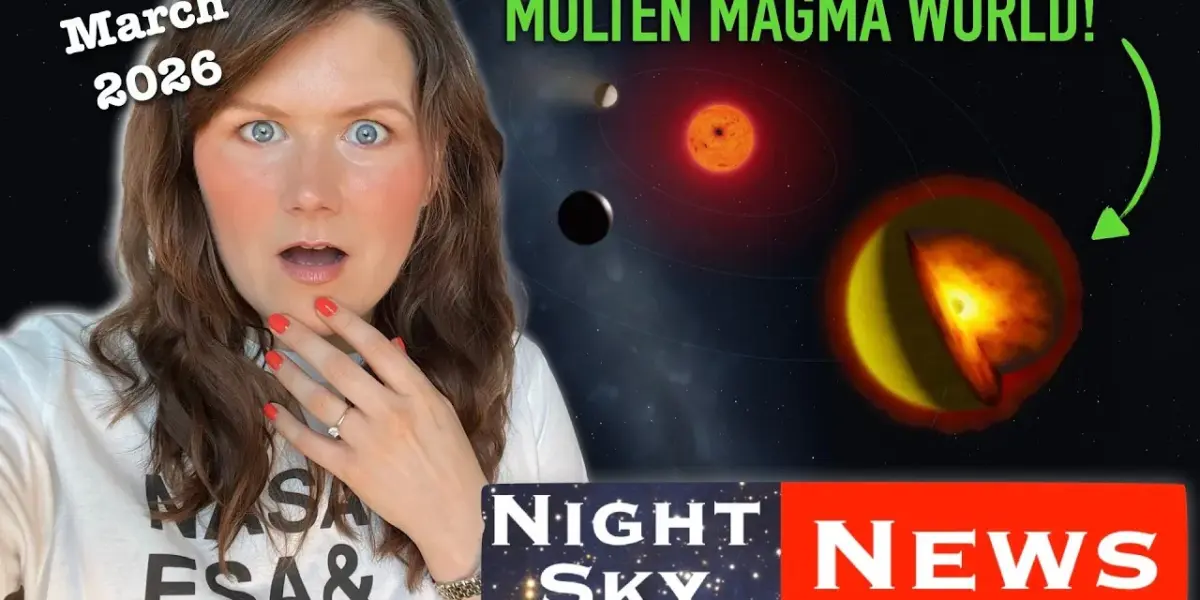
Astronomers have discovered a new class of exoplanets, dubbed ‘sulfur worlds.’ These planets are rich in sulfur and may possess vast magma oceans beneath their crusts. This exciting finding comes from new analysis of data from the James Webb Space Telescope (JWST) and other missions.
Spring Equinox and Celestial Sights
March 2026 marks the official start of astronomical spring in the Northern Hemisphere. The spring equinox, occurring on March 20th, signifies the moment when neither hemisphere is tilted towards or away from the sun. While often thought to bring exactly 12 hours of daylight and 12 hours of night, this is technically the equil, which happens a few days earlier. Refraction, the bending of sunlight as it enters Earth’s atmosphere, causes the sun to appear visible for a few extra minutes at sunrise and sunset. This makes the day of the equinox slightly longer than 12 hours.
As spring begins, stargazers can look forward to seeing Venus alongside a slim crescent moon shortly after sunset. Venus, being the brightest object in the night sky after the moon, should be easily visible. The moon will serve as a guide to help locate Venus. Both will set within an hour after sunset, so early viewing is recommended. Venus will become more prominent in the evening sky throughout April.
Around April 26th, the moon will reach its half-moon phase. It will be positioned between the bright planet Jupiter and the star Pollux in the constellation Gemini. This alignment is expected to resemble Orion’s belt, offering a beautiful sight for observers, especially those with telescopes or binoculars. Jupiter’s brightness will help it stand out among fainter stars.
Comet Panstarrs May Dazzle Naked Eye
Hopes are high for Comet C/2025 R3 Panstarrs, which is predicted to become bright enough to be seen with the naked eye in April. This comet makes its closest approach to Earth on April 19th. Its journey from the Oort Cloud at the edge of our solar system to the inner solar system takes about 60,000 years. Because it’s a newcomer to the inner solar system, its exact brightness is uncertain. Comets are known for their unpredictable nature, much like cats, as the saying goes.
Predictions for the comet’s brightness range from being as faint as Neptune, requiring binoculars, to as bright as stars in Cassiopeia, easily visible to the naked eye. If the comet does become bright enough, updates will be provided. The comet can be seen in the western sky just before sunrise, located in the constellation Pegasus. As the comet gets closer to the sun, its ice will melt, creating a large, dusty tail that reflects sunlight, making it visible. This celestial event is particularly anticipated by those planning trips to dark sky locations like Joshua Tree National Park.
Rubin Observatory and JWST Alerts Public
The Vera C. Rubin Observatory, which began its 10-year sky survey last year, is now making its alerts public. The observatory captures images of the entire sky every three nights. If any changes are detected in a patch of sky compared to previous observations, an alert is generated. Previously, these alerts were only available to the Rubin team. Now, they are accessible to anyone worldwide, including amateur astronomers.
Software brokers process this vast amount of data, making it understandable. On the first night of public alerts, 800,000 alerts were issued, with data becoming available just five minutes after observation. This represents an enormous influx of information for scientific research. The Laser broker in the UK is one example of how this data is processed and made accessible.
Additionally, the list of successful scientific proposals for the James Webb Space Telescope (JWST) was announced. Each year, astronomers submit proposals detailing how they would use JWST for groundbreaking research. Many of these proposals focus on exoplanet research, particularly on rocky planets and ‘super-Earths’ like 55 Cancri e. A significant number of proposals, twelve in total, will study the mysterious ‘little red dots’ observed in the distant universe, which are thought to be galaxies or growing supermassive black holes.
Artemis Mission Updates
Changes have been announced for NASA’s Artemis missions, aimed at returning humans to the Moon. Artemis 2, which will send astronauts to orbit the Moon, is set for an early April 1st launch, following a delay due to a helium flow issue. The original plan had Artemis 3 landing astronauts on the Moon in 2028 at the earliest.
The updated plan introduces an extra mission before the lunar landing. A new Artemis 3 mission is scheduled for 2027. This mission will involve low-Earth orbit tests of new lunar landers being developed by companies like SpaceX and Blue Origin. The original Artemis 3 moon landing mission is now designated as Artemis 4 and is still planned for 2028. This revised timeline is similar to the Apollo program, where missions like Apollo 9 tested lunar modules before the actual landing missions.
Discovering the ‘Sulfur Worlds’
A new class of exoplanets has been identified, thanks to observations by JWST and earlier data from the TESS mission. The planet L98-59d, discovered in 2019, orbits a red dwarf star about 35 light-years away. This planet is about 1.5 times the diameter of Earth but only 2.1 times its mass. Its density is roughly half that of Earth.
This low density suggests L98-59d is not a rocky planet like Earth or Mars, which have dense iron cores. Instead, it’s likely either a miniature gas giant or a water world. Initial observations with the Hubble Space Telescope hinted at a water-rich atmosphere, ruling out a hydrogen-helium gas giant composition.
However, recent JWST observations revealed that L98-59d’s atmosphere lacks water. Instead, it appears to be rich in sulfur compounds, such as sulfur dioxide and hydrogen sulfide. This composition suggests the planet might have an unpleasant odor, reminiscent of rotten eggs.
Computer simulations by researchers suggest that L98-59d’s sulfur-rich atmosphere could be sustained by a global magma ocean. This ocean, located kilometers below a silica crust, acts as a reservoir, replenishing sulfur in the atmosphere over billions of years. The planet likely started with a large hydrogen atmosphere, resembling a mini-Neptune, but gradually shrank and cooled. This process, coupled with sulfur enrichment from the magma ocean, created its unique atmospheric composition.
This discovery of sulfur-rich planets with long-lasting magma oceans represents an entirely new category of exoplanets. It raises intriguing questions about the diversity of planets that may exist throughout the universe, waiting to be found.
DART Mission Reveals Asteroid Material Transfer
New results from NASA’s DART (Double Asteroid Redirection Test) mission provide the first direct evidence of material transfer between two asteroids. The DART mission’s primary goal was to test humanity’s ability to alter an asteroid’s trajectory by impacting it. This capability is crucial for planetary defense, offering a way to deflect potentially Earth-threatening asteroids by making small adjustments to their orbits.
DART targeted the binary asteroid Didymos, specifically its moonlet Dimorphos. By measuring the change in Dimorphos’s orbit after the impact, scientists could calculate the energy transferred and estimate the effectiveness of such a deflection for larger asteroids.
Before the impact, images of Dimorphos revealed a peculiar fan-like pattern. Scientists initially considered instrumental errors or unusual lighting conditions. However, after ruling out artificial sources and accounting for shadows, the pattern persisted, with rays converging near Dimorphos’s equator. This led to the conclusion that the pattern was real.
Further investigation explored potential causes, including asteroid quakes and static electricity on the surface, but these could not fully explain the observed fan shape. Through physical experiments and simulations, researchers concluded that the most plausible explanation is a low-speed impact of boulders from Didymos onto Dimorphos’s surface. This suggests that Didymos has been ejecting material, which then impacts its orbiting moonlet.
This finding is significant as it offers the first concrete proof of material exchange between asteroids. It also lends support to the concept of panspermia, the hypothesis that life could spread throughout the universe by hitching rides on celestial bodies like asteroids and comets. While not direct proof of panspermia, this discovery moves the idea closer to scientific plausibility.
Source: A new type of exoplanet discovered | Night Sky News March 2026 (YouTube)

Related Articles


Giant Space Telescope Mission Faces Uncertain Future
The ambitious LUVOIR telescope concept, designed to search for life on exoplanets, is currently in a state of uncertainty. While not actively in development, its goals continue to drive future space observatory designs and the ongoing quest to find life beyond Earth.


Cosmic Collisions Reshape Our View of Planet Formation
Astronomers are uncovering cosmic surprises, from planetary systems that defy formation rules to the echoes of the Moon's birth in distant star systems. Discoveries include a peculiar planetary arrangement, a hot Earth-sized world offering atmospheric insights, and a spectacular planetary collision. Meanwhile, new technologies aim to capture asteroids, and recent findings shed light on lunar magnetic fields and the intense radiation risks on Mars. Finally, a seven-hour gamma-ray burst and the chaotic dance of dwarf galaxies reveal the universe's dynamic and often violent nature.

Giant Star Shade Could Reveal Alien Worlds to Ground Telescopes
A groundbreaking proposal envisions a 99-meter starshade orbiting Earth, capable of blocking starlight to reveal exoplanets for powerful ground-based telescopes. Meanwhile, new analysis of the DART mission's final moments offers visual proof of asteroid moon formation, and cosmic tension persists as scientists refine the age of the universe.