Trump’s Pearl Harbor Remark Stuns Japan’s Leader
Former President Donald Trump's unexpected question to Japan's Prime Minister about Pearl Harbor caused visible discomfort. The remark used a historical enemy attack to explain a point about military surprise, overlooking current alliance dynamics. This highlights the importance of context and careful communication in international diplomacy.


Trump’s Pearl Harbor Remark Stuns Japan’s Leader
During a recent meeting, former President Donald Trump made a surprising comment to Japan’s Prime Minister, Fumio Kishida. He questioned why Japan didn’t warn the U.S. about the attack on Pearl Harbor. This remark clearly caught the Japanese leader off guard. The video shows Kishida looking visibly uncomfortable and shocked by the question.
Trump’s reasoning for bringing up Pearl Harbor was to explain his own approach to military action. He suggested that sometimes, keeping plans a secret is important for surprise. He argued that Japan, having carried out a surprise attack itself, would understand this concept best. This is why he asked why they didn’t warn the U.S. about Pearl Harbor.
Historical Context and Diplomatic Norms
The attack on Pearl Harbor in 1941 was a pivotal moment in World War II. Japan launched a surprise military strike against the United States naval base in Hawaii. This event directly led to the U.S. entering the war. At that time, Japan and the United States were enemies. Therefore, an attack would not be preceded by a warning.
Fast forward to today, Japan is a key ally of the United States. The nature of international relations means allies typically share important information, especially regarding potential conflicts or military actions. The expectation is that allies would inform each other of significant plans, not be kept in the dark about potential attacks on other nations. This is a fundamental aspect of modern diplomatic and military cooperation.
Analyzing Trump’s Statement
Trump’s comment seems to blur the lines between past and present. He used a historical event where Japan was an adversary to make a point about current alliance dynamics. It’s like asking a former opponent why they didn’t tell you their game plan before a championship match they won. The context is entirely different.
The prime minister’s reaction suggests that Trump’s remark was not only historically inaccurate in its implication but also diplomatically awkward. Invoking a surprise attack by an enemy nation from decades ago in a conversation with the leader of that nation, now an ally, is unusual. It highlights a potential disconnect in understanding historical events and current geopolitical relationships.
Why This Matters
This incident touches upon several important points. Firstly, it shows how historical events can be interpreted and used in different ways. Trump used Pearl Harbor to illustrate a point about surprise in military strategy. However, the way he framed it seemed to ignore the fact that Japan was an enemy during that attack.
Secondly, it raises questions about diplomatic communication. Allies are expected to communicate openly. Trump’s statement, by questioning why an ally didn’t warn about a past enemy attack, could be seen as misinterpreting or downplaying the importance of current alliance bonds. The discomfort of the Japanese prime minister underscores the sensitivity of such historical references in diplomatic settings.
Finally, the incident highlights the importance of context in international relations. A statement that might make sense in one context can be highly inappropriate or confusing in another. Using a wartime attack by an enemy as an analogy for communication between allies demonstrates a lack of awareness regarding the nuances of current global partnerships.
Implications and Future Outlook
The implications of such a statement, even if made in jest or as a strategic point, can be far-reaching. It could potentially create a slight strain in the relationship between the U.S. and Japan, or at least create an awkward moment that needs to be smoothed over. Allies rely on trust and mutual understanding, and remarks like these can sometimes create unintended friction.
Looking ahead, this event serves as a reminder of the careful language required in international diplomacy. Leaders need to be mindful of historical sensitivities and the current state of relationships when making public statements. The way historical events are referenced can significantly impact present-day alliances and perceptions. The focus for the U.S. and Japan remains on their strong partnership and shared interests in regional security.
Source: Trump Drops INSANE Pearl Harbor Line to Japan's PM #politics #fyp #new (YouTube)

Related Articles

Rubio Puts US First at G7 Summit, Sparks Debate
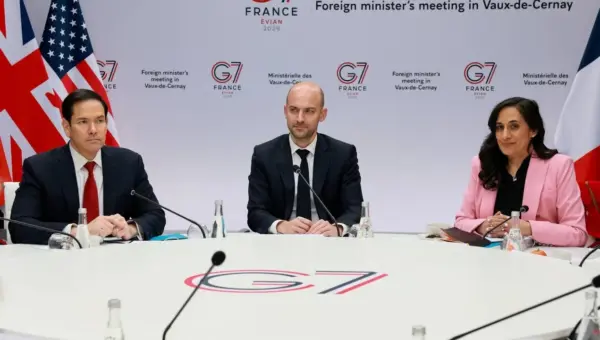
Secretary of State Marco Rubio attended the G7 summit in France, emphasizing his commitment to serving the American people above all else. The meeting addressed the war in Iran and Russia's role, revealing differing approaches among allies on regional security and the Strait of Hormuz.
Trump’s Name Everywhere: A ‘Stain’ on GOP Legacy?
Former President Donald Trump's efforts to brand national symbols, including a proposed signature on dollar bills, spark debate. Critics view this as an authoritarian attempt to embed his legacy, potentially staining the Republican Party's history and contrasting with democratic ideals of public ownership.

Trump’s War Talk Stuns Financial Crowd
Donald Trump's recent speech in Miami focused on his foreign policy, particularly his critical views on NATO and his vision for international relations. He declared the U.S. would no longer defend NATO allies, questioned the value of existing alliances, and suggested renaming the Strait of Hormuz. The speech also touched on his personal views of success, his allies, and his perceived role as a global peacemaker.