Intel Chiefs Detail Global Threats to Homeland Security
Top U.S. intelligence officials presented a detailed threat assessment for 2026, highlighting dangers from international crime, terrorism, and rival nations' military advancements. The briefing noted progress in border security but warned of persistent migratory pressures and drug trafficking. Global rivals like China and Russia are aggressively developing advanced weapons and cyber capabilities, with AI further complicating the threat landscape.


Nation’s Top Intelligence Leaders Outline 2026 Threat Assessment
In a comprehensive briefing to Congress, the nation’s top intelligence officials laid out a stark picture of the global threats facing the United States in 2026. Directors from the CIA, FBI, DIA, and NSA presented the annual threat assessment, highlighting dangers ranging from transnational criminal organizations and terrorist groups to the advanced military ambitions of rival nations. The assessment, delivered by [Speaker’s Name – inferred as Gabbard from video title], emphasized threats to the U.S. homeland and its interests abroad, aligning with the President’s national security strategy.
Homeland Defense and Border Security Efforts Show Progress
The briefing began by detailing efforts to bolster homeland defense, citing successes in securing the U.S.-Mexico border. Strict enforcement of U.S. policies has reportedly led to a significant reduction in illegal immigration. Customs and Border Patrol data indicated that monthly encounters in January 2026 were down 83.8% compared to January 2025 and 79% compared to 2024.
However, officials cautioned that underlying drivers of migration persist. Instability in countries like Cuba and Haiti could trigger new migration surges. Transnational criminal organizations continue to exploit such chaos for profit, posing a direct threat to American citizens through drug trafficking. Under President Trump’s leadership, fentanyl overdose deaths have reportedly decreased by 30% from September 2024 to September 2025. Aggressive efforts to target these organizations and reduce the inflow of fentanyl precursors have shown significant impact, including a likely decrease in fentanyl potency due to supply chain disruptions.
Despite improvements, the threat from drug cartels remains substantial. Mexico-based groups like the Sinaloa Cartel and Jalisco New Generation Cartel dominate the production and smuggling of fentanyl, heroin, meth, and cocaine into the U.S. Colombian groups, including the Revolutionary Armed Forces of Colombia and the National Liberation Army, are major traffickers of cocaine, with indications of expansion into the Asia-Pacific region. MS-13 continues to operate within the U.S., fueling violence and instability through murder, extortion, and other criminal activities.
Terrorism Threats Evolve Amidst Shifting Global Dynamics
The intelligence community also detailed the evolving threat from Islamist terrorist actors. While al-Qaeda and ISIS are considered weaker than at their peak, the spread of Islamist ideology, sometimes linked to the Muslim Brotherhood, poses a fundamental threat to Western principles. These groups use ideology for recruitment and funding, aiming to establish global caliphates governed by Sharia law.
In response to setbacks in conducting large-scale attacks, these groups have shifted focus to information operations, spreading propaganda to inspire individuals in the West. Counterterrorism efforts in Iraq, Somalia, Yemen, and Syria in 2025 were crucial in degrading the ability of al-Qaeda and ISIS to plan major attacks. Strict border enforcement and increased deportations have also reduced potential access for terrorists to the homeland.
Despite these efforts, the threat remains. In 2025, there were at least three Islamist terrorist attacks in the U.S., and law enforcement disrupted 15 U.S.-based plotters. Roughly half of these had online contact with foreign-inspired terrorist organizations. The briefing cited an example of a plot against a Michigan synagogue where the shooter had familial ties to a Hezbollah leader. Overseas, al-Qaeda in the Arabian Peninsula (AQAP) in Yemen, ISIS-K in South Asia, and ISIS in Syria are considered the most likely groups to conduct external plotting.
Rival Nations Accelerate Advanced Weapons Development
State actors present a broader risk, with nations like Russia, China, North Korea, Iran, and Pakistan actively researching and developing advanced missile systems. The intelligence community assesses that threats to the homeland will collectively expand to over 16,000 missiles by 2035, a significant increase from the current estimate of over 3,000. China and Russia are developing systems designed to bypass U.S. missile defenses, while North Korea’s intercontinental ballistic missiles (ICBMs) can already reach U.S. soil. Pakistan is also developing long-range ballistic missiles, potentially including ICBMs.
Iran has demonstrated technology that could be used to develop a militarily viable ICBM before 2035. However, the full impact of “Operation Epic Fury” on Iran’s missile capabilities is still being assessed. These nations are likely studying U.S. missile defense plans to shape their own development programs.
Cyber Threats Intensify with AI and State-Sponsored Hacking
The cyber domain presents persistent threats from China, Russia, Iran, and North Korea, as well as non-state ransomware groups. These actors seek to compromise U.S. networks and critical infrastructure for intelligence gathering, disruption, and financial gain. China and Russia are noted as the most persistent threats, continuing research and development efforts.
North Korea’s cyber program is sophisticated, with cryptocurrency heists in 2025 reportedly stealing $2 billion, funding its weapons programs. Financially or ideologically motivated non-state actors are becoming bolder, with ransomware groups shifting to faster, high-volume attacks. Artificial intelligence is expected to accelerate these threats, with both attackers and defenders using AI tools to enhance speed and effectiveness. An example cited involved an AI tool used in August 2025 for data extortion against various sectors.
Arctic Competition and the Rise of AI
In the Arctic, Russia and China aim to strengthen their presence through increased trade, resource extraction, and military activity. Russia, with the longest Arctic coastline, is deploying more military forces and building infrastructure. China, while not an Arctic nation, is pursuing its strategic and economic interests in the region.
The intelligence community identifies China as the most capable competitor in artificial intelligence. AI capabilities are rapidly advancing, changing the threat landscape. The potential for AI to aid in weapons design and battlefield decision-making poses significant risks. Furthermore, early developers in quantum computing could gain an extraordinary technological advantage, potentially breaking current encryption methods used to protect sensitive information.
Global Conflicts and Regional Instability Persist
The global security landscape is volatile, with armed conflict becoming more common. Strategic competition and regional powers are increasingly willing to use force. The space domain is becoming contested, with China and Russia developing counter-space capabilities. The threat of nuclear proliferation and advancing chemical and biological warfare capabilities continues to grow.
In the Western Hemisphere, flagging economies, high crime rates, organized crime, migration, corruption, and narcotics trafficking pose risks to U.S. interests. China, Russia, and Iran are actively seeking to increase their influence in Latin America. China’s demand for raw materials drives its economic outreach, while Russia seeks to expand security and diplomatic ties.
China continues to modernize its military with the goal of achieving world-class status by mid-century, including capabilities to deter U.S. forces and potentially seize Taiwan. However, China likely prefers peaceful reunification. North Korea remains a regional and global concern due to its weapons of mass destruction, conventional military capabilities, and cyber activities. Its partnership with Russia is growing, and its support for Russia in Ukraine has enhanced its combat experience and equipment.
Russia retains the capability to challenge U.S. interests globally. The most dangerous threat from Russia is the potential for escalation in existing conflicts, such as Ukraine, or new conflicts leading to direct hostilities, possibly including nuclear weapons. Russia is investing in novel capabilities, including hypersonic missiles and undersea systems, and using “grey zone” tactics below the level of armed conflict. Russia is also developing counter-space capabilities, with a nuclear counter-space weapon posing a significant threat to global space architecture.
In the Middle East, “Operation Epic Fury” is seen as advancing fundamental change, weakening Iran and its proxies. While the Iranian regime appears intact, its capabilities are degraded. Iran and its proxies continue to attack U.S. and allied interests, and the regime faces increasing internal tensions due to its worsening economy.
Africa faces persistent conflicts due to poor governance and external support. Tensions between Ethiopia and Eritrea, the civil war in Sudan, and increased attacks by ISIS in West Africa and the Sahel are ongoing concerns. African governments are likely to use their resources, including critical minerals, to seek beneficial partnerships.
Intelligence Community’s Commitment to Security
In closing, the leaders of the intelligence community affirmed their commitment to providing timely, unbiased, and relevant intelligence to policymakers. Their goal is to inform decision-making and ensure the safety, security, and freedom of the American people.
Source: Gabbard makes opening statement in worldwide threats hearing (YouTube)

Related Articles

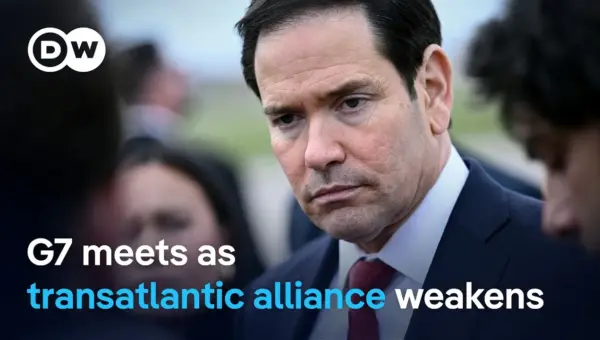
G7 Allies Clash Over Iran War Strategy, Urge Focus on Russia
G7 foreign ministers met in Paris, revealing deep divisions over the U.S. war with Iran. European allies urged the U.S. to pressure Russia, linking its actions to the conflict and fearing support for Ukraine will wane.

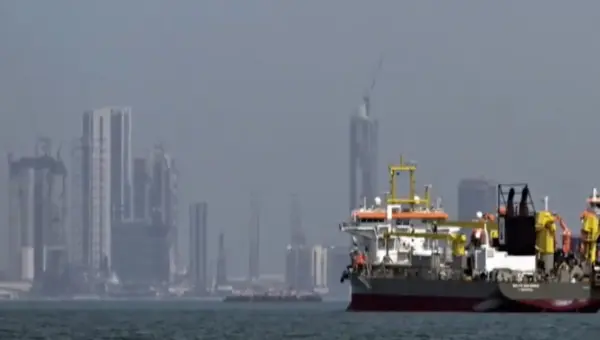
Iran Blocks China Ships, Exposing Beijing’s Weak Grip
Iran's recent decision to block Chinese ships at the Strait of Hormuz is exposing the limits of Beijing's influence in the Middle East. This action is causing delays and cancellations for Chinese manufacturers, turning a perceived geopolitical win into an economic strain.
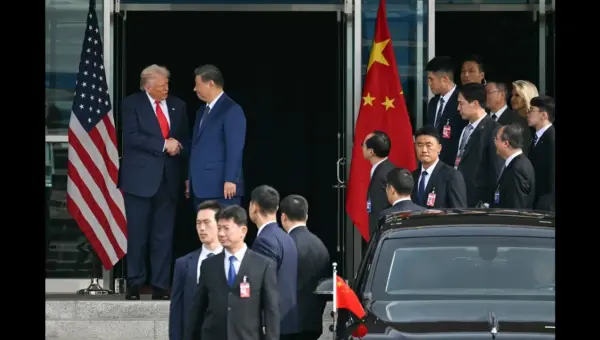
Trump’s “Walk Away” Tactic Signals Tougher Stance on China
Retired Air Force Brigadier General David Stillwell believes President Trump's strategy of being willing to walk away from negotiations puts pressure on China. This tactic, combined with US global actions and strengthened alliances, signals a more assertive American foreign policy.