UK Navy Lacks Ships for Hormuz, Ex-Intel Officer Says
A former British Army intelligence officer has stated that the UK's Royal Navy is too small to deploy ships to the Strait of Hormuz, making specialized vessels like HMS Dragon ill-suited for crucial mine-sweeping operations. This assessment comes as the British government reportedly seeks legal advice on intervening in the vital shipping lane, highlighting a significant gap in national defense capabilities.

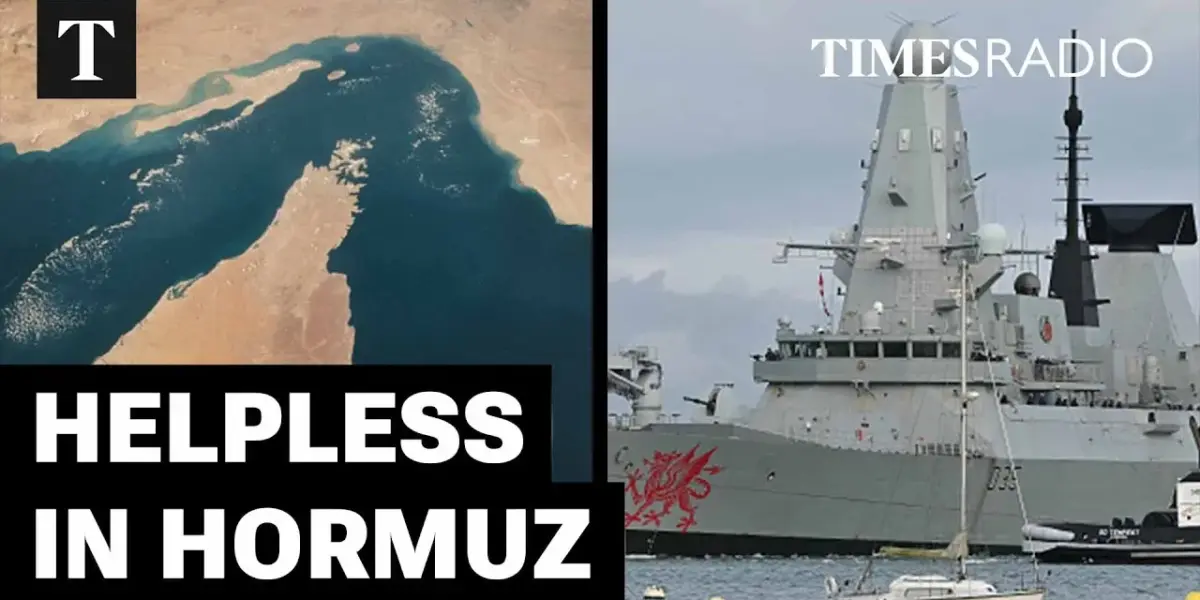
Britain’s Royal Navy is too small to deploy ships to the Strait of Hormuz, a former British Army intelligence officer stated, calling the idea of sending advanced destroyers to sweep for mines impractical.
The United Kingdom lacks the naval capacity to effectively respond to potential threats in the Strait of Hormuz, according to Dr. Lynette Nusbacher, a former British Army intelligence officer. She argued that Britain’s Royal Navy is no longer large enough to maintain a dedicated squadron in the Persian Gulf. Sending a highly specialized air defense destroyer, like the HMS Dragon, to perform mine-sweeping duties in the vital shipping lane would be impossible, she explained.
“We haven’t got anyone to send because the Navy isn’t big enough anymore for us to have a Persian Gulf squadron,” Dr. Nusbacher said. “If we took one of our very expensive air defense optimized destroyers like HMS Dragon, there is no way we’re going to turn that into a mind sweeper in the next couple of days and use that to mind sweep the straight of Hormuz.” She added that the UK does not have enough dedicated mine-sweeping vessels for such a task.
Government Explores Legal Avenues for Hormuz Intervention
The comments come as reports suggest the British government is exploring legal options to intervene and help secure the Strait of Hormuz. According to Steven Swinford, political editor for The Times, government lawyers are examining whether Britain can legally deploy naval assets to the region under the grounds of self-defense for its Gulf allies. However, Swinford cautioned that this does not guarantee deployment.
“There is a discussion in government, I’m told, that they have been taking legal advice on whether we can deploy naval assets to the Strait of Hormuz on the grounds of self-defense of our Gulf allies,” Swinford reported. He highlighted a significant issue: the UK currently has no seaworthy naval vessels in the Middle East. “For the first time in half a century, we have no naval assets in the Middle East, which is extraordinary and there will be repercussions for that in the long term.”
Criticism Over Lack of Naval Assets
Dr. Nusbacher expressed frustration with the government’s approach, suggesting it is more focused on consulting lawyers than on making policy and executing it. “The prime minister of the United Kingdom not making policy, not executing policy, but consulting his solicitors. It is like a Victorian novel,” she commented. “The prime minister has got to think about defending the interests of the United Kingdom, using armed force to do that or holding back armed force where it’s not the right thing to do.”
She questioned the point of legal consultations when the fundamental problem is a lack of available naval assets. Dr. Nusbacher also criticized the lack of clear communication and strategy from the US regarding operations in the region. “The Americans didn’t properly consult us on this operation. They didn’t explain what they’re trying to achieve and how they’re going to achieve it,” she stated. “They’ve made demands. They’ve issued insults. They’ve said it’s too late. They’ve said now send someone. This is a big mess.”
US President’s Disappointment with Allies
The situation unfolds against a backdrop of criticism from US President Donald Trump, who has expressed disappointment with the response from UK Prime Minister Boris Johnson and other European leaders regarding the conflict in Iran. Trump has suggested the US no longer needs NATO allies for such operations and has hinted at potentially withdrawing support for the alliance.
The President specifically criticized the UK’s reluctance to deploy warships to the Gulf. “I was disappointed because Kier was willing to send two aircraft carriers after we won because essentially we’re there’s no threat for the aircraft carriers right now,” Trump reportedly said, referring to UK Labour leader Keir Starmer. “And they said no, no, we want things sent before the war, not after the war is won. So yeah, I’m disappointed with I like him. I think he’s a nice man, but I’m disappointed.”
Broader Transatlantic Rifts
Dr. Nusbacher believes the rift between the US and the UK on this issue is not new. She traces it back to President Trump’s questioning of US commitment to NATO and support for Ukraine. “I think there has been a rift ever since Donald Trump walked into the Oval Office for his second term and started to say that he was no longer going to support Ukraine properly and that he was no longer going to be as committed to NATO as the United States has been since the Second World War,” she explained.
She suggested that much of the rhetoric from the US is an attempt to shift blame, arguing that President Trump did not adequately prepare for the possibility of Iran shutting down the Strait of Hormuz. “Donald Trump didn’t do his homework before this war started,” she stated.
Resignation Highlights Internal US Divisions
Adding another layer to the complex situation is the resignation of Joe Kent, the Director of the US National Counterterrorism Center. In his resignation letter, Kent argued that Iran posed no imminent threat to the United States and that the war was initiated due to pressure from Israel and its influential lobby in America. He stated the war is not justified.
President Trump dismissed Kent as weak on security. However, Dr. Nusbacher sees Kent’s resignation as significant, representing a segment of the MAGA and America First movements that believed Trump was committed to ending foreign wars. “Joe Kent is going to be leading a slice of Trump’s base away from him over this war,” she predicted. This internal division could affect Trump’s resolve to continue the conflict.
The challenges facing the Royal Navy, coupled with international political disagreements and internal US divisions, paint a complex picture of the UK’s role and capacity in responding to global security challenges. The long-term implications of reduced naval presence in key regions remain a significant concern.
Source: HMS Dragon Would Be Useless In The Strait Of Hormuz | Former British Army Intelligence Officer (YouTube)

Related Articles

G7 Allies Clash Over Iran War Strategy, Urge Focus on Russia
G7 foreign ministers met in Paris, revealing deep divisions over the U.S. war with Iran. European allies urged the U.S. to pressure Russia, linking its actions to the conflict and fearing support for Ukraine will wane.

Iran Blocks China Ships, Exposing Beijing’s Weak Grip
Iran's recent decision to block Chinese ships at the Strait of Hormuz is exposing the limits of Beijing's influence in the Middle East. This action is causing delays and cancellations for Chinese manufacturers, turning a perceived geopolitical win into an economic strain.

Rubio: US Can Achieve Iran War Goals Without Troops
Senator Marco Rubio outlined a strategy to counter Iran without deploying U.S. ground troops, focusing on weakening the regime and enhancing maritime security. He also criticized Cuba's economic system and expressed concerns about West Bank violence.