Global Leaders Divided on Strait of Hormuz Crisis
Global leaders are reportedly divided on forming a coalition to secure the Strait of Hormuz amidst rising oil prices and escalating regional tensions. Despite U.S. calls for international cooperation, key allies remain hesitant, citing a lack of consultation and a reluctance to engage militarily. The situation is compounded by mixed messaging regarding the threat level posed by Iran and its impact on global energy markets.


Global Leaders Divided on Strait of Hormuz Crisis
As global oil prices continue to fluctuate and concerns mount over energy security, international efforts to secure the vital Strait of Hormuz are showing significant divisions among key global powers. The United States has been actively seeking a coalition to ensure safe passage through the waterway, which accounts for roughly 20% of the world’s oil supply, but responses from potential allies have been mixed, with none publicly committing to military action thus far.
President’s Call for Coalition Meets Hesitation
President Trump has repeatedly urged other nations to join the U.S. in securing the Strait of Hormuz, emphasizing the need for a swift and enthusiastic response. However, many countries are hesitant to commit resources, citing a lack of prior consultation on the escalating conflict and a reluctance to be drawn into a regional war. “We strongly encourage other nations to get involved with us and get involved quickly and with great enthusiasm,” the President stated, though he acknowledged that some nations might prefer to remain unaligned publicly to avoid becoming targets.
White House correspondents report that the President’s attempts to rally support are facing an uphill battle. “It doesn’t seem like it, Kelly, because he’s trying to do this retroactively, right? He’s trying to kind of bring this coalition together to countries, asking them for help when they weren’t really consulted in the first place on launching this attack against Iran with Israel,” noted NBC News White House Correspondent Monica Alba. This retrospective approach, coupled with differing leadership styles and diplomatic approaches, has led to a cautious reception from allies like the United Kingdom, France, South Korea, Japan, and China.
Contradictory Messaging on Threat Level
Adding to the complexity, the President has simultaneously claimed that Iran has been militarily “obliterated” and its leadership “dismantled,” while also asserting that the U.S. could secure the Strait of Hormuz independently. This creates a perceived contradiction between the urgency of the situation and the reduced threat level described by the administration. “Yeah, I think there are kind of a myriad of contradictions that the President has been making here, because he is trying to make the argument that militarily, so many of these targets have been hit, so many of the objectives have been met,” Alba observed. This makes it difficult to declare victory while the economic implications, particularly concerning the Strait of Hormuz, remain unresolved.
Economic Impact: Oil Prices and Consumer Concerns
The disruption in the Strait of Hormuz has had a tangible impact on global energy markets. Crude oil prices surged, hitting $100 a barrel at one point, though they have since receded to around $93 a barrel. Despite this drop, prices remain approximately 40% higher than before the conflict began. Average gasoline prices are also climbing, nearing the $4 per gallon mark. Energy Secretary Chris Wright indicated that consumers might have to wait a few more weeks for prices to stabilize. “After the conflict is over, you’ll start to see prices come back down. It is a short-term disruption in the flow of energy. Americans are feeling it right now. Americans will feel it for a few more weeks, but at the end, we will have removed the greatest risk to global energy supplies,” Wright said.
Military Options and Coalition Feasibility
NBC News Senior National Security Correspondent Courtney Kube addressed the military aspects of forming a coalition and potential responses. While acknowledging that a multinational coalition could theoretically help ships navigate the Strait, she noted a lack of current momentum. “At this point, we don’t see any real momentum towards that goal,” Kube stated. Options include surveillance aircraft and air defense systems, but the fundamental challenge remains: countries may have an economic interest in the Strait’s safety but are unwilling to engage militarily due to the inherent risks. “The reality is the same exact threat that exists to the U.S. Navy would exist for all of those other militaries as well,” Kube added.
Regarding the critical oil depot on Kharg Island, Kube explained that while securing it is a possibility the U.S. has war-gamed, it would require thousands of troops and be a dangerous endeavor. The strategic value of Kharg Island could also be a factor if the administration seeks to control or leverage Iranian oil.
Role of AI and Disinformation
The discussion also touched upon the growing role of Artificial Intelligence (AI) in modern warfare and the spread of disinformation. AI is being used for intelligence purposes, aiding in target identification. However, concerns remain about the human oversight in the targeting process, particularly after a school was reportedly bombed. The President has expressed frustration with media outlets repeating AI-generated memes and fallacies, even as the White House itself utilizes AI content.
Internal Administration Dynamics
The interview segment also shed light on internal administration dynamics, particularly regarding the President and Vice President’s differing approaches to foreign policy. While not explicitly detailed, it was noted that the President acknowledged “philosophical differences” with the Vice President on the lead-up to the conflict. The appearance of the President and Vice President together at a public event after a period of separation was seen as significant, potentially signaling alignment or setting the stage for future discussions on these differences.
On-the-Ground Situation and Future Outlook
NBC News International Correspondent Matt Bradley provided an on-the-ground perspective from the region, reporting on ongoing missile alerts but also a return to normalcy in some aspects of daily life, with schools and businesses reopening. He also touched upon the uncertainty surrounding Iran’s leadership, with speculation arising from the absence of certain figures. The President himself has commented on the difficulty of knowing who to negotiate with, given the perceived lack of clear leadership in Iran.
Looking ahead, the administration faces the challenge of building a viable international coalition while managing domestic concerns about energy prices and the ongoing costs of the conflict. The daily presentation of “off-ramps” or options to end the war to the President suggests a complex decision-making process, though current military objectives appear to remain the priority. The coming weeks will be critical in determining whether diplomatic efforts can succeed in stabilizing the Strait of Hormuz and reassuring global energy markets.
Source: Meet the Press NOW — March 16 (YouTube)

Related Articles

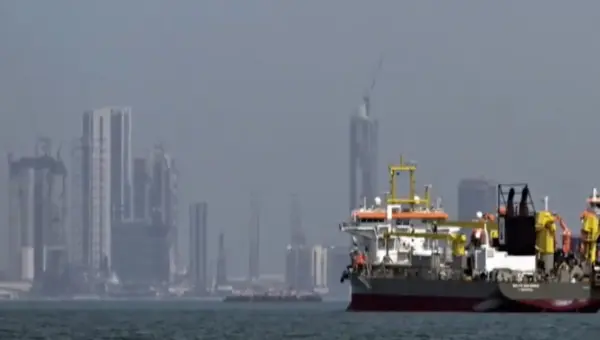
Iran Blocks China Ships, Exposing Beijing’s Weak Grip
Iran's recent decision to block Chinese ships at the Strait of Hormuz is exposing the limits of Beijing's influence in the Middle East. This action is causing delays and cancellations for Chinese manufacturers, turning a perceived geopolitical win into an economic strain.
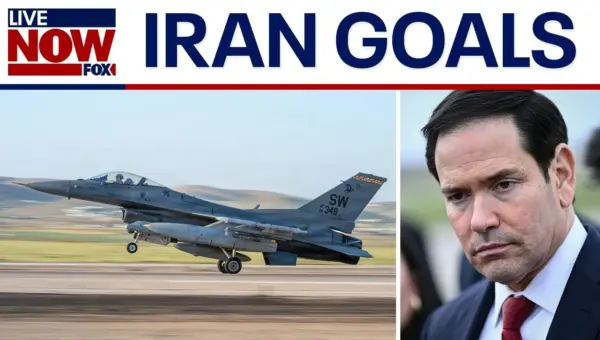
Rubio: US Can Achieve Iran War Goals Without Troops
Senator Marco Rubio outlined a strategy to counter Iran without deploying U.S. ground troops, focusing on weakening the regime and enhancing maritime security. He also criticized Cuba's economic system and expressed concerns about West Bank violence.


Israel Escalates Iran Strikes, Warns of Wider War
Israel has launched significant strikes inside Iran following continued missile fire, warning of further escalation. The conflict risks wider regional instability and economic disruption, especially concerning the Strait of Hormuz.