Habermas: The Philosopher Who Championed Public Discourse
Jürgen Habermas, a seminal philosopher born in 1929, dedicated his life to understanding how democracies survive and thrive through public discourse. His theories on the public sphere and communicative action emphasize the critical role of open debate and reasoned dialogue in holding power accountable and fostering societal understanding. Habermas's work remains a vital guide for contemporary democratic engagement.

Habermas: The Philosopher Who Championed Public Discourse
In an era often dominated by the electoral process, the fundamental question of how democracy truly begins – and thrives – lies not just at the ballot box, but in the very act of conversation. This was the central tenet of Jürgen Habermas, a towering figure in modern philosophy whose ideas have profoundly shaped our understanding of democracy, communication, and the public sphere. Born in Germany in 1929, Habermas’s formative years were shadowed by the horrors of the Nazi dictatorship. Witnessing the rise and fall of authoritarianism, particularly at the tender age of 15 when World War II concluded, instilled in him a lifelong quest to understand how democracies can not only survive but also resist the resurgence of oppressive regimes.
The Power of Communication in Democracy
Habermas posited that genuine democracy is cultivated through continuous public discourse. It is not merely a system of governance enacted through elections, but a dynamic process where citizens actively engage in debate, argumentation, and reasoned deliberation. This belief became the bedrock of his seminal work on the concept of the ‘public sphere’.
The Public Sphere: A Bulwark Against Authoritarianism
In his influential book, The Structural Transformation of the Public Sphere, Habermas meticulously outlined how open debate within various societal institutions – including the media, academic circles, and civil society organizations – serves as a crucial mechanism for holding political power accountable. This ‘public sphere’ acts as a vital intermediary, translating the concerns and opinions of citizens into a force that can influence and check governmental authority. It is in these spaces that ideas are tested, policies are scrutinized, and a collective understanding of societal needs can emerge.
Communicative Action: Reaching Shared Understanding
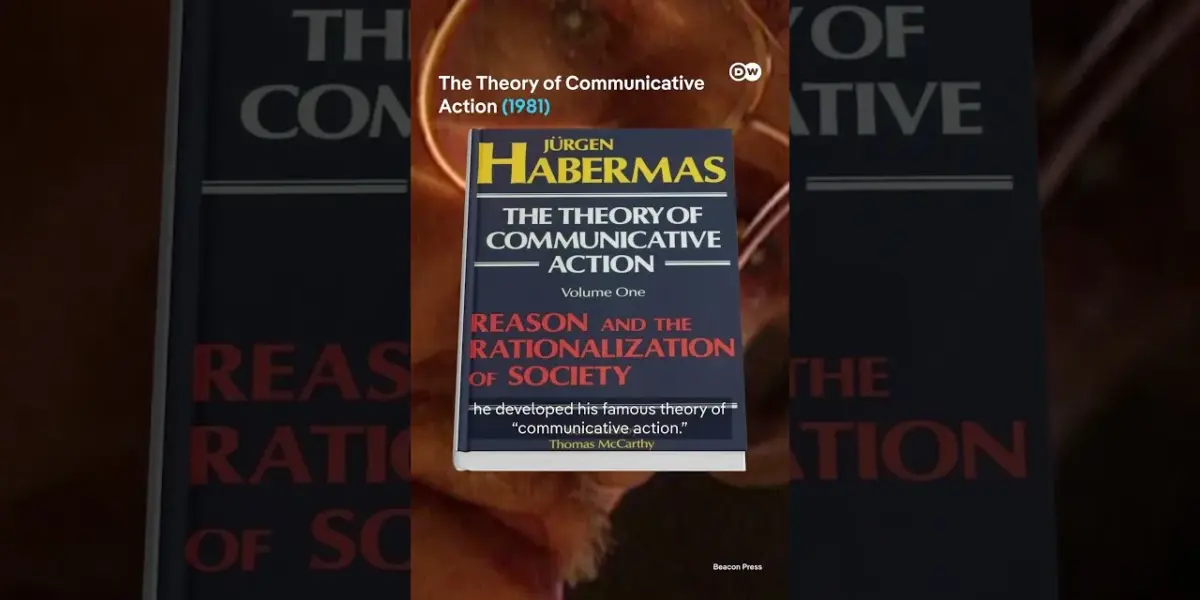
Further developing his theories, Habermas introduced the groundbreaking ‘theory of communicative action’. This theory delves into the ways in which individuals can achieve mutual understanding and consensus through open, rational dialogue. He argued that the capacity for such communicative action is essential for the health and legitimacy of democratic societies. The profound impact of this work is underscored by its translation into over 50 languages, solidifying Habermas’s position as one of the most widely read and internationally recognized philosophers of his generation.
Beyond Academia: A Public Intellectual
Habermas was not content to confine his profound insights to the ivory towers of academia. He consistently engaged with contemporary political issues, offering sharp analysis and often controversial perspectives. A notable example was his stance on German reunification in 1990. Habermas controversially criticized the process, viewing it not as a democratic unification but as an ‘undemocratic annexation’ of East Germany by the West. He articulated his concerns:
“The old Federal Republic had developed a certain sense for the dialectic of normalization. That is a sense that only the avoidance of a self-satisfied covering up consciousness of normality had allowed halfway normal conditions to emerge in our country.”
This critique highlighted his unwavering commitment to democratic principles, even when it meant challenging prevailing national sentiments. He also sounded alarms regarding the rise of right-wing populism across Europe, urging for more robust and engaged democratic participation from citizens.
Enduring Legacy: The Importance of Dialogue
Jürgen Habermas’s enduring legacy rests on his powerful conviction that democratic societies remain vibrant and resilient only when their citizens actively engage in perpetual dialogue. This involves not just speaking, but also listening critically, questioning assumptions, and striving for reasoned consensus. His life’s work serves as a critical reminder that the foundations of democracy are built not on silence or decree, but on the ongoing, often challenging, but ultimately vital process of public conversation.
Looking Ahead
As contemporary societies grapple with increasing polarization, the spread of misinformation, and challenges to democratic institutions, Habermas’s emphasis on reasoned public discourse remains more relevant than ever. Future discussions will likely continue to explore how his theories can be applied to navigate the complexities of the digital public sphere and to foster a more inclusive and deliberative form of democracy in the 21st century.
Source: Who was Jürgen Habermas? | DW News (YouTube)

Related Articles


Jane Fonda Warns of ‘Existential Crisis’ Amid Protests
Jane Fonda has issued a stern warning about widespread attacks on the First Amendment, urging Americans to defend their freedoms. The veteran activist highlighted the growing number of large-scale protests as a sign of public concern and a crucial opportunity to address both democratic erosion and the climate crisis.


Mass Protests Erupt as Trump Approval Plummets
Thousands of 'No Kings' rallies are scheduled nationwide, protesting perceived autocratic actions by Donald Trump. As Trump's approval ratings fall, concerns grow over his challenges to democratic norms and the rule of law.


Millions Rise Up: A Defiant Stand Against Authoritarianism
Millions are protesting, calling their movement 'No Kings.' Organizers see it as a chance to make history and send a message against what they call an existential threat. The movement emphasizes community and collective action to counter feelings of hopelessness.