Britain’s Skyperion Sensor: Ukraine’s Drone War Tests Its Limits
Ukraine's battleground is testing Britain's Skyperion RF sensor against Shahed drones. While effective against emitting targets, its inability to detect radio-silent autonomous variants highlights the evolving tactics and the critical need for layered, diverse air defense systems rather than single solutions.

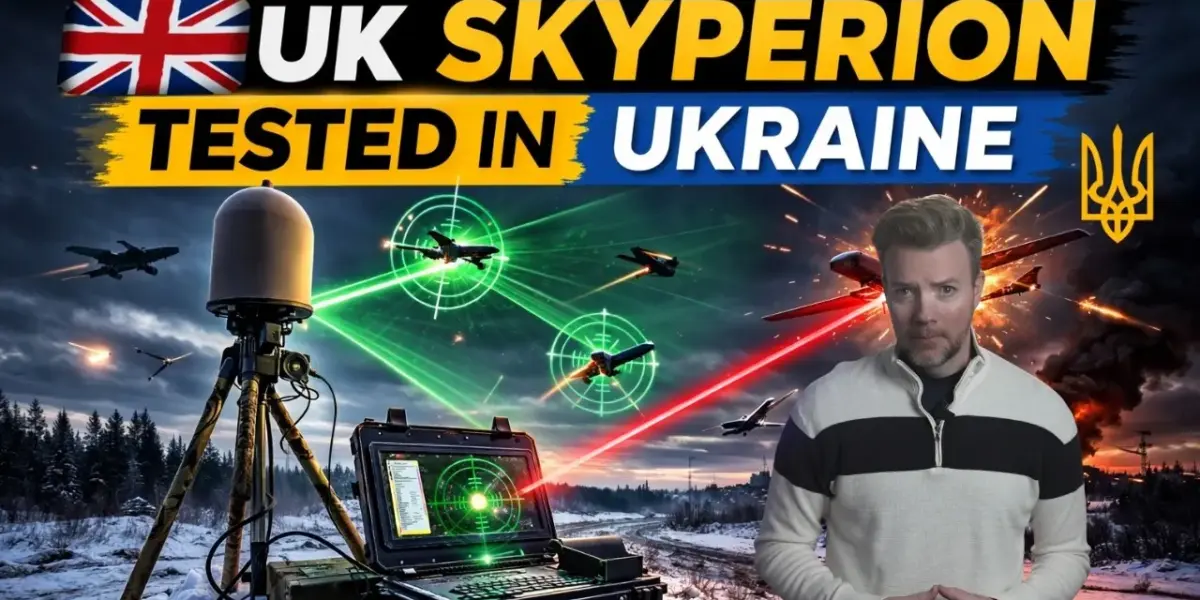
Britain’s Skyperion Sensor: Ukraine’s Drone War Tests Its Limits
The ongoing conflict in Ukraine has transformed into a relentless proving ground for advanced military technology, particularly in the realm of air defense. Night after night, the skies become a canvas for tracer fire and the ominous hum of incoming threats, with Ukrainian defenders striving to intercept drones like the Shahed series. Amidst this high-stakes environment, a new British system, the Skyperion lightweight passive RF sensor from Metis Aerospace, has undergone testing. While the initial headlines suggest a straightforward “Shahed detector,” a deeper dive reveals the complex and evolving nature of counter-drone warfare.
The Promise and Peril of Passive RF Detection
The Skyperion system is designed to detect Shahed 131 and 136 variants by identifying their radio frequency (RF) emissions. These signals can include telemetry data, video links, or cellular modem communications. Crucially, the system can also perform bearing localization, indicating the direction from which these signals originate. This capability is significant, especially as Russia reportedly begins arming Shaheds with air-to-air missiles or man-portable air-defense systems (MANPADS), which would require a video signal for manual targeting.
However, the very nature of passive RF detection presents a fundamental limitation. The Skyperion can only detect drones that are actively emitting signals. The problem arises with Shahed variants configured for fully autonomous flight using GNSS-aided inertial navigation systems. In this mode, the drones can operate in a “radio silent” state, emitting no RF trail for passive sensors to intercept. This is not a flaw in the technology, but rather a consequence of physics and the evolving tactics of the adversary.
Understanding the Technology: A Deeper Dive
Wes O’Donnell, an expert familiar with RF systems, breaks down the Skyperion’s functionality. As a passive RF monitoring sensor, it operates by listening rather than transmitting, thus not revealing its own position. It scans a broad spectrum (approximately 30 MHz to 18 GHz) for signals matching known drone signatures and uses a signature library for classification. Modern drones often communicate with operators, payloads, or cellular networks, leaking RF emissions that can be detected.
The advantage of passive RF is its ability to detect threats earlier than visual observers or even some short-range radars, all while remaining covert. Yet, its Achilles’ heel is its reliance on emissions. If a drone is silent, it is invisible to this type of sensor. The autonomous, radio-silent Shahed, navigating via satellite and inertial systems, bypasses this detection method entirely. This is analogous to trying to jam a fiber optic connection; if there’s no wireless signal, a traditional jammer is useless.
Ukraine: The Ultimate Counter-Drone Laboratory
Since 2022, Ukraine has been operating the world’s most demanding counter-drone testing environment. Companies worldwide are eager to demonstrate their capabilities, and the Ukrainian military’s pragmatic approach is well-known: if a system works, it’s deployed; if it fails, it becomes a learning experience.
The headline “Shahed detector” is an oversimplification. The pertinent question is not *if* a system detects a Shahed, but *which* Shahed, in *what configuration*, under *which conditions*, and *paired with what other systems*. Skyperion’s success in detecting variants with RF emissions is valuable. If Russia utilizes specific routes or regions where these emissions are present, they become exploitable fingerprints. However, the autonomous configuration exists precisely to negate these fingerprints, creating a continuous cycle of countermeasures and counter-countermeasures that defines drone warfare.
The Necessity of Layered Defense
The challenge for Ukraine’s air defense is immense, requiring protection for cities, critical infrastructure, air bases, and front-line logistics against a diverse array of threats, including Shaheds, cruise missiles, ballistic missiles, and smaller, low-flying drones. This necessitates a layered detection approach.
Skyperion, according to Metis, is designed for integration into multi-sensor counter-UAS setups. This is the correct framing: a single RF sensor is not air defense in itself but a crucial component of a larger sensing stack. A layered defense architecture typically involves:
- Passive RF Sensors (like Skyperion): Best for detecting active emissions and providing bearing, useful for cueing other sensors.
- Radar: Effective at detecting physical objects, including silent ones, though it can struggle with small drones in cluttered, low-altitude environments.
- Electro-Optical/Thermal Cameras: Used for confirmation and tracking, but are line-of-sight and weather-dependent, requiring significant operator workload.
- Acoustic Sensors: Can aid in some scenarios but are limited by ambient noise and range.
The ideal architecture sees these systems working in concert: RF or radar detects an object, which cues cameras for identification, leading to a targeted engagement by guns, missiles, electronic warfare, or interceptor drones. Skyperion’s value lies in its contribution to early warning, cueing, and providing additional classification data, helping defenders decide the most efficient use of limited interceptors.
The Arms Race of Adaptation
A significant implication of Skyperion’s limitations is the potential for Russia to increasingly favor the autonomous, radio-silent Shahed variants as Ukraine improves its ability to hunt RF emissions. This highlights a critical dynamic: success in one detection method can drive the adversary towards exploiting the blind spots of other methods. If air defense relies too heavily on a single sensing modality, the enemy will adapt and circumvent it.
Why This Matters
The Skyperion test in Ukraine underscores a fundamental tension between the demands of modern warfare and traditional defense procurement. Western defense procurement often favors clear requirements, stable threats, and standardized testing. Ukraine, however, presents a fluid battlefield where threats mutate rapidly, environments are hostile, and evaluations occur under intense pressure. The capability demonstrated today can become obsolete the moment the enemy adapts.
This situation yields two critical strategic lessons:
- Modularity and Adaptability: Systems must be designed for integration into broader networks, allowing for rapid swapping of components and quick updates to signature libraries. Metis’s framing of Skyperion as integrable and signature-library-driven aligns with this principle.
- Sensor Diversity: A layered defense, while more complex to manage, is far more resilient. While an enemy can neutralize one detection method (e.g., by going radio silent), they cannot simultaneously erase all signatures. Silent drones still possess physical characteristics detectable by radar, thermal imaging, or even acoustics, and must still traverse physical terrain.
The Ukrainian Industrial Context
Adding another layer of complexity, Ukraine possesses its own burgeoning domestic defense industry. Ukrainian manufacturers are developing comparable RF solutions and adapting them rapidly to battlefield needs. This reality can make large-scale procurements of imported systems less likely, unless they arrive as military aid or fill a very specific, unmet niche. The speed at which local teams can modify systems in weeks contrasts sharply with the longer procurement cycles of foreign defense contractors, a critical factor when lives are on the line.
Conclusion: A Piece of the Puzzle, Not the Whole Picture
The Skyperion’s testing in Ukraine is not a story of failure, but a nuanced demonstration of what passive RF sensors can and cannot do. It successfully detected Shaheds that were communicating, but predictably, could not detect those operating in radio silence. This is an expected outcome, acknowledged by Metis itself.
The true takeaway is a warning against the misconception that any single sensor type can be a panacea for the drone threat. The Shahed, and drone threats in general, are diversifying. Some emit, some go silent, some leverage cellular networks, and others fly with sophisticated autonomous navigation. Defenses must anticipate and adapt to this evolution, recognizing that the enemy is already doing so.
Skyperion is a valuable component within a layered counter-drone network, offering crucial early warning and cueing capabilities. However, it is not a magical shield. It is akin to a sensitive microphone in a noisy room – it can only pick up the voices that are speaking. The ongoing adaptation by both sides in Ukraine underscores the dynamic and complex nature of modern warfare, where continuous innovation and layered resilience are paramount for survival.
Source: Ukraine Tests Skyperion: Does Britain's Sensor Stop Shahed Drones? (YouTube)

Related Articles


Ukraine Strikes Russian Oil Refinery, Eyes Iran Threat
Ukrainian forces struck a key Russian oil refinery, disrupting Moscow's war capabilities. Meanwhile, Finland's president urged continued U.S. support for Ukraine, as Kyiv shares its air defense expertise globally amid growing geopolitical complexities involving Iran and potential sanctions against Hungary.

US Weighs Shifting Ukraine Weapons to Iran Amid Missile Shortage
The U.S. is reportedly considering diverting weapons destined for Ukraine to support operations against Iran, driven by rapidly depleted missile stocks. This potential shift raises concerns about Ukraine's defense capabilities and highlights the complex interplay between global conflicts.


Ukraine Strikes Cripple Russian Oil Exports
Ukrainian drone strikes are crippling Russia's oil exports and damaging its economy, leading to falling domestic support for President Putin. The targeted attacks on refineries and terminals aim to cut off war funding and have significant geopolitical consequences.