Iran War of Survival: US Faces Gulf Crisis
The US and Israel's 'war of choice' against Iran has escalated into a 'war of survival' for Tehran, leading to threats against the Strait of Hormuz. Miscalculations by US leadership and the pervasive threat of Iranian drones have created a global energy crisis, with no easy solutions in sight.


US and Israel’s ‘War of Choice’ Triggers Iran’s ‘War of Survival’
In a rapidly escalating geopolitical crisis, the United States and Israel initiated a conflict with Iran under the premise of a ‘war of choice,’ aiming for swift disarmament. However, Iran, facing existential threats and the specter of regime change, has reframed the engagement as an ‘all-or-nothing battle for survival.’ This divergence in strategic objectives is now converging, forcing the US and its allies to confront the severe global energy shock and the potential closure of the vital Strait of Hormuz.
The Strait of Hormuz: A Critical Chokepoint Under Threat
The Strait of Hormuz, a narrow waterway through which a significant portion of the world’s oil supply passes, has become the focal point of the crisis. Iran’s threats to disrupt or close the strait, employing tactics such as drone attacks and mining, have sent shockwaves through global energy markets. The potential impact on oil prices and regional economies is a primary concern for international powers.
“Iran entered the war once some language about regime change had been used by uh uh Donald Trump and Benjamin Netanyahu as an all or nothing battle for survival uh in which they would use any tactic necessary including blowing up half the Gulf’s oil industry and shattering the economies of their neighbors.”
US Miscalculations and the Reality of Iranian Tactics
Mark Urban, a columnist for The Sunday Times, suggests that a key failing has been a miscalculation by senior US political leadership. Assumptions that the conflict would be short-lived and that Iran would not risk closing the strait appear to have been overly optimistic. While military planners, including those in the Pentagon and the Royal Navy, have long considered scenarios involving the closure of the Strait of Hormuz, and have even conducted war games and exercises, the US seemed unprepared for the current reality.
The experience of the 1980s ‘tanker war,’ where Iran harassed shipping and the US and its allies escorted vessels, provides a historical precedent. However, current capabilities, particularly for the UK, have been diminished due to financial pressures and manpower shortages, leading to the shutdown of crucial mine-sweeping capabilities shortly before the current conflict began.
The Challenge of Opening the Strait
Reopening the Strait of Hormuz by military means, should the US decide to pursue this route, presents a monumental logistical challenge. Urban estimates that such an operation would require hundreds of aircraft and dozens of ships, taking months to assemble and execute. During this period, the energy price crisis would undoubtedly continue to escalate.
Philip Crowther, an Associated Press correspondent based in Dubai on the UAE side of the Strait of Hormuz, reports minimal shipping traffic. He notes that oil, transport, and insurance companies deem the risk too high, leading to skyrocketing insurance rates and a general cessation of attempts to cross the strait. While there haven’t been direct attacks on ships in the last 72 hours, the threat remains palpable. Exceptions to the blockade are rare, typically involving ships bound for India or those linked to China, which appear to be allowed passage under specific agreements with the Iranian regime.
Drones and the Climate of Fear
The effectiveness of low-cost drones, even when they do not directly hit targets, is a significant factor. Gulf countries, including the UAE and Saudi Arabia, are experiencing dozens of drone attacks daily. While air defenses are largely successful in intercepting these threats, the constant barrage creates a pervasive climate of fear. The incident at Dubai International Airport, where a drone fragment hit a fuel depot, leading to the airport’s closure, underscores the disruptive potential of these weapons.
Crowther highlights the difficulty in stopping cheap drones and the potential for Iran to mine the strait, although confirmation of such actions remains elusive. The Trump administration’s calls for an international coalition to secure the strait have so far seen little uptake, with no firm commitments from countries like China, Japan, South Korea, the United Kingdom, or France.
An Uncertain Future
The current situation suggests a prolonged period of uncertainty. The US is facing pressure to act, but the path forward is fraught with complexities. A military solution is logistically daunting and time-consuming, while a diplomatic resolution seems distant as long as the US and Israel continue their actions against Iran. The ongoing conflict, initiated as a ‘war of choice,’ has evolved into a high-stakes struggle for survival, with global economic stability hanging precariously in the balance.
What happens next will depend on whether the US can rally an international coalition, the effectiveness of its military options if pursued, and Iran’s willingness to de-escalate its actions in the Strait of Hormuz. The world watches closely as this critical chokepoint navigates an unprecedented crisis.
Source: US & Israel In A ‘War Of Choice’: Iran In A ‘War Of Survival’ | Mark Urban (YouTube)

Related Articles


US Cardinal’s Papal Upset Redraws Vatican Influence
Pope Francis's election defied expectations, including his own, as an American cardinal believed an "American" Pope was unthinkable. The swift conclave surprised many, highlighting the unpredictable nature of papal selections and signaling a potential shift in the Church's global direction.


Mexico Navigates US-China Rivalry
Mexico is caught in a geopolitical tug-of-war between the United States and China. The nation must carefully balance its economic needs and strategic interests with both superpowers. This situation highlights Mexico's growing importance in global affairs.
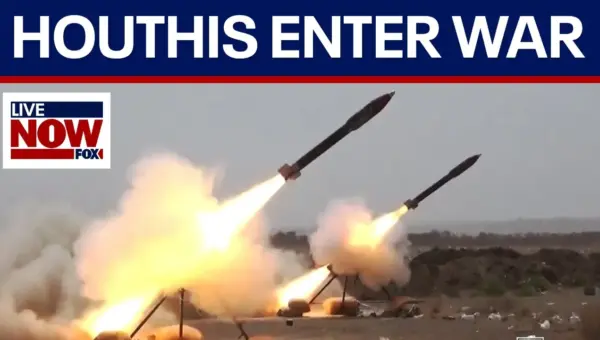
Iran-Backed Houthis Strike Israel, Escalating Regional Tensions
Iran-backed Houthi rebels have launched a missile attack targeting Israel, marking their first such strike since the current Middle East conflict began. The Israeli military confirmed the interception of the projectile. Analysts view this action as part of Iran's broader regional strategy, highlighting the regime's reliance on proxy forces amid internal weaknesses.