Trump’s ‘Holy War’ Fuels Christian Nationalism’s Global Aims
Author Tia Levings argues that Donald Trump's political actions, particularly his foreign policy towards Iran, are viewed by Christian Nationalists as a "holy war." She contends this movement is pursuing a global agenda of ethnic and religious cleansing, impacting both the U.S. and international relations.

Trump’s ‘Holy War’ Fuels Christian Nationalism’s Global Aims
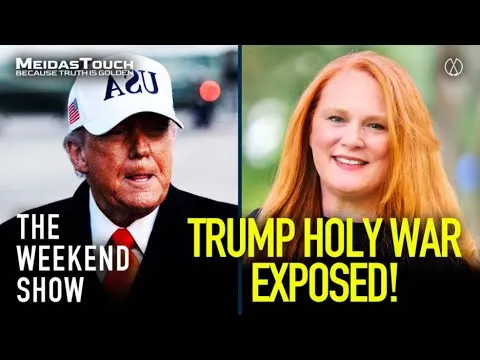
The intersection of political power and religious fervor is a recurring theme in human history, often leading to significant social and geopolitical consequences. In contemporary America, this nexus is particularly evident in the rise of Christian Nationalism, a movement that author and former Christian fundamentalist Tia Levings argues is inextricably linked to Donald Trump’s political agenda, specifically what she terms his “holy war” on Iran. Levings, speaking on The Weekend Show, posits that this movement is not merely a domestic phenomenon but actively pursues a global agenda of “ethnic and religious cleansing,” both within the United States and internationally.
The Doctrine of Christian Nationalism
Christian Nationalism, as understood by its critics and many scholars, is an ideology that fuses Christian identity with American identity, asserting that the United States was founded as a Christian nation and should be governed according to Christian principles. While proponents often frame this as a return to traditional values, critics, including Levings, see it as a dangerous ideology that seeks to establish a theocratic or quasi-theocratic state and exclude those who do not conform to its specific brand of Christianity.
Levings’s critique suggests that this movement is not content with influencing domestic policy but extends its ambitions to foreign policy, viewing geopolitical events through a specific, often apocalyptic, religious lens. The “holy war” rhetoric, as applied to Trump’s foreign policy, particularly concerning Iran, implies a belief among some adherents that specific nations or leaders are divinely ordained to act against perceived enemies, often framed in religious or civilizational terms.
Trump’s Role and the ‘Crusade’ Narrative
Donald Trump’s political persona has, for many years, resonated with a significant segment of the evangelical Christian population. His rhetoric, often perceived as strong and decisive, coupled with his appointments of conservative judges and his administration’s pro-Israel policies, has been interpreted by many Christian Nationalists as a sign of divine favor or even a mandate. Levings suggests that Trump’s actions and pronouncements, particularly in foreign policy, are not just geopolitical decisions but are seen by this base as part of a larger, divinely sanctioned struggle.
The concept of a “crusade” evokes historical religious wars, and when applied to the current context, it carries a heavy implication of righteous conflict against perceived infidels or enemies of faith. Levings’s assertion that Christian Nationalists are “leading a crusade of ethnic and religious cleansing” is a grave accusation. This suggests a belief system that not only seeks to impose its religious and cultural norms but actively aims to marginalize, oppress, or eliminate those who differ. Such rhetoric, when linked to state power or political movements, raises serious concerns about human rights and international stability.
Global Ambitions and Domestic Echoes
The idea that Christian Nationalism operates on a global scale is a critical component of Levings’s analysis. This suggests that the movement’s influence is not confined to the United States but seeks to shape international relations and policies in alignment with its worldview. The focus on Iran, a predominantly Muslim nation, as a target for this perceived “holy war” aligns with broader geopolitical tensions and the specific religious interpretations held by some Christian Nationalist factions.
Furthermore, the claim of “ethnic and religious cleansing” within the U.S. points to domestic policies and social trends. This could refer to efforts to restrict immigration, limit LGBTQ+ rights, influence public education curricula, or promote a singular, exclusive vision of American identity that marginalizes minority religions and cultures. The underlying ideology, according to this perspective, is one of purity and exclusion, seeking to “cleanse” the nation of elements deemed incompatible with its Christian Nationalist vision.
Historical Context and Modern Manifestations
The concept of religious groups seeking to impose their will on society and government is not new. Throughout history, various religious movements have sought political influence, sometimes leading to periods of persecution or intolerance. In the United States, the tension between religious freedom and the establishment of religious dominance has been a persistent undercurrent. The rise of Christian Nationalism represents a contemporary, and for many, a particularly aggressive, manifestation of this historical dynamic.
The post-World War II era saw the rise of the religious right in American politics, which gained significant traction by mobilizing around social issues and a perceived decline in traditional values. Christian Nationalism, however, is often seen as a more radical evolution, moving beyond mere influence to a desire for direct control and the redefinition of the nation’s foundational identity. Trump’s presidency provided a focal point for many of these sentiments, offering a political figure who, intentionally or not, amplified and legitimized these aspirations for a significant portion of the electorate.
Why This Matters
The implications of Levings’s analysis are profound. If Christian Nationalism, as embodied by its alignment with figures like Trump and its “holy war” rhetoric, is indeed pursuing a global agenda of ethnic and religious cleansing, it poses a direct threat to:
- International Peace and Stability: Religious justifications for conflict can escalate tensions and lead to devastating wars.
- Human Rights: The pursuit of ethnic and religious purity inherently infringes upon the rights of minority groups and individuals.
- Democratic Values: A movement seeking to establish a religiously defined nation-state challenges the principles of secular governance and pluralism.
- Religious Freedom: Ironically, a movement claiming to defend Christianity may end up persecuting other faiths and even dissenting Christian denominations.
Trends and Future Outlook
The ongoing influence of Christian Nationalism within certain political circles suggests that this movement is not a fleeting phenomenon. Its ability to mobilize voters, shape political discourse, and influence policy remains a significant factor in American politics. The “holy war” narrative, whether literal or metaphorical, highlights a worldview that can justify aggressive actions and intolerance.
The future outlook depends on several factors: the continued engagement of critics and counter-movements, the political strategies of leaders who appeal to this base, and the broader societal response to the challenges posed by exclusive ideologies. Levings’s perspective serves as a stark warning, urging a closer examination of the ideological underpinnings of political movements and their potential for both domestic and international impact.
The discourse surrounding Trump’s “holy war” on Iran, as presented by Levings, forces a confrontation with the potent and potentially dangerous fusion of religious fundamentalism and political power. It underscores the need for vigilance in safeguarding democratic institutions and promoting a pluralistic society that respects the dignity and rights of all individuals, regardless of their faith or ethnicity.
Source: LIVE: Ex-Christian Fundamentalist BLOWS LID off Trump HOLY WAR (YouTube)

Related Articles

US Cardinal’s Papal Upset Redraws Vatican Influence
Pope Francis's election defied expectations, including his own, as an American cardinal believed an "American" Pope was unthinkable. The swift conclave surprised many, highlighting the unpredictable nature of papal selections and signaling a potential shift in the Church's global direction.

Mexico Navigates US-China Rivalry
Mexico is caught in a geopolitical tug-of-war between the United States and China. The nation must carefully balance its economic needs and strategic interests with both superpowers. This situation highlights Mexico's growing importance in global affairs.
Europe Strikes New Trade Deals, Eyes Global Influence
The European Union is actively forging new trade alliances, notably with South American nations like Brazil, to reduce reliance on China and the US. Driven by the need for critical resources like rare earth metals and the desire to boost its own industries, Europe is making strategic concessions and seeking new markets, despite facing internal criticism and a changing global economic landscape.