US Army’s New ‘BFG’ Machine Gun Redefines Combat
The U.S. Army's new RM338 machine gun offers unprecedented firepower and range, potentially reshaping infantry tactics and triggering a global arms race. This analysis delves into its technological advancements, strategic implications, and the ongoing debate about its role.

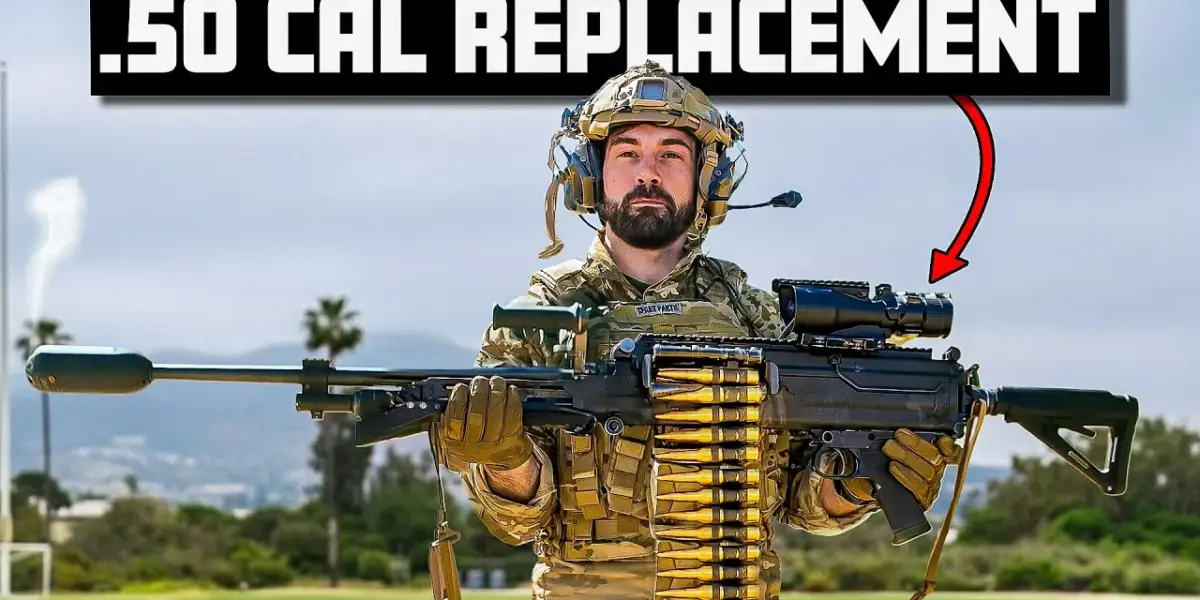
US Army’s New ‘BFG’ Machine Gun Redefines Combat
The U.S. Army is on the cusp of a significant shift in its infantry capabilities with the development of the RM338, a man-portable machine gun designed to bridge a critical gap in firepower and range. Touted as the world’s most powerful machine gun that a single soldier can carry, the RM338 fires the formidable .338 Norma Magnum round, offering approximately twice the firepower and range of the standard M240. This innovation is not merely an incremental upgrade; it represents a potential paradigm shift in ground combat tactics, prompting a global arms race, with China reportedly developing its own .338 caliber machine gun in response.
Bridging the Capability Gap
For over two decades, U.S. infantry units have grappled with a tactical dilemma: either carry the reliable but outranged M240, or deploy the powerful but cumbersome M2 .50 caliber machine gun, which often requires specialized transport like a forklift. This capability gap became acutely apparent in environments requiring extended reach, such as mountainous terrain.
The RM338, a product of the Army’s Future Medium Machine Gun (FMMG) program initiated around 2010, aims to solve this problem. The program seeks a weapon that can deliver .50 caliber-like effects in a more manageable, man-portable package. The RM338 is a leading contender in this multi-billion dollar competition, designed to offer a ’50-ish effect’ without the logistical burden of its larger counterpart.
Technological Advancements Driving Overmatch
The breakthrough lies in advancements in ammunition and precision machining. The .338 Norma Magnum cartridge boasts triple the performance of the 7.62x51mm NATO round used in the M240, delivering over 6,300 joules of muzzle energy. Crucially, it offers .50 caliber-level performance at roughly half the size and weight of a .50 caliber round.
Key to its effectiveness is its ballistics. The .338 Norma Magnum round travels at approximately 2,750 feet per second and maintains supersonic performance beyond 1,700 meters. This allows for direct fire engagement at extreme ranges, a stark contrast to the ‘plunging fire’ (lobbing rounds in an arc) often necessary with the M240 at similar distances. Plunging fire is less accurate and often insufficient to penetrate armored vehicles at those ranges.
The weapon itself is remarkably compact for its power, measuring around 49 inches long with a 24-inch barrel, and weighing approximately 25 pounds unloaded – comparable to the M240. This portability is achieved through innovative recoil mitigation technologies, including short recoil and gas operation. These systems effectively reduce the felt recoil to that of a 7.62mm weapon, despite the significantly more powerful cartridge. The design also incorporates a one-handed barrel swap and a simplified operating group with fewer parts than the M240, suggesting improved maintainability and durability.
A New Era of Tactics and Doctrine
The RM338 is poised to reshape infantry tactics. Its extended range and accuracy enable smaller units to project power over greater distances, enhancing standoff capabilities. This is particularly relevant for the Army’s envisioned future conflicts, which may involve distributed operations from small, isolated bases, such as those in the South China Sea.
The weapon’s precision, with claims of accuracy between 2.5 to 4 MOA (Minute of Angle) for a belt-fed machine gun, is exceptional. It offers select-fire capability, including semi-automatic fire, allowing for precise single-round engagements at ranges exceeding 400 meters, akin to a Designated Marksman Rifle (DMR). This dual capability could make it effective for overwatch, counter-sniper roles, or engaging drones.
Furthermore, the RM338 features an optics mounting system that attaches to the receiver rather than the feed cover, ensuring that zero is maintained even after barrel changes – a significant improvement over legacy systems.
The Question of Replacement and Integration
A central debate surrounds what the RM338 will actually replace. While official documents sometimes label it as an M240 replacement, its capabilities suggest it’s more of a new class of weapon. The M240, a beloved and battle-proven system in service since 1977, is unlikely to be fully retired soon.
Budget documents indicate the FMMG program is intended to replace M240s within the Close Combat Force (CCF) to enhance survivability and lethality in large-scale combat operations. However, Special Operations Command (SOCOM) has also explored adopting the .338 machine gun to replace some of their .50 caliber assets. The Marine Corps has similarly considered it as a replacement for both.
The integration into existing squad and platoon structures remains a complex question. Traditional infantry platoons feature M249s and M4s at the squad level, with M240Bs in a heavy weapons squad. The RM338’s placement – whether it augments or replaces existing weapons, or forms a new dedicated role – is still being determined. The Army’s strategy often involves framing new acquisitions as replacements to justify funding, highlighting capability gaps rather than introducing entirely new concepts upfront.
Addressing Logistical and Durability Concerns
A key concern is the potential logistical strain of introducing a new ammunition type. While the .338 Norma Magnum offers superior performance, it requires a robust supply chain. The Army claims it can ramp up production, and True Velocity’s development of polymer-cased ammunition could mitigate weight issues, potentially reducing ammunition load by up to 30% compared to brass-cased rounds.
Durability is another critical factor. The M240 and .50 caliber are renowned for their reliability. The RM338 program has reportedly endured extensive testing, with claims of over 350,000 rounds fired during development and exceptional suppressor durability. Initial maintenance is scheduled at 2,000 rounds, with the first cleaning at 4,000 rounds, suggesting a design that prioritizes longevity.
The weapon also offers features like a folding stock for vehicle transport, modular trigger options, and the ability to convert to 7.62mm for training purposes, adding to its versatility.
Why This Matters
The RM338 represents a significant leap in infantry firepower, directly addressing a long-standing tactical deficiency. Its development signals a broader shift in military thinking towards achieving ‘overmatch’ – not just matching, but significantly exceeding, the capabilities of potential adversaries. The fact that China is reportedly racing to develop a similar weapon underscores the perceived strategic importance of this technological advancement.
The implications extend beyond the battlefield. The competition for the FMMG program, worth billions, drives innovation within the defense industry. The debate over how to integrate such a potent weapon into existing doctrine and force structures highlights the ongoing challenge of adapting military organizations to rapidly evolving technology. The RM338 is not just a new gun; it’s a catalyst for rethinking how infantry fights and wins wars in the 21st century.
Future Outlook
The RM338’s path to widespread adoption will likely mirror that of the M240, which began as a vehicle-mounted weapon before becoming a standard infantry support gun. While the immediate role is still being defined, its capabilities suggest it will be a crucial asset for units operating in contested environments requiring long-range precision and significant suppressive fire. As the Army refines its doctrine and the FMMG program progresses, the RM338 stands to become a cornerstone of future infantry combat power, fundamentally altering the calculus of engagement on the modern battlefield.
Source: U.S Army's .338 Machine Gun is a Nightmare for China (YouTube)

Related Articles


Army Raises Age Limit: Is This a Sign of Desperation?
The U.S. Army has raised its maximum enlistment age to 42 and eased some marijuana policies, signaling a struggle to recruit. This move comes as a vast majority of young people express disinterest in military service, raising concerns about the future of the all-volunteer force.


Army Lifts Age Ceiling, Eases Pot Rules for Recruits
The U.S. Army has raised its maximum enlistment age to 42 and eased rules on past marijuana use. These changes aim to address ongoing recruiting shortfalls by broadening the pool of eligible candidates and adapting to societal shifts.


US Military Fights Drone Threat: Bureaucracy Slows Tech
The US military faces a critical challenge in countering the rapidly evolving drone threat. While innovative solutions exist, bureaucratic hurdles and slow acquisition processes often prevent them from reaching the field in time. Experts discuss the need for faster adoption and policy reform to keep pace with evolving dangers.