Iran Targets Gulf Energy Facilities Amid Escalating Conflict
Iran has escalated its conflict with the U.S. and Israel by openly threatening energy facilities in neighboring Gulf states. This strategy aims to increase the cost of the war, potentially impacting global energy prices and sparking fears of a wider energy crisis.

Iran Escalates Conflict, Threatens Gulf Energy Infrastructure
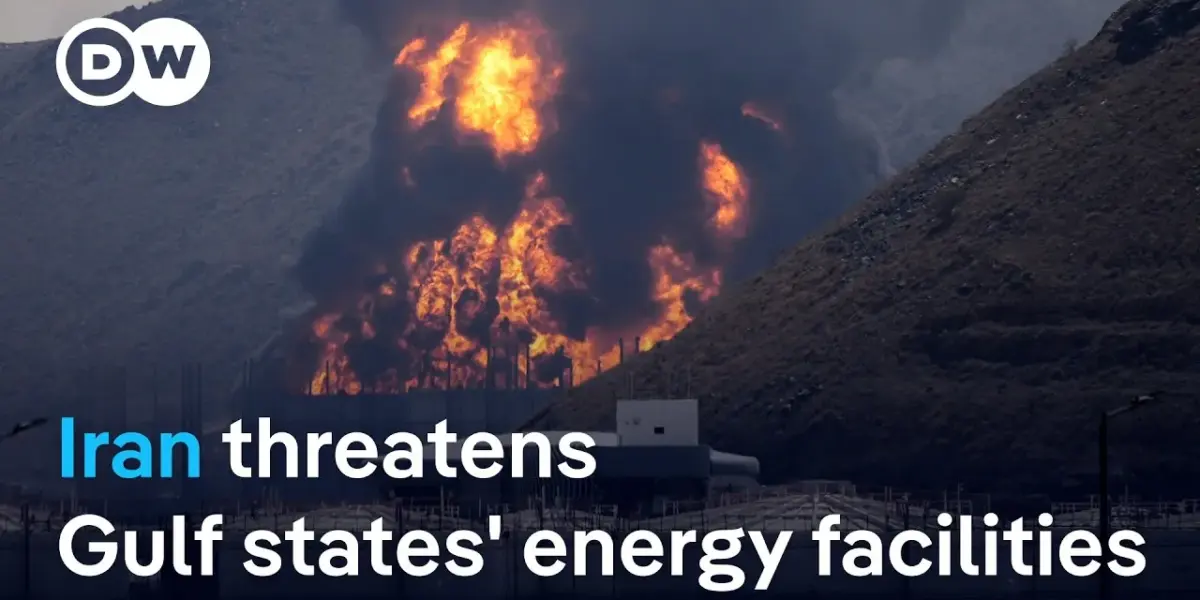
In the third week of an escalating conflict involving Iran, the United States, and Israel, energy infrastructure across the Persian Gulf is increasingly being drawn into the hostilities. For the first time, Iran has openly threatened energy facilities in neighboring countries, issuing warnings to civilians to evacuate three major ports in the United Arab Emirates, which it claims are sheltering U.S. forces. Tehran asserts these locations are legitimate targets due to the ongoing U.S.-Israeli campaign against Iran.
Strikes and Blockades: A Region Under Pressure
Recent events underscore the growing threat. In Fujairah, United Arab Emirates, an Iranian drone strike ignited a fire at a critical oil terminal, an incident that occurred mere hours after U.S. forces attacked Iran’s Kharg Island oil hub. A look at the region reveals strikes on oil facilities spanning from Kuwait to Oman, highlighting the widespread vulnerability of the area’s energy sector. Adding to the pressure, Iran has begun deploying sea mines in the Strait of Hormuz, a vital chokepoint for global energy supplies. It is estimated that approximately 25% of the world’s liquefied natural gas and 25% of its seaborne oil pass through this strait annually.
Iran’s Strategy: Inflicting Pain to Deter Aggression
Rosemary Kalanic, Director of the Middle East Program at Defense Priorities, explains Iran’s strategic calculus. “Iran’s strategy here is very clear. This is bogged down into an attrition war between the United States and Iran. And Iran is playing the role of a porcupine, trying to defend itself from a bear,” Kalanic stated. The objective, she elaborated, is to inflict enough pain on the United States and the global community through attacks on oil infrastructure and threats to close the Strait of Hormuz, thereby ratcheting up the costs of the war and compelling the U.S. to reconsider its involvement.
“The idea is that by doing that they’re ratcheting up the costs to the United States and the whole world of this war continuing in hopes that the United States will decide to stop.”
– Rosemary Kalanic, Director, Middle East Program, Defense Priorities
Targeting U.S. Domestic Concerns and Allies
The escalating tensions are designed to impact multiple facets of the conflict’s support base. Kalanic suggests Iran’s actions are aimed at influencing U.S. domestic politics, potentially by driving up gasoline prices and discouraging American voters from supporting the ongoing campaign. Furthermore, while allies play a role, the strategy is seen as primarily directed at the United States itself, its voters, and potentially influencing the decision-making of leadership perceived as ‘go-it-alone’. The assumption that the U.S. is averse to casualties and costs, especially under leadership that prefers quick, decisive, and low-cost military actions, underpins this approach.
Miscalculation and Unpreparedness in the Face of Escalation
While the threat of conflict with Iran is not new, the world’s preparedness for the targeting of the Gulf’s energy infrastructure has been called into question. The U.S. military has prepared for such contingencies for decades, and the difficulties of keeping the Strait of Hormuz open were known. However, Kalanic suggests a miscalculation by the U.S., particularly concerning Iran’s willingness to retaliate broadly and disrupt the Strait. This miscalculation may stem from an underestimation of the duration of the conflict and a belief that a swift decapitation strike on Iranian leadership would end hostilities. “Unfortunately, the world does not seem to be very well prepared for this even though many people saw it coming,” Kalanic noted.
U.S. Strategy: A Dual Approach of Attack and Threat
The U.S. response has involved striking military targets on Iran’s Kharg Island, an area responsible for a significant portion of Iran’s oil exports. While President Trump has stated that no oil infrastructure was directly hit, the attacks serve as a clear threat to do so if Iran does not cease its actions in the Strait of Hormuz. This strategy aims to increase the cost for Iran by potentially crippling its ability to export oil and fund the conflict. However, Kalanic expresses skepticism about Iran backing down solely due to these measures, given the existential stakes for Iran compared to the U.S. objectives.
Global Energy Market Risks and Long-Term Implications
The immediate impact on global energy markets is already evident, with rising oil and natural gas prices. These supply shocks carry the risk of economic recession if sustained. In the longer term, however, such crises can accelerate a transition away from fossil fuels. Drawing parallels to the 1970s energy crisis, Kalanic suggests that prolonged disruption could lead to increased energy efficiency and a faster shift towards greener, sustainable energy sources.
Navigating Uncertainty: Market Adaptation and Future Outlook
The willingness of tankers to transit the Strait of Hormuz without military escorts remains a key concern. While the U.S. has indicated a willingness to assist, the logistical and military challenges of protecting shipping are significant. Historically, during conflicts like the Iran-Iraq War, neutral shipping continued despite attacks, with the market adapting through price increases and higher insurance rates. However, Kalanic notes that in today’s interconnected world, with visible images of oil tanker incidents, market participants may exhibit a lower tolerance for risk. The strategic drawdown of oil reserves by the U.S. and other G7 countries is expected to provide some short-term market cushioning.
An Asymmetric Conflict with High Stakes
Looking ahead, Kalanic anticipates continued Iranian efforts to raise the costs for the U.S. and Israel. As Iran is militarily weaker, its primary recourse is to escalate the conflict’s impact on global energy markets and economies. “Iran is a weak country compared to the US and Israel. It can’t defend its airspace from US and Israeli attack. The only thing it can do is ratchet up the cost to everybody else and the United States and Israel,” she stated. Given that Iran is fighting for its sovereignty, its stakes are considered extremely high, making it unlikely to be the first to yield in this asymmetric conflict.
Source: Iran threatens Gulf states‘ energy facilities | DW News (YouTube)

Related Articles


Iran Targets US With Cyberattacks, Escalating Digital Warfare
Iran is increasingly using cyberattacks to challenge the U.S., as seen in a recent hack of the FBI director's account. Experts say this is a strategic shift due to Iran's limitations in conventional warfare. The U.S. needs to strengthen its digital defenses, focusing on encryption and cloud computing, rather than solely relying on traditional security measures.


Iran Hacks FBI Chief, Exposing U.S. Cyber Vulnerabilities
A recent hack of FBI Director Kash Patel's personal email by an Iran-linked group highlights Iran's growing cyber threat to the U.S. Experts explain how simple security oversights are exploited, emphasizing the need for basic defenses like two-factor authentication to protect against propaganda and potential infrastructure attacks.

Trump Halts Iran Strikes Amid Stalled Diplomacy
President Trump announced a pause on planned strikes against Iran, citing productive talks, though Iran denies negotiations occurred. Reports also suggest a potential U.S. ground operation on Iran's Hark Island. The situation raises concerns about international support for Ukraine and potential shifts in U.S. foreign policy.