Auburn’s Tourney Hopes Fade as Bubble Bursts
Joe Lunardi, the famed "Bracketologist," dissects the murky NCAA Tournament bubble, asserting that teams like Auburn are falling victim to shifting definitions rather than a worsening field. He also weighs in on the top seed race between Florida and UConn.

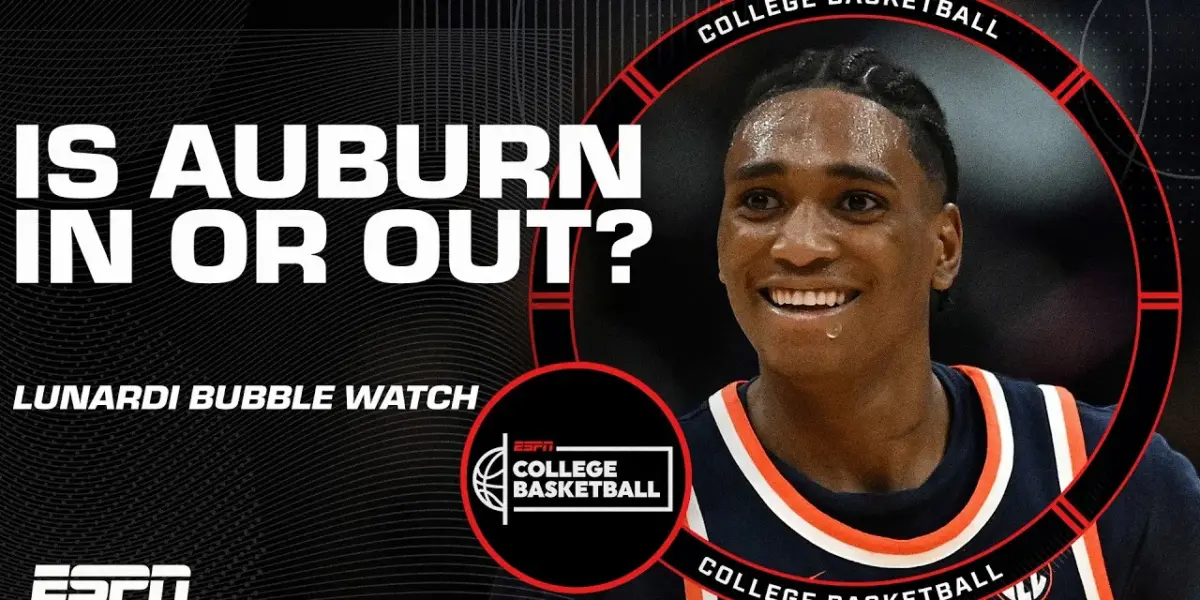
Auburn’s NCAA Tournament Aspirations Dim as Bubble Shrinks
The landscape of college basketball’s bubble is as chaotic as ever, and for teams like Auburn, the dream of an NCAA Tournament bid is rapidly fading. Joe Lunardi, the renowned “Bracketologist,” joined the ‘Champ Week Live’ broadcast to dissect the precarious bubble situation, offering a stark assessment of teams on the fringe and the ever-present questions surrounding tournament expansion.
The Perennial Bubble Debate
For years, the discussion around the NCAA Tournament bubble has centered on a perceived decline in the quality of teams vying for at-large bids. Lunardi, however, argues that the bubble itself hasn’t worsened; rather, our definition of what constitutes a bubble team has shifted. “It’s the same bubble that it always is,” Lunardi stated. “So, why are we making more of it? Because we’ve adjusted over the years the definition of what makes a bubble team and we’re talking about the wrong teams on the bubble.”
He contends that the focus should be on teams that have achieved significant success, like Belmont, Liberty, or Stephen F. Austin, rather than debating the merits of teams with sub-.500 records in their conference play. The inclusion of teams like Miami of Ohio in these discussions, Lunardi believes, is a symptom of a larger issue within the selection process.
Auburn’s Precarious Position
Auburn, with a challenging 7-16 record, finds itself squarely in the crosshairs of this bubble debate. Lunardi highlighted the stark reality for teams like Auburn, Oklahoma, and San Diego State, who are part of a crowded field of eight teams competing for just five remaining at-large spots. The situation is further complicated by potential upsets in conference tournaments, which could eliminate at-large bids entirely.
“The math here on selection Saturday morning is eight teams for five spots. The four starting with VCU plus Oklahoma, Auburn, and well San Diego State now they beat New Mexico last night plus Miami. That’s eight teams for five spots,” Lunardi explained. The prospect of a team from Mississippi advancing in the SEC tournament, he wryly noted, could make that team “incredibly unpopular in the other 49 states if they win more games.”
The Case for Expansion and Minimum Standards
The ongoing conversation about the bubble’s quality has reignited the debate on NCAA Tournament expansion. While Lunardi acknowledges the desire for a larger tournament, he has shifted his focus from advocating for a return to the 64-team format to pushing for minimum eligibility standards for at-large bids.
“I’ve always felt we need modest expansion to save the committee from itself because the fact that we’re still talking about Auburn at 7 and 16, the fact that Oklahoma and Texas made it last year at 6 and 12 in their league. I don’t care if it was the NBA Pacific division. We keep score for a reason, okay? And typical fans understand winning,” Lunardi asserted. He believes that establishing a baseline, perhaps a winning record in conference play or achieving some measure of success, is crucial.
“Win something. There’s got to be standards.”
The challenge for teams like Miami of Ohio, who often struggle to get games scheduled against power conference opponents, is also a point of consideration. However, Lunardi emphasizes that the message sent by rewarding teams that don’t challenge themselves is equally problematic. The alternative – a team that goes undefeated but is still denied entry – sends an even louder message that winning isn’t always enough.
One-Seed Battle and Bracketing Principles
Shifting focus to the top of the bracket, Lunardi addressed the race for the final No. 1 seed, with Florida and UConn in contention. He believes that if Florida wins their semi-final game, they will secure the final top seed, which he suggests might actually be beneficial for UConn. A lower seed could place UConn in a more favorable regional location, avoiding a potential matchup with Duke if Duke secures the overall No. 1 seed.
Lunardi also touched upon obscure bracketing principles, noting that teams like UConn, if placed as a No. 2 seed, cannot be placed in the same region as the No. 1 overall seed. This often forces them into the next closest available region, which in this hypothetical scenario, would be the Midwest, potentially pitting them against a top seed like Michigan.
The Demands of Championship Week
As Championship Week reaches its fever pitch, the life of a bracketologist is intense. Lunardi, who woke up at 5:30 AM to catch his alma mater, the St. Joe Hawks, in the A10 tournament, acknowledged the demanding schedule. Despite the allure of playing a round of golf, duty calls for Lunardi, who, unlike some of his online counterparts, insists he still finds time to sleep, albeit perhaps not as much as he’d like during the crucial months of March and April.
“I got up at 5:30 in Pittsburgh cuz I insisted on going to see my St. Joe Hawks in the A10 tournament. Haven’t had a game that mattered for, you know, we were pretty excited about that. Uh, but duty calls here and and they’ll play on,” he shared. The next 24 hours promise more intense basketball action, and for Joe Lunardi, it means continued dedication to tracking every potential bracket move.
Source: Is Auburn officially out + other bubble questions with Joe Lunardi 🏀 (YouTube)

Related Articles

UCLA Dominates Minnesota to Reach Elite 8
The top-seeded UCLA Bruins dominated the Minnesota Golden Gophers in the Sweet 16, securing a spot in the Elite 8 with their 28th consecutive win. Led by Kiki Rice and a strong performance from Lauren Betts, UCLA showcased their offensive firepower and defensive intensity.


McNamara Takes Orange Helm: ‘We’ll Get Right Guys!’
Gerry McNamara is embracing his new role as Syracuse head coach, aiming to bring energy and the right players back to the program. He draws on his experience turning around Siena and the legendary atmosphere of the Carrier Dome. Former teammate Carmelo Anthony is also a key supporter.
UConn Rolls Past UNC in Sweet 16 Thriller
The UConn Huskies defeated the North Carolina Tar Heels in a hard-fought Sweet 16 matchup to advance to the Elite Eight. The Huskies extended their winning streak to 53 games with a dominant performance.