Trump’s War Aims Face Unintended Consequences
Donald Trump's strategy in the current conflict faces unforeseen challenges as 'unintended consequences' emerge, according to analyst Katy Balls. While Trump seeks a swift resolution, the complexities of the situation, including economic impacts and shifting international dynamics, suggest a less controlled outcome than initially envisioned.

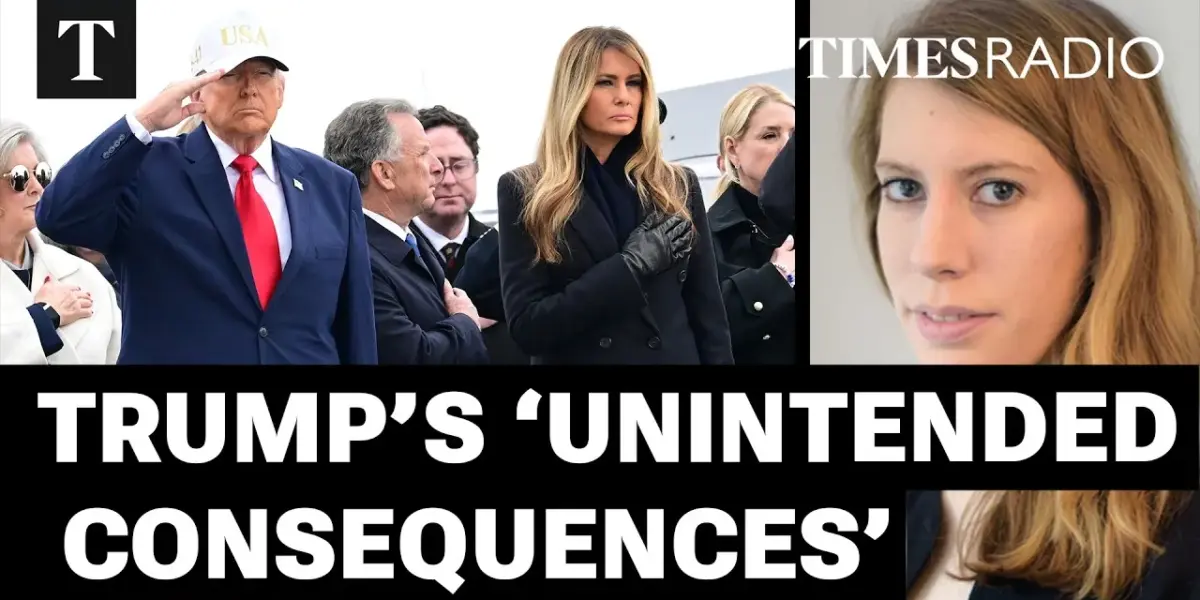
Trump’s War Aims Face Unintended Consequences
In the volatile landscape of international conflict, the initial days of war often present the clearest path, a sentiment echoed by analysts observing Donald Trump’s approach to the current conflict. As the situation evolves, the former president, despite his pronouncements, faces a growing challenge in controlling the ‘unintended consequences’ that inevitably arise, according to Katy Balls, Washington Editor for The Times and Sunday Times.
Seeking an Off-Ramp
While Donald Trump has expressed a desire for a swift resolution to the conflict, the feasibility and timeline of such an ‘off-ramp’ remain uncertain. “I think we’re seeing growing evidence that Trump wants to have an offramp,” Balls noted on Times Radio. “I think there’s still a question of how realistic is that and what’s the time for it? Is it uh, you know, a couple of days? Is this more like a couple of weeks?” The aspiration is to project an image of control and a quick end to the war, a message that would likely resonate with voters. However, the definition of a successful resolution and its aftermath, particularly concerning Iran’s nuclear program, presents a complex dilemma.
Ambiguous Objectives and Shifting Stances
The objectives for any resolution appear multifaceted and subject to change, a characteristic often associated with Trump’s foreign policy. Initially, concerns extended beyond Iran’s nuclear capabilities to potential regime change. However, this objective seems to have been softened, with a more recent focus on damaging Iran’s capabilities and setting back its progress by several years. “I think if you go back to some of the initial things he said, it’s not just about the nuclear capability. Um, clearly that’s the one I think that is the most consistent. We’ve also had a regime change from Donald Trump in the past. It feels as though he’s walked away from that,” Balls observed. The potential for a scenario where a new leader, possibly within the same family, replaces the current one, while still achieving a degree of perceived success through military action, is a prospect being discussed.
“The first day of a war like this is the simplest and from then on it just gets more complicated and you have all these unintended consequences. And even Donald Trump cannot, no matter what he says, control all these unintended consequences.”
Economic and Global Trade Impacts
Beyond the immediate military objectives, the economic repercussions and their impact on global trade are significant considerations. Iran’s actions, such as disrupting shipping, have already affected oil prices. The hope for Trump would be that Iran ceases to be a disruptive force, allowing him to claim success. However, recent events, including the destruction of ships despite assurances of safety, present a visual contradiction to such claims. “The Iranian army navy is at the bottom of the sea and the straits of Hormos are perfectly navigable and no reason for anyone to frightened and immediately four ships are blown up. You know, this that must be uh visually a huge problem for Trump,” Balls highlighted.
The Challenge of Unforeseen Events
The inherent unpredictability of warfare is a significant challenge, particularly in an environment where decisions hinge on the views of a single individual. Former White House officials have pointed out the difficulty of managing such situations, where even loyal aides struggle to anticipate Trump’s pronouncements. The discrepancy between Trump’s assertions of safety in shipping lanes and the subsequent destruction of vessels underscores this challenge. “It’s very difficult when it’s all about the views of one man and you can see that even in the teams of those trying to guess and be loyal about what he says,” Balls explained.
Escalating Military Presence and Shifting Dynamics
The deployment of additional military assets, such as 5,000 Marines to the Middle East, signals a potential escalation and a prolonged timeline for the conflict. While intended to ensure safe passage for ships, the move raises concerns about a potential increase in ground troop involvement. The estimated two-week transit time for these forces suggests that a swift resolution may not be imminent, contradicting hopes for a quick and tidy end to the hostilities. Furthermore, recent reports of American soldier deaths due to a fueling mishap, rather than direct enemy action, add another layer of complexity and tragedy to the unfolding events.
Gulf States’ Influence and Legacy Aspirations
Donald Trump appears to be mindful of the perspectives of key international players, particularly the Gulf Arab states, whose economic and security interests are deeply intertwined with regional stability. Unlike European allies, whose opinions may hold less sway, the Gulf states’ concerns are likely to be a significant factor in Trump’s decision-making. “I think he is. I actually think of the countries that Donald Trump cares about what they say. Um, I think Europe’s pretty low on that list these days. I think that the Gulf States are pretty high,” Balls stated. This alignment of interests, driven by financial and security considerations, could influence the duration and nature of the conflict’s resolution. Trump’s foreign policy legacy, potentially cemented by initiatives like the Abraham Accords, may also play a role, with a desire to maintain the support of these key Arab nations.
Looking Ahead
As the conflict progresses, all eyes will be on how Donald Trump navigates the escalating complexities and manages the unforeseen consequences. The influence of regional allies, coupled with the inherent unpredictability of warfare, will likely shape the trajectory of events, potentially leading to outcomes that diverge from initial expectations. The coming weeks will be critical in determining whether Trump can indeed orchestrate a controlled exit from the conflict or if he will be increasingly shaped by the unintended consequences of his chosen approach.
Source: Trump Can’t Control ‘Unintended Consequences’ Of His War Approach | Katy Balls (YouTube)

Related Articles

Stocks Ignore War Risks, Focus on “Taco Moments”
Stock markets appear to be overlooking the severe supply chain risks stemming from the Iran conflict, focusing instead on potential diplomatic de-escalations. While the S&P 500 shows resilience, bond and commodity markets signal deep concern over disruptions to critical resources like LNG, helium, and fertilizers.

U.S. Iran Tensions Rise Amid Shifting Alliances
Rising tensions between the U.S. and Iran are creating a volatile geopolitical situation. With conflicting signals on de-escalation and potential shifts in alliances like NATO and U.S.-Israel relations, the path forward remains uncertain. The global economy and regional stability hang in the balance.


Iran Targets US With Cyberattacks, Escalating Digital Warfare
Iran is increasingly using cyberattacks to challenge the U.S., as seen in a recent hack of the FBI director's account. Experts say this is a strategic shift due to Iran's limitations in conventional warfare. The U.S. needs to strengthen its digital defenses, focusing on encryption and cloud computing, rather than solely relying on traditional security measures.