NASA Revamps Moon Missions: SLS Ignites New Era, Centaur V Powers Ahead
NASA's Artemis program is undergoing significant changes, with the SLS rocket preparing for an April launch and the Centaur V set to replace the Exploration Upper Stage from Artemis IV onwards. Artemis III is also being reconfigured as a low Earth orbit mission, while legislative efforts push for a permanent lunar base.

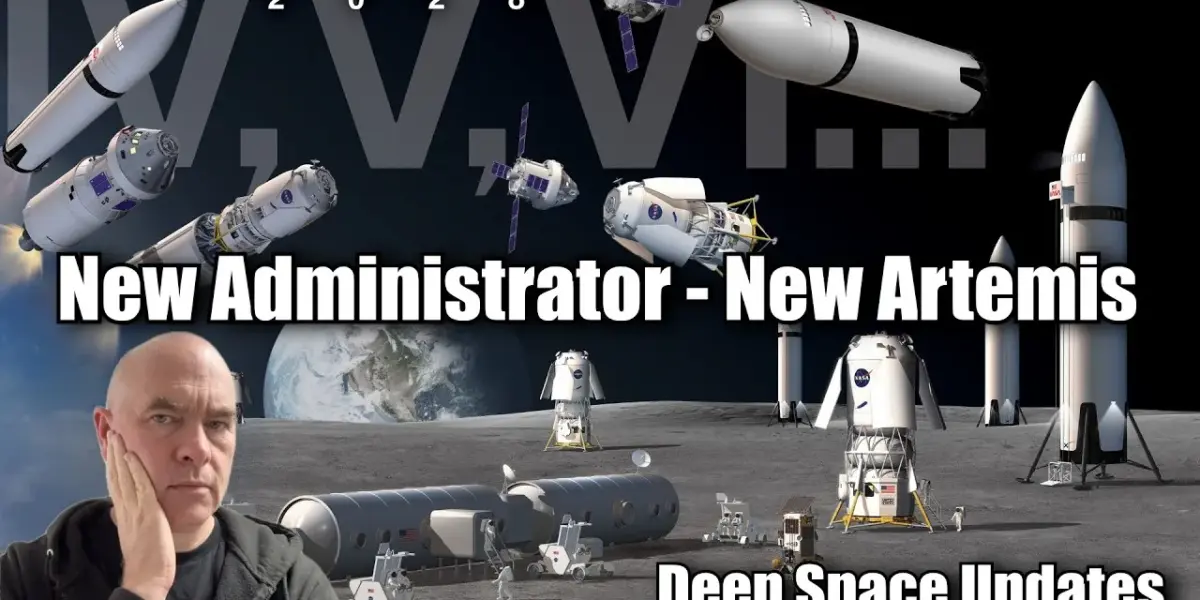
Artemis Ascendant: SLS Readies for April Launch, Centaur V Takes the Reins
The next chapter in humanity’s return to the Moon is set to unfold with NASA’s Space Launch System (SLS) poised for launch in early April. Following extensive preparations and a confirmed flight readiness, the colossal rocket is scheduled to roll out to the launchpad for the Artemis II mission, targeting a launch window between April 1st and April 7th. This mission, carrying astronauts on a journey around the Moon, marks a critical step in NASA’s ambitious Artemis program, aiming to establish a sustained human presence on the lunar surface.
In a significant update to the Artemis program, NASA has confirmed a major shift in its deep space strategy, particularly concerning the upper stages of the SLS rocket. Starting with the Artemis IV mission, the Exploration Upper Stage (EUS) will be replaced by the Centaur V, a more capable and versatile upper stage developed by United Launch Alliance (ULA). This decision, driven by the need for increased performance and efficiency, will leverage the Centaur V’s greater propellant capacity, offering more than double that of the current Interim Cryogenic Propulsion Stage (ICPS). This enhancement is crucial for delivering heavier payloads and enabling more complex lunar operations.
The transition to the Centaur V necessitates several engineering adaptations. The stage adapter connecting the SLS core stage to the Centaur V will require a new design, as will the adapter between the Centaur V and the Orion spacecraft. These changes highlight the intricate nature of space mission design, where even seemingly minor alterations can have cascading effects on the overall architecture.
The implications of this change extend to NASA’s long-term lunar architecture. With the Centaur V taking over the primary lunar injection role from Artemis IV onwards, the ICPS, currently slated for Artemis II and III, will become surplus to requirements for its original purpose. This leaves NASA with a highly capable, fuel-rich ICPS and the potential to assign it to new, exciting missions. Calculations suggest the ICPS possesses enough delta-v to facilitate interstellar journeys or reach the outer planets with attached CubeSats. While the limitations of CubeSats for deep space exploration are acknowledged, potential missions to asteroids or even repurposing of dormant spacecraft like the Janus mission are being considered.
Artemis III’s New Orbit and a Lunar Base Beckons
Further underscoring the dynamic nature of the Artemis program, NASA has announced a significant alteration to the Artemis III mission. Instead of a direct lunar landing, Artemis III will now be a low Earth orbit mission. This revised plan aims to rendezvous with both Human Landing System (HLS) providers, allowing for crucial testing and validation of these systems in a controlled environment before committing to a lunar surface operation. The mission is now slated for 2027, with the readiness of the HLS systems remaining a key factor.
In a move that signals a decisive shift away from the lunar Gateway concept, recent legislative language introduced by U.S. lawmakers, including Senators Ted Cruz and Maria Cantwell, advocates for the establishment of a permanent lunar surface base. This directive emphasizes long-duration habitation, robotic industrial operations, and the advancement of scientific, technological, and strategic interests on the Moon. While the Gateway may still see some hardware repurposed, the focus has clearly pivoted towards establishing a tangible, long-term human presence on the lunar surface.
Commercial Spaceflight Rounds Out the Month
Beyond the monumental developments in the Artemis program, the past few weeks have seen a flurry of activity across the commercial space sector. SpaceX continued its prolific launch cadence with the deployment of the Echoar 25 geostationary communication satellite, one of the heaviest payloads ever sent to geostationary transfer orbit by a Falcon 9. Firefly Aerospace successfully launched its Alpha rocket for the final time in its Block 1 configuration, carrying a payload for Lockheed Martin. The company is now focused on its enhanced Block 2 version, promising increased performance and capabilities.
Rocket Lab conducted a successful Electron launch for a confidential commercial customer, widely believed to be BlackSky, a provider of high-resolution Earth imagery. The company also performed the HASTE suborbital flight, launching the DART AE hypersonic scramjet, a testament to advancements in high-speed flight technologies. In Japan, Space One’s third attempt to launch its Kairos small satellite rocket ended in failure, highlighting the persistent challenges in developing reliable launch systems.
China continues its rapid expansion of its satellite constellations with multiple Long March launches, deploying satellites for its Guowang program, a potential competitor to Starlink. Meanwhile, the ongoing geopolitical tensions in the Middle East have had a ripple effect on space-based observation, with imaging providers imposing delays on imagery from the region due to security concerns.
ISS Operations and Future Prospects
The International Space Station (ISS) continues its vital role in scientific research and human spaceflight. The station’s environmental control team has achieved a remarkable milestone, recycling 100,000 pounds of wastewater, a crucial step towards enabling longer-duration space missions. In a move to ensure continuity of human spaceflight capabilities, Congress has introduced language requiring a six-month overlap between the operational readiness of commercial space stations and the retirement of the ISS, potentially extending the station’s life to 2032.
The development of commercial space stations has faced funding challenges, but the recent legislative actions signal a renewed commitment to fostering a diverse and robust orbital economy. This also comes amidst a debate surrounding launch provider diversity, with a previously proposed amendment aiming to limit reliance on a single provider, though it was ultimately removed from the bill. The inspector general’s office has also released reports on the human landing systems, identifying areas for improvement in risk management and operational procedures, particularly concerning the Starship elevator system.
Looking Ahead: Lunar Bases and Interplanetary Potential
The convergence of these developments—the imminent SLS launch, the strategic shift to Centaur V, the revised Artemis III mission, and the push for a lunar base—paints a picture of a rapidly evolving space exploration landscape. The focus is shifting from merely returning to the Moon to establishing a sustainable, long-term presence. The potential for the surplus ICPS stage to undertake ambitious interplanetary missions further underscores the growing capabilities and opportunities in space exploration. As NASA and its commercial partners navigate these exciting new frontiers, the coming years promise to be transformative for humanity’s reach into the cosmos.
Source: Decoding NASA's New Moon Strategy – Deep Space Updates – March 13th 2026 (YouTube)

Related Articles


NASA Ditches Moon Gateway for Lunar Base
NASA is shifting its Artemis program focus from the Lunar Gateway to building a permanent lunar base, while SpaceX reveals ambitious plans for a massive lunar chip factory. Both initiatives signal a new era of deep space exploration and resource utilization.


Astronaut Recounts Space Medical Scare, Informs Future Missions
Astronaut Mike Fincke detailed a recent medical emergency aboard the ISS that led to his return to Earth. While doctors ruled out serious conditions like stroke, the exact cause is still being studied, with theories pointing to a space-related anomaly. The experience is providing crucial data for future long-duration missions, including NASA's Artemis program.

NASA Pivots: Mars Nuclear Probe, Moon Base Ahead
NASA is pivoting its exploration strategy, prioritizing a nuclear-powered Mars probe and accelerating plans for a moon base. The International Space Station's future is uncertain, with a shift towards commercial platforms. Meanwhile, new telescope data reveals overmassive black holes in dwarf galaxies and captures stunning images of Saturn and the Crab Nebula.