Veteran Surgeon’s Gaza Witnessing Fuels Congressional Bid
A combat surgeon who witnessed the horrors of Gaza firsthand is running for Congress, vowing to speak truth to power and redirect U.S. priorities from war to domestic needs. Dr. Adam Hamawi's journey from the battlefield to Capitol Hill is fueled by a profound moral imperative.

Veteran Surgeon’s Gaza Witnessing Fuels Congressional Bid
Dr. Adam Hamawi, a decorated Army veteran and plastic surgeon, has emerged as a vocal critic of U.S. foreign policy, particularly concerning the ongoing conflict in Gaza. His recent volunteer mission to the region, where he served as a combat trauma surgeon during the height of the Iraq War and later as a reconstructive surgeon, has profoundly shaped his perspective and propelled him into the political arena. Hamawi’s direct experience on the ground in Gaza, coupled with his long-standing commitment to humanitarian aid, forms the bedrock of his congressional campaign in New Jersey.
A Surgeon’s Perspective from the Front Lines
Hamawi’s journey into public service is deeply intertwined with his medical career and military experience. After joining the New Jersey Army National Guard at 19 and securing an educational delay for medical school, he entered active duty during the Iraq War in 2003. As a combat trauma surgeon, he witnessed firsthand the brutal realities of war, describing the period as “brutal” and marked by “the height of the war” with “the highest rate of casualties.” He vividly recalls seeing “soldiers, Marines, you know, seaman and airmen all getting wounded” and the “real cost of war on a daily basis.” The experience left him with “burdens” that he carries even after his active duty service.
Following his deployment, the Army sent him for specialized training in reconstructive plastic surgery, a critical need for returning soldiers. Now, he serves in a trauma center and runs an independent practice, often grappling with the challenges of healthcare affordability and insurance bureaucracy. This civilian practice, however, has not diminished his desire to help. Driven by a commitment to use his skills where they are most needed, Hamawi has dedicated himself to annual volunteer trips to war zones and disaster areas worldwide. His extensive humanitarian work includes missions in Haiti, Central America, Sudan, Syria, Jordan, Turkey, and most recently, Gaza and the West Bank.
Gaza: A Turning Point
Hamawi’s recent experiences in Gaza have been particularly impactful, serving as a direct catalyst for his congressional run. He describes the situation as “at another scale” and “could only be described as a genocide.” Unlike secondhand accounts from media or social media, he was “in the middle of it,” witnessing “civilians targeted every single day that I was there and in a deliberate fashion.” The sheer volume of child casualties was staggering: “I took care of more children there than in my entire career altogether as a surgeon. Every day at least half the people that came in were children that were blown apart with the bombs that we are making.”
This firsthand observation led him to believe that his role extended beyond providing medical care; he was also acting as a witness. “Our job is twofold. We’re going in there because we could provide care. We’re allowed to go in and then we’re also acting as witnesses.” He found it essential for American doctors like himself to speak out, especially since access to Gaza is heavily restricted, even for journalists. “If we’re not going to speak out, then who is?” he questioned, highlighting the limited access for outsiders and the reliance on Palestinian accounts, which he feels are often dismissed.
A Call to Action and Congressional Ambitions
Hamawi’s return from Gaza galvanized his decision to run for Congress. He admits he never envisioned a political career, seeing himself as a “doer” rather than a talker. However, the gravity of what he witnessed compelled him to act. “I experienced something there that most people don’t because, you know, even journalists were not allowed to get in there.” He felt a duty to “come and speak out as a witness.” Since his return, he has actively lobbied on Capitol Hill, advocating against U.S. complicity through its funding and enabling of the conflict. He expressed frustration with the lack of engagement from many members of Congress, noting that “most of the doors were closed” and many were unwilling to hear his testimony. Some acknowledged the wrongdoings but cited political constraints, stating, “we understand that’s wrong, but we can’t do anything about it or I can’t speak about it.”
This environment spurred him to seek a position where he could effect change. Inspired by representatives like Bonnie Watson Coleman, who he credits as being “brave enough to stand up for a ceasefire since day one,” Hamawi aims to bring more voices of conscience to Congress. He believes it’s not enough to simply speak out; a climate must be created where speaking truth to power is not feared. “We need to take it further. You know, it’s not enough just to speak out. We need to like create an environment where they’re not afraid to say something is wrong.” He challenges the inaction of elected officials, drawing a parallel to his own willingness to act based on his skills and abilities. “You’re in Congress and you have an ability to do something. And you should be doing the same thing.”
Critique of U.S. Foreign Policy and Domestic Priorities
Hamawi extends his critique to broader U.S. foreign policy, particularly its involvement in conflicts in the Middle East. He views the situation with Iran as a recurring pattern of escalating tensions leading to war, driven by the financial interests of defense contractors and war profiteers. He criticizes leaders, including former President Trump, for sending troops into conflict without a clear understanding of war’s realities or a demonstrable benefit to national security. “We didn’t get any safer with Iran or with uh with with Iraq or with Afghanistan.” He questions the immense financial expenditure, noting that billions of dollars spent on military interventions could instead be invested in domestic priorities like healthcare, infrastructure, and education.
This contrast between foreign spending and domestic needs is a central theme in his campaign. He laments that while the U.S. can allocate substantial funds to conflicts, it struggles to address its own citizens’ needs. “We’ve paid $30 billion in the last two years to, you know, to for this genocide so we could afford funding that, but we can’t afford to take care of our our own communities.” He illustrates this point by stating that $30 billion could have provided significant support for affordable housing, groceries, education, and healthcare in his district alone. He advocates for redirecting wealth away from “billionaires and corporations and the corrupt special interests” towards tangible improvements in the lives of everyday Americans.
A Principled Stand for Change
When asked to describe himself and his platform, Hamawi emphasizes his principled nature and unwavering commitment to his beliefs. “I would say that they would see me as a principled person who is not afraid to speak up and who will not change his stances. So I am ready to fight. I’ve always been ready to fight uh and speak out for what’s right.” He draws a parallel to his long-standing criticism of U.S. immigration policies and the formation of agencies like ICE, which he believes began eroding civil rights after 9/11 under the guise of security. He argues that these policies, which he has spoken against for nearly 20 years, have become increasingly extreme, targeting not only minority communities but all citizens and creating an environment of fear.
Hamawi sees his service as a continuation of his oath to protect and serve, extending it beyond his military duty to his fellow citizens and the international community. He views his willingness to speak out, even when questioned about his loyalty, as a testament to his character and commitment. His campaign is a direct response to a perceived failure of leadership to address both international humanitarian crises and domestic well-being, driven by a deep-seated belief that a more just and compassionate approach is not only possible but necessary.
Why This Matters
Dr. Adam Hamawi’s candidacy represents a significant intersection of direct experience, moral conviction, and political ambition. His background as a combat surgeon provides him with a unique and credible perspective on the human cost of war. His volunteer work in Gaza, in particular, thrusts the often-abstract discussions of foreign policy and humanitarian crises into the harsh light of reality. His frustration with the political establishment’s perceived inaction and unwillingness to confront uncomfortable truths about U.S. foreign policy and its domestic consequences is a powerful narrative.
For voters, Hamawi offers a candidate who claims to prioritize principled stands over political expediency. His critique of healthcare costs and the diversion of public funds to military endeavors resonates with concerns about economic inequality and national priorities. His campaign serves as a challenge to the status quo, suggesting that a more ethical and responsible approach to both foreign and domestic policy is attainable. His story highlights the growing trend of individuals with deep personal experience in conflict zones or humanitarian crises entering the political arena, seeking to translate their on-the-ground understanding into legislative action.
Implications, Trends, and Future Outlook
Hamawi’s narrative taps into a broader disillusionment with traditional politics and a growing demand for authenticity and direct action. His emphasis on witnessing and speaking truth to power reflects a desire among some voters for representatives who are not beholden to established political norms or special interests. The candidate’s willingness to criticize U.S. foreign policy, even when it is popular or politically convenient, signals a potential shift in voter priorities, with an increasing emphasis on humanitarian concerns and ethical considerations.
His campaign also underscores the evolving role of veterans in politics. While many veterans have entered public service throughout history, Hamawi’s specific focus on the humanitarian impact of U.S. military actions and his direct advocacy for ceasefire and de-escalation represent a more contemporary and critical engagement with foreign policy. The trend of candidates drawing directly from their experiences in conflict zones or humanitarian aid to fuel their political platforms is likely to continue, especially in an era of heightened global instability and increased public awareness of international crises.
The future outlook for candidates like Hamawi depends on their ability to connect their specialized experiences with the broader concerns of their constituents. His challenge will be to translate his powerful personal testimony and moral clarity into a cohesive political platform that addresses the diverse needs of his district while maintaining his principled stance on national and international issues. His campaign serves as a litmus test for whether voters are ready to embrace a more ethically driven and experientially informed brand of politics.
Source: Navy Commander SPILLS THE BEANS on Pentagon’s DIRTY SECRET (YouTube)

Related Articles

Protesters Challenge Presidential Power, Ignite Debate
Millions are protesting nationwide under the "No Kings" banner, challenging presidential authority and policies they deem unconstitutional. Organizers emphasize First Amendment rights while debating foreign policy, immigration, and the balance of power.
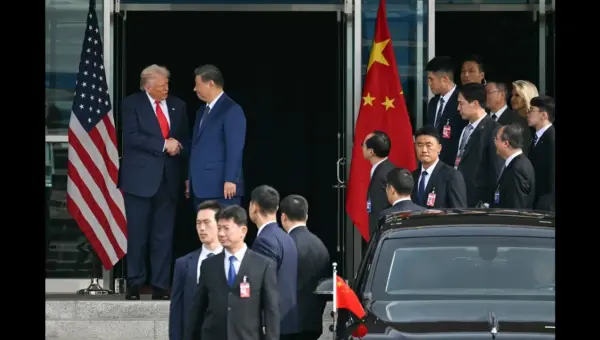
Trump’s “Walk Away” Tactic Signals Tougher Stance on China
Retired Air Force Brigadier General David Stillwell believes President Trump's strategy of being willing to walk away from negotiations puts pressure on China. This tactic, combined with US global actions and strengthened alliances, signals a more assertive American foreign policy.


Trump’s War Talk Stuns Financial Crowd
Donald Trump's recent speech in Miami focused on his foreign policy, particularly his critical views on NATO and his vision for international relations. He declared the U.S. would no longer defend NATO allies, questioned the value of existing alliances, and suggested renaming the Strait of Hormuz. The speech also touched on his personal views of success, his allies, and his perceived role as a global peacemaker.