Fish Scales Become Artificial Corneas in Promising New Tech
Scientists in Spain are developing artificial corneas from fish scales, offering a promising low-cost alternative to traditional donor transplants. Initial studies show high compatibility and promising results, potentially addressing the global shortage of donor corneas and restoring sight to millions.

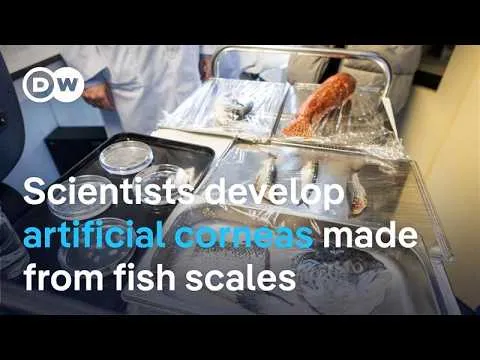
Innovative Cornea Transplants Could Soon Use Fish Scales
Scientists in Spain have developed a groundbreaking, low-cost artificial cornea using the scales of common market fish. This innovative technology, which has shown promising initial results in lab and animal studies, could offer a viable solution for the global shortage of donor corneas, potentially restoring sight to millions worldwide. While human trials are still on the horizon, the research represents a significant leap forward in regenerative medicine.
The Challenge of Cornea Damage and Donor Shortages
Corneal diseases are a leading cause of blindness globally, affecting over 23 million people. The cornea, the transparent front part of the eye, lacks blood vessels, making it difficult to heal on its own. Consequently, many patients with severe corneal damage or disease require a transplant, which involves replacing the damaged tissue with a healthy cornea from an organ donor. However, the demand for donor corneas far outstrips the supply, leaving thousands of individuals waiting for a transplant and facing potential permanent vision loss. This critical shortage has spurred researchers to explore alternative materials for corneal implants.
From Fish Scales to Vision Restoration
Researchers at the University of Granada, Spain, have identified fish scales as a surprisingly suitable material for creating artificial corneas. Professor Ingred Garcullen, one of the scientists involved in the study, explained the rationale behind this unconventional approach.
“We were looking for a material that is naturally strong, transparent, and biocompatible, and these are the main characteristics of fish scales, which are also essential for a cornea,” Professor Garcullen stated. “Fish scales fulfill these minimal requirements for cornea models.”
The process of transforming fish scales into a functional cornea implant is complex and time-consuming. It begins with isolating the fish scales, followed by a dual process of desellularization to remove the fish’s own cells and elimination of organic components on the surface. The resulting biomaterial then undergoes functionalization before human cells are cultured onto its surface. This intricate procedure aims to create a scaffold that can integrate seamlessly with human eye tissue.
Promising Preclinical Results and Regulatory Hurdles
Initial studies have demonstrated the potential of these fish scale-derived corneas. Both in vitro (laboratory) tests and in vivo (animal) studies have yielded encouraging results, indicating good compatibility with biological systems. The surface texture of the fish scales, described as ideal for cell adhesion, further enhances their suitability.
“It is highly compatible with implementation in humans and has theoretically yielded very good results in laboratory tests and animal studies,” Professor Garcullen noted.
Despite these positive findings, the path to human application is rigorous. The research team is currently in the first stage of preclinical evaluation, which includes in vitro and in vivo testing. To proceed to clinical trials, they must successfully complete two more crucial steps: testing in Good Manufacturing Practice (GMP) facilities and then obtaining approval for human trials from European regulatory agencies.
Timeline for Human Trials and Broader Impact
Professor Garcullen, drawing on her experience with other tissue engineering projects, estimates that the entire process, from preclinical studies to potential clinical use, could take between 10 to 15 years, although she expressed optimism that their accumulated experience might shorten this timeline to under a decade. This extended timeline underscores the stringent safety and efficacy standards required for medical innovations.
The implications of successfully developing fish scale corneas are immense. For patients suffering from corneal pathologies arising from degenerative diseases, infections, inflammatory conditions, or trauma, this technology could offer a lifeline. The persistent scarcity of donor corneas means many patients face long waiting lists. An accessible, artificial alternative could dramatically reduce these wait times and provide a readily available solution.
A Future of Storable, Accessible Corneas
If the fish scale corneas prove successful in human trials, they could be stored in artificial banks, much like blood or other tissues. This would ensure a consistent supply, alleviating the dependency on human donors and making sight-restoring treatments more accessible globally. Professor Garcullen highlighted this potential:
“This will make a huge difference because we expect that in the future we can store these artificial tissues into artificial banks and all these tissues will be a solution for all these patients that are currently waiting for a donor.”
The research team’s work represents a beacon of hope for individuals facing vision loss due to corneal damage. While challenges and regulatory hurdles remain, the innovative use of a readily available natural material like fish scales offers a promising glimpse into a future where sight can be restored more effectively and equitably.
What’s Next?
The focus now shifts to the rigorous preclinical evaluations. The success of the in vitro and in vivo studies will determine the next steps, paving the way for GMP facility testing and, eventually, the highly anticipated human clinical trials. The global medical community will be watching closely as this pioneering research progresses, holding the potential to transform the lives of millions awaiting the gift of sight.
Source: Scientists develop artificial corneas from fish scales | DW News (YouTube)

Related Articles


Nigeria’s ‘Kito’ Scam Targets LGBTQ+ People with Violence
Nigeria's LGBTQ+ community is facing a surge in violent 'Kito' scams, where victims are lured online, ambushed, beaten, and blackmailed. Rights groups report over 50 cases since December, highlighting the dangerous exploitation of anti-gay laws and societal homophobia. Survivors share harrowing accounts of physical and emotional trauma, living in constant fear.


White House Launches “OnlyFarms” Website for Farmer Support
The White House has launched "OnlyFarms," a new website at onlyfarmms.gov, to highlight benefits and support for American farmers facing rising costs. The initiative aims to showcase how administration policies are intended to ease financial burdens and lower prices for both producers and consumers.


House Funds DHS, But Senate Deal Unlikely Amid Shutdown
The House of Representatives has passed a bill to fund the Department of Homeland Security, but the measure is unlikely to pass the Senate. TSA workers, who have faced missed paychecks and disruptions, may receive some pay soon due to a presidential order, but the broader shutdown continues.