Russia’s Iran Dilemma: Ally’s Fate Poses Strategic Threat
Russia faces a complex dilemma regarding its ally Iran amidst escalating conflict. While publicly condemning actions against Tehran, Moscow's limited intervention suggests a strategic calculation balancing its own vulnerabilities with potential geopolitical gains from a prolonged Middle East war.

Russia’s Iran Dilemma: Ally’s Fate Poses Strategic Threat
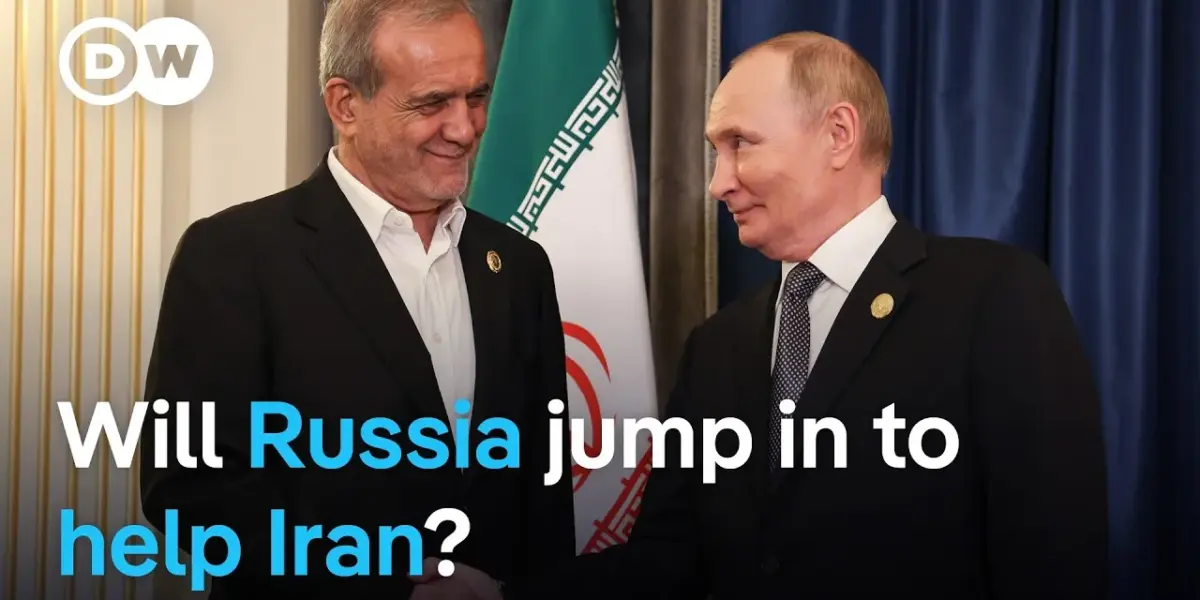
As the world grapples with the escalating conflict involving Iran, attention has turned to Russia’s response. Moscow, a long-standing ally of the Islamic Republic, faces a complex strategic dilemma: how to react to a potential regime defeat without undermining its own global standing and interests. While Russia publicly condemns actions against Iran, its hands-off approach suggests a calculated strategy, driven by its own vulnerabilities and the potential geopolitical benefits of a prolonged Middle East conflict.
A Strained Alliance: Ideology and History
Despite a shared worldview that rejects a Western-dominated global order and a push for a multipolar world, the alliance between Russia and Iran is far from a natural fit. Ideologically, the secular, Orthodox-influenced Russia and the Islamic Republic of Iran present stark contrasts. Historically, mistrust has characterized their relationship, with Russian leaders often viewing Iranians with skepticism and Iran historically seeing Russia as an imperial power seeking to exert influence and territorial control.
However, shared circumstances, particularly international sanctions, have forged a pragmatic partnership. Both nations, isolated by Western sanctions, have found common ground in circumventing these economic restrictions. Iran, having endured sanctions for a longer period, has shared its expertise with Russia, strengthening their economic and military ties in recent years.
“Although Moscow wouldn’t want to see the Iranian regime defeated, it’s not doing much to stop that happening.”
Economic Lifelines and Strategic Corridors
The economic dimension of the Russia-Iran partnership is significant. Following the formalization of their alliance with a treaty covering military cooperation, trade, and research, joint projects have progressed. A notable agreement involved Russia’s Rosatom committing to build four nuclear reactors in southern Iran. However, the current conflict raises questions about the feasibility of such ambitious undertakings.
Of particular strategic importance is the planned North-South corridor, a trade route designed to connect St. Petersburg to Mumbai, passing through Iran. This project is crucial for Russia’s long-term transit security and logistical diversification, offering alternative routes for exports amid its increasing isolation from traditional European transit paths. Experts like Nikita Smagin, an independent analyst on Russia and the Middle East, emphasize that Russia views this corridor as vital for its future transit security, especially after being cut off from European routes following the 2022 invasion of Ukraine.
While the completion of 70% of the route was reported last year, the current turmoil and potential regime change in Iran could bring the project to a halt. Despite this risk, experts suggest that Russia’s economy, though weakened by sanctions, would not collapse from the delay or cancellation of projects with Iran, but another blow would be difficult to absorb.
Military Cooperation and Limited Support
Military cooperation forms another key pillar of the bilateral partnership. Iran’s supply of Shahed drones to Russia during the early stages of the Ukraine war proved instrumental, leading Russia to develop its own versions, known as Geran. Reports of other secret Iranian weapon shipments have also surfaced.
In return, Russia has provided Iran with military vehicles, helicopters, ammunition, and intelligence, as confirmed by Iranian officials regarding the current conflict. However, this cooperation is not a defense alliance, and Russia’s support has clear limits, as noted by expert Smagin. The weaponry provided by Russia is primarily for internal use or against rebels, rather than for confronting foreign powers like Israel or the US.
“Moscow wants to depict itself as a great global power. But what we’re seeing right now is that it’s not really a great power. At least it doesn’t have the influence, the power to intervene in this conflict very actively.”
Strategic Restraint and Geopolitical Calculations
Several strategic reasons explain Russia’s limited military intervention in support of Iran. Firstly, Russia is heavily engaged in the ongoing war in Ukraine, stretching its military resources thin. Secondly, Moscow is wary of antagonizing the United States, particularly given President Trump’s perceived leniency towards Russian arguments in the Ukraine conflict. A strong intervention on Iran’s behalf could risk losing this crucial, albeit silent, backing.
Furthermore, a prolonged war in the Middle East could paradoxically benefit Russia. As Ruse, director of the Europe, Russia and Eurasia program at Chatham House, points out, a wider conflict could divert US diplomatic and military attention, proving advantageous for Moscow and detrimental to Ukraine’s support. The ensuing media focus on the Middle East would also draw attention away from the war in Ukraine.
Economic Windfall from Middle East Turmoil
The conflict has already led to a significant surge in oil and gas prices, with the Strait of Hormuz, through which a substantial portion of global energy passes, being effectively blocked by Iran. While prices have seen some fluctuation, they remain above pre-war levels, a development that significantly benefits energy exporter Russia, which has faced limitations on its resource sales due to sanctions.
Kiril Dmitri, Putin’s special envoy for investment and economic cooperation, alluded to this potential benefit, predicting oil prices exceeding $100 per barrel. Experts, including Julian Waller, a research analyst at the Center for Naval Analysis, suggest that high energy prices for an extended period could provide a substantial economic windfall for Moscow, aiding its efforts to maintain economic stability and fund its war effort without full mobilization.
This economic advantage, coupled with the distraction from Ukraine, presents a complex calculus for Russia. Yet, the potential weakening of Iran or the loss of its regional ally would represent a significant setback for Moscow, particularly following the recent erosion of influence with the ousting of allies like Syria’s Bashar al-Assad and Venezuela’s Nicolás Maduro.
A Spectator’s Role and Diminishing Influence
The current situation places Russia in a precarious position. It lacks the military capacity to significantly aid Iran while engaged in Ukraine and is hesitant to alienate the US. Simultaneously, losing Iran as a regional ally would be a considerable blow to its global standing and prestige.
Gregor from Chatham House highlights that Russia currently lacks the means to actively support the Iranian regime, leaving Moscow in the role of a passive spectator. The ongoing events in Iran, coupled with previous instances of helplessness regarding its allies, erode Russia’s image as a great global power. The potential fall of Iran could signify the end of Russia’s regional influence as it has been known, leaving Moscow between the rock of limited military capability and the hard place of strategic necessity.
As the conflict unfolds, Russia faces a difficult balancing act. While the war may offer some economic advantages and a strategic distraction, the long-term implications of Iran’s potential weakening could represent a significant geopolitical loss, further diminishing Moscow’s influence on the world stage.
Source: Could Russia come to its ally Iran’s rescue? │DW News (YouTube)

Related Articles

G7 Allies Clash Over Iran War Strategy, Urge Focus on Russia
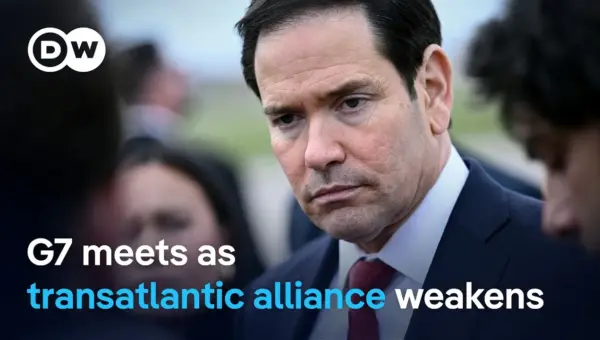
G7 foreign ministers met in Paris, revealing deep divisions over the U.S. war with Iran. European allies urged the U.S. to pressure Russia, linking its actions to the conflict and fearing support for Ukraine will wane.
Iran Blocks China Ships, Exposing Beijing’s Weak Grip
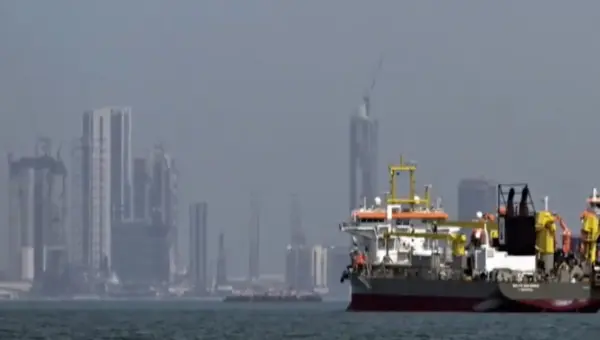
Iran's recent decision to block Chinese ships at the Strait of Hormuz is exposing the limits of Beijing's influence in the Middle East. This action is causing delays and cancellations for Chinese manufacturers, turning a perceived geopolitical win into an economic strain.
Rubio: US Can Achieve Iran War Goals Without Troops
Senator Marco Rubio outlined a strategy to counter Iran without deploying U.S. ground troops, focusing on weakening the regime and enhancing maritime security. He also criticized Cuba's economic system and expressed concerns about West Bank violence.