AI Unleashes Boundless Creation, Overcoming Human Limits
The biggest danger in the AI revolution isn't technological, but psychological. Experts warn that 'limiting beliefs' are the primary obstacle to innovation. AI's rapid development means ideas can be realized in hours, but only if we believe they are possible.


AI’s Exponential Leap: The Dawn of Rapid Creation
The artificial intelligence landscape is evolving at an unprecedented pace, not just in terms of raw computational power but in its ability to translate human ideas into tangible realities with astonishing speed. Experts suggest that within the next 6 to 12 months, the primary obstacle to innovation will not be technological limitations, but rather the internal ‘limiting beliefs’ held by individuals and organizations.
The core of this revolution lies in the rapid advancement of AI models. These sophisticated systems, trained on vast datasets, are becoming increasingly adept at understanding complex instructions and generating creative outputs. The implication is profound: virtually any concept, idea, or project that can be clearly articulated could potentially be brought to life in a matter of hours, rather than the weeks or months traditionally required by human development teams.
The Power of Belief in the Age of AI
The central thesis is that the true barrier to progress is no longer the ‘how’ but the ‘if.’ If an individual or a team truly believes in the feasibility of their idea and approaches AI development with an open mind, unburdened by preconceived notions of what is possible, they can unlock capabilities previously unimaginable. AI tools, when leveraged effectively, can act as powerful accelerators, enabling the creation of sophisticated applications, digital assets, or even complex systems with remarkable efficiency.
This shift fundamentally redefines the innovation process. Instead of focusing on the arduous journey of building from scratch, the emphasis moves towards conceptualization, ideation, and the strategic application of AI. The ability to rapidly prototype and iterate based on AI-generated outputs means that the speed of innovation is directly tied to the speed at which we can conceptualize and refine our ideas, and crucially, our willingness to believe they can be realized.
Overcoming Internal Barriers
The concept of ‘limiting beliefs’ refers to the internal mental frameworks, assumptions, and doubts that prevent individuals and organizations from pursuing ambitious goals. In the context of AI, these beliefs might manifest as skepticism about AI’s current capabilities, fear of the unknown, or an ingrained understanding of development cycles that is now obsolete. The most significant danger in the near future, therefore, is not an external threat from AI itself, but the internal resistance to embracing its full potential.
The individual or entity poised to thrive in this new era will be the one capable of identifying, challenging, and ultimately discarding these limiting beliefs. This requires a mindset shift towards embracing experimentation, accepting failure as a learning opportunity, and continuously adapting to the rapidly evolving AI landscape. The future belongs to those who can harness AI’s creative power by first freeing their own minds from self-imposed constraints.
Why This Matters
The implications of AI-driven rapid creation are far-reaching:
- Democratization of Innovation: Complex software development, content creation, and even scientific modeling could become accessible to a much wider audience, lowering the barrier to entry for entrepreneurs and creators.
- Accelerated Problem-Solving: Societal challenges, from climate change to healthcare, could see faster progress as AI enables rapid development of solutions and research tools.
- Personalized Experiences: AI can facilitate the creation of highly personalized digital products, services, and educational content tailored to individual needs and preferences.
- Economic Transformation: Industries will need to adapt their workflows and business models to incorporate AI-powered rapid development, leading to shifts in job markets and the emergence of new economic opportunities.
The key takeaway is that the most powerful tool in the coming years might not be the AI model itself, but the human capacity for belief and the courage to act upon it. By shedding limiting beliefs, we can unlock a future where human ingenuity, amplified by AI, knows virtually no bounds.
Source: The biggest danger in the next 12 months (YouTube)

Related Articles


AI Threatens White-Collar Jobs, Reshaping U.S. Workforce
Artificial intelligence is poised to significantly reshape the U.S. job market, raising concerns among recent graduates and experienced professionals about future employment. While some lawmakers call for regulation, experts emphasize adaptation and learning to work with AI.


AI’s Dual Future: Hope and Hazard for Humanity
Artificial intelligence presents humanity with both immense potential and significant risks. 'The AI Doc' explores this dual nature, highlighting AI's ability to solve global problems while warning of dangers like job loss and existential threats. The film aims to spark crucial conversations about shaping AI's future to align with human values.

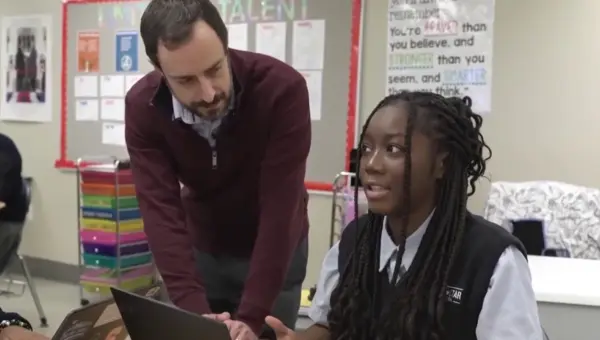
NJ Teacher Uses AI Chatbot to Boost Student Writing Scores
A New Jersey teacher has developed an AI chatbot to help students improve their writing skills, leading to a 22% increase in pass rates. The tool provides instant feedback and targeted guidance, acting as a valuable supplement to traditional instruction. The teacher emphasizes that AI is a tool to assist educators, not replace the crucial human element in teaching.