New Physics Engine Merges “Cops” for Realistic Simulations
A new physics simulation technique merges two distinct computational methods, Finite Element Method and Material Point Method, to achieve unprecedented realism in simulating complex interactions. This breakthrough allows for simultaneous simulation of rigid structures and chaotic fluids, promising to revolutionize visual effects and scientific research.

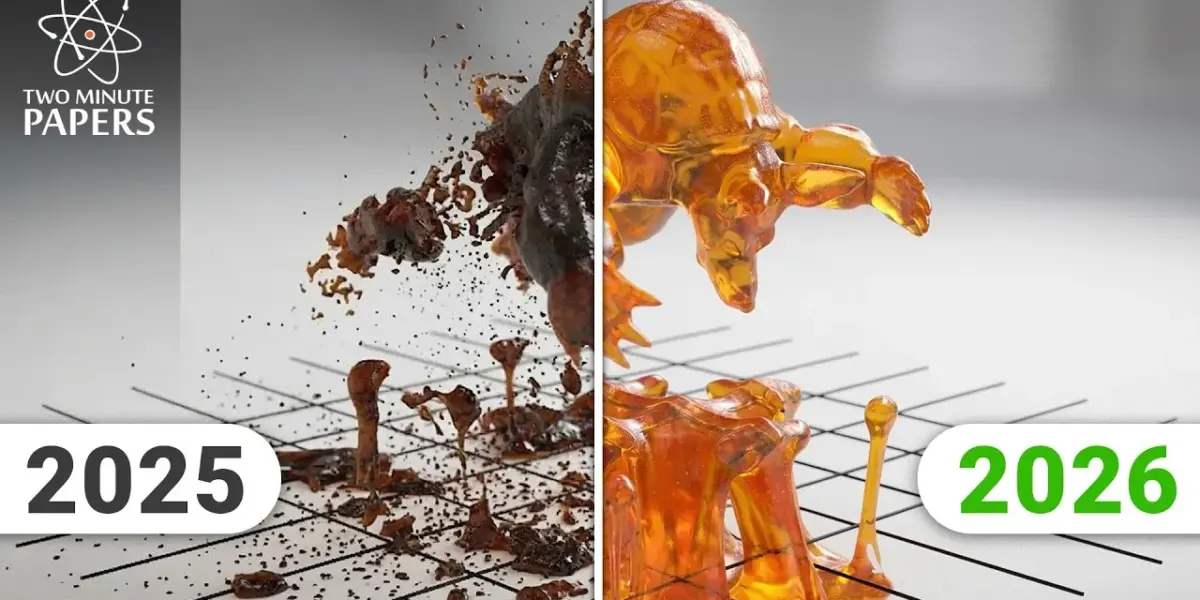
Physics Simulation Breakthrough Unites Conflicting Methods for Unprecedented Realism
Researchers have unveiled a groundbreaking physics simulation technique that successfully merges two previously incompatible computational methods, enabling highly realistic simulations of complex interactions like fluid dynamics and solid deformation simultaneously. This novel approach promises to revolutionize fields ranging from video game development and animation to scientific research by overcoming long-standing limitations in simulating chaotic and delicate physical phenomena.
Traditionally, simulating the physical world in computer graphics and engineering has relied on distinct mathematical approaches, each with its own strengths and weaknesses. One prominent method, known as the Finite Element Method (FEM), excels at simulating rigid objects and solid structures. It works by dividing an object into a vast number of tiny, interconnected blocks and calculating their interactions. While precise for solids, FEM struggles with chaotic scenarios like splashing water or crumbling sand, often requiring excessive computational power and time for such tasks.
On the other hand, the Material Point Method (MPM) is adept at handling fluid-like behaviors and granular materials, such as sand or snow. MPM treats materials as a collection of discrete points, allowing for dynamic and chaotic movements. However, it falters when trying to maintain the integrity of solid objects or precisely define their geometry, often leading to visual glitches like objects passing through each other (clipping) or simulations breaking down entirely.
The “Two Cops” Analogy: Bridging the Gap
The researchers liken these two methods to a pair of contrasting police officers: the slow, methodical “by-the-book” cop (FEM) and the fast, reactive “loose cannon” cop (MPM). For simple tasks like simulating a solid object, the FEM cop is efficient. For chaotic riots like fluid splashes or sandstorms, the MPM cop is invaluable. However, these two officers, representing the two simulation methods, have historically been unable to work together effectively. Their fundamental differences meant that attempts to combine them resulted in instability and visual artifacts, preventing the simultaneous simulation of both rigid geometry and chaotic fluid or granular behavior.
A “Shared Bulletin Board” for Collaboration
The key innovation presented in the research is the creation of a novel communication framework, metaphorically described as a “shared bulletin board.” This system allows the two distinct simulation methods to exchange information about forces and interactions without directly interfering with each other’s core processes. This ingenious solution enables them to cooperate, achieving what was previously considered impossible: simulating both the precise geometry of a cloth and the chaotic flow of honey interacting with it, without the typical simulation errors.
The collaboration is managed through a synchronized schedule. The slower FEM method takes a larger, deliberate step in its simulation. Within that single step, the faster MPM method can perform multiple, rapid updates. Crucially, the two methods only synchronize and exchange information at specific, necessary intervals. This carefully orchestrated process ensures that the strengths of each method are leveraged while mitigating their weaknesses, leading to stable and crash-proof physics simulations.
Visualizing the Breakthrough: From Sandstorms to Honey Flows
The researchers demonstrate the power of their new technique through a series of compelling visualizations. One striking example shows a large mass of sand particles being wrapped in a piece of cloth. The FEM method handles the cloth’s deformation and rigidity, while the MPM method simulates the behavior of the sand. The result is a seamless interaction where the sand behaves realistically without clipping through the cloth, and the cloth deforms naturally under the weight of the sand.
Another demonstration involves a rolling pin flattening dough. The dough deforms permanently under the pressure, while the rolling pin maintains its rigid shape. Perhaps most impressive is the simulation of a massive landslide, where the granular material of the landslide interacts with elastic elements like trees. The trees sway realistically, and the landslide leaves distinct streaks in the soil, showcasing the system’s ability to handle complex, multi-material interactions with high fidelity.
The simulation of viscous honey pouring onto a thin piece of cloth further highlights the technique’s robustness. Previously, such a scenario would likely result in the honey particles passing through the thin cloth. However, the new method allows the cloth to buckle and deform under the honey’s weight, and the honey itself folds and coils realistically, even adhering to the fabric.
Why This Matters: Real-World Impact and Future Potential
This breakthrough has profound implications across multiple industries. For the entertainment sector, it means more realistic visual effects in movies and video games, enabling complex destruction sequences, fluid simulations, and character interactions that were previously unachievable or prohibitively expensive to render. Developers can create more immersive and believable virtual worlds.
In scientific research and engineering, the ability to accurately simulate the behavior of materials under stress, such as soil mechanics, fluid-structure interaction, or the behavior of granular materials, can lead to better designs for infrastructure, more efficient industrial processes, and deeper understanding of natural phenomena like landslides or avalanches.
The researchers emphasize that this advancement was achieved through human ingenuity rather than AI, highlighting the power of fundamental physics and mathematical innovation. They note that the research paper itself is a testament to meticulous scientific work, deserving wider recognition within the technical community.
While specific pricing and availability for this simulation technology are not detailed, the underlying research is publicly available, paving the way for its integration into existing simulation software and game engines. Companies like NVIDIA, through initiatives like their Lambda platform offering powerful GPUs, are crucial in providing the computational resources necessary to run such complex simulations.
Source: Honey Is Way More Complex Than You Think (YouTube)

Related Articles


AI Simulates Reality, Inspiring New Creative Tools
AI is making it easier to simulate reality with technologies like ray tracing. While early simulations were rough, AI now helps create realistic images faster. This breakthrough is opening new creative possibilities for artists and developers.

Physics Breakthrough Simulates Water With Unprecedented Realism
A groundbreaking physics simulation technique achieves unprecedented realism in modeling water and air interactions, overcoming long-standing 'clipping' issues. Utilizing the Lattice Boltzmann Method and two-way coupling, the approach is not only visually superior but also significantly faster than previous methods.

Physics Simulation Leaps Forward: 45x Faster, Real-Time Rendering
A new physics simulation technique drastically accelerates complex animations, achieving up to 45x speed improvements and enabling real-time rendering for hair, cloth, and structural dynamics. The open-source method bypasses traditional bottlenecks, offering unprecedented realism and efficiency for games, film, and scientific applications.